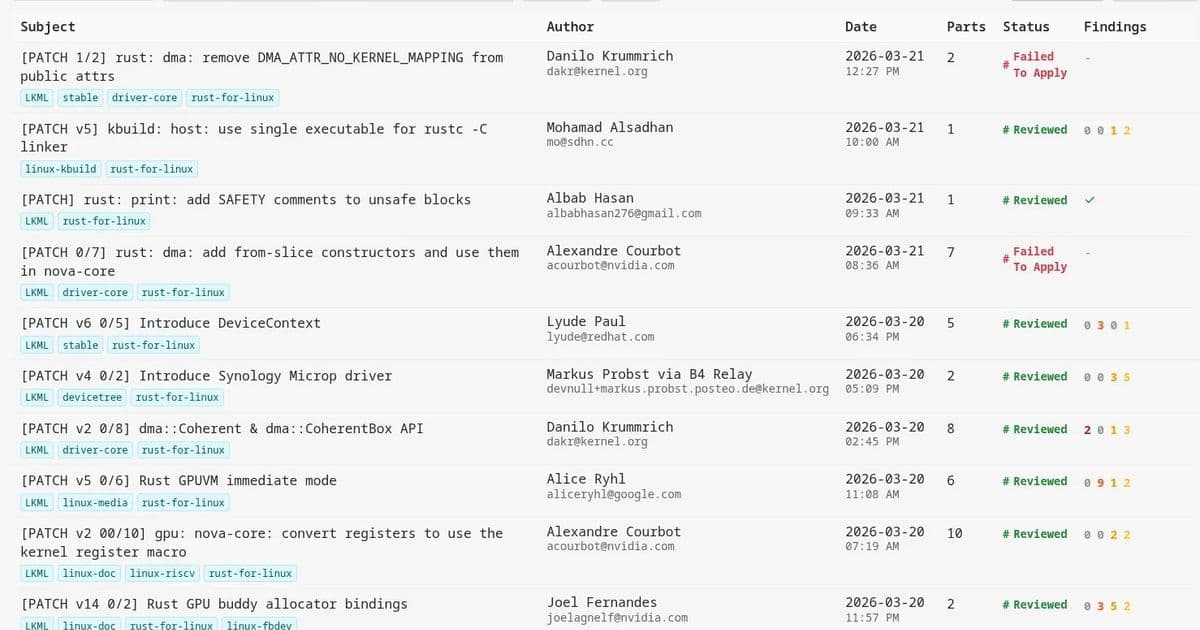
Google's Gemini Pro-powered AI code review system Sashiko expands to cover Rust submissions for the Linux kernel, with plans for language-specific improvements.
Sashiko Now Providing AI Reviews On Rust Code For The Linux Kernel
Google's innovative AI code review system, Sashiko, has expanded its capabilities to include automated reviews of Rust code submissions for the Linux kernel. This development represents a significant step forward in applying artificial intelligence to the complex task of kernel development, particularly as the Linux community continues to explore Rust as a safer alternative to C for certain components.
What is Sashiko?
Sashiko is an agentic AI code review system developed by Google engineers that automatically monitors the Linux kernel mailing lists for new patch submissions. Powered by Google's Gemini Pro large language model, the system analyzes code changes and provides feedback on potential issues, best practices, and improvements.
The service has been operational for a few days and has already demonstrated its utility in reviewing C code submissions. The expansion to Rust code reviews marks an important milestone in the ongoing effort to modernize kernel development practices.
Technical Implementation
Sashiko operates by scanning the Linux kernel mailing lists in real-time, identifying new patch submissions, and then analyzing the code changes using its AI model. The system can identify common programming issues, suggest improvements, and help maintain code quality across the massive codebase that is the Linux kernel.
The Rust-For-Linux mailing list coverage was announced by Miguel Ojeda, a key figure in the Rust-for-Linux effort. According to Ojeda, the current implementation doesn't include custom Rust prompts yet, but improvements are already in progress.
Current State and Future Improvements
At present, Sashiko's coverage of Rust code is essentially an extension of its existing capabilities without language-specific customization. However, the development team has outlined several planned enhancements:
Custom Rust prompts: Gary and Miguel Ojeda are working on developing prompts specifically tailored to Rust programming patterns and conventions used in the kernel.
Integration with kernel guidelines: The system will be updated to include the specific rules and guidelines established for Rust code in the Linux kernel.
Specialized analysis tools: Potential development of a Coccinelle-like tool for Rust, complementing the recently added Coccinelle capability for C code. Coccinelle is a source code transformation tool that helps developers make consistent changes across large codebases.
These improvements will make Sashiko increasingly effective at reviewing Rust code as the language becomes more integrated into the kernel development process.
Impact on Kernel Development
The introduction of AI-powered code reviews for Rust code in the Linux kernel has several significant implications:
Quality assurance: As more developers experiment with Rust in the kernel, having an automated system to catch issues early will help maintain the high standards of the kernel codebase.
Learning curve: Rust is a new language for many kernel developers, and Sashiko can serve as an educational tool, helping developers learn Rust best practices through automated feedback.
Efficiency: By automating the initial review process, Sashiko can help human reviewers focus on more complex architectural decisions rather than catching simple mistakes or style issues.
Consistency: The AI system can ensure consistent application of coding standards across different parts of the kernel being developed in Rust.
The Broader Context: Rust in the Linux Kernel
The expansion of Sashiko to cover Rust code comes at a crucial time in the Linux kernel's evolution. The Rust-for-Linux project aims to introduce Rust as a systems programming language option for kernel development, complementing the traditional C codebase.
Rust offers several advantages over C for kernel development, including memory safety guarantees, concurrency safety, and modern language features. These benefits could help reduce the number of security vulnerabilities and stability issues that have historically plagued the kernel.
However, introducing a new language into a mature codebase like the Linux kernel presents significant challenges. These include establishing coding standards, building tooling, training developers, and ensuring compatibility with existing systems.
Sashiko's expansion to Rust reviews represents one piece of the broader effort to build infrastructure around Rust development in the kernel.
Performance Considerations
While the article doesn't provide specific benchmarks for Sashiko's performance, we can consider several metrics that would be relevant for evaluating such a system:
Review accuracy: The percentage of issues identified by the AI that are actual problems requiring attention.
False positive rate: The frequency with which the AI flags acceptable code as problematic.
Processing speed: How quickly the system can analyze and provide feedback on new submissions.
Coverage: The proportion of potential issues the AI can detect compared to human reviewers.
As the system evolves and becomes more specialized for Rust, we would expect these metrics to improve, particularly as custom prompts and language-specific rules are implemented.
Community Reaction
The announcement of Sashiko's expansion to Rust reviews has been met with interest from the kernel development community. While only four comments were mentioned in the original article, the fact that coverage has been expanded suggests that the initial reception has been positive.
Kernel developers have long sought ways to improve code review efficiency while maintaining quality. AI-powered systems like Sashiko represent one approach to addressing this challenge, though they are not intended to replace human reviewers entirely.
Future Possibilities
Looking ahead, Sashiko could evolve in several directions:
Multi-language support: Beyond C and Rust, the system could potentially be adapted to review code in other languages used in kernel development.
Integration with development workflows: Sashiko could be more tightly integrated with tools like git and patch submission systems to provide real-time feedback.
Customizable rule sets: Allowing different subsystem maintainers to customize the review criteria based on their specific requirements.
Learning from feedback: The system could improve over time by learning from how human reviewers accept or reject its suggestions.
Conclusion
Sashiko's expansion to cover Rust code reviews for the Linux kernel represents an important step in applying AI technology to the complex task of kernel development. While the current implementation is still in its early stages for Rust, the planned improvements promise to make it an increasingly valuable tool for the kernel development community.
As the Linux kernel continues to evolve and explore new programming languages and development methodologies, tools like Sashiko will play an important role in maintaining code quality, improving efficiency, and supporting developers in adopting new technologies.
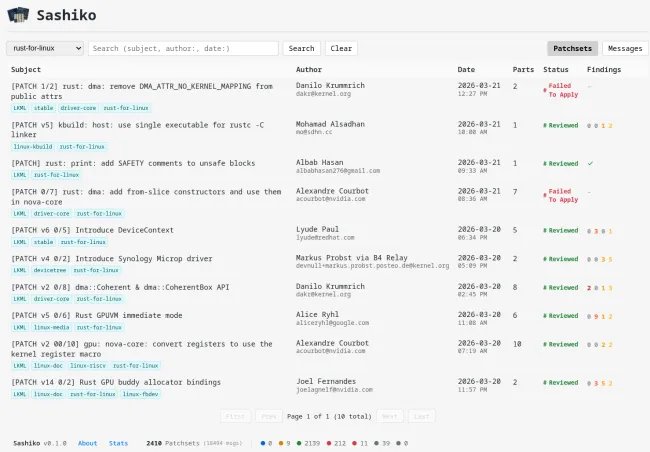
For those interested in exploring Sashiko's capabilities, the Rust code reviews can be found directly on Sashiko.dev. The project's ongoing development will be worth watching as it becomes increasingly specialized for the unique requirements of kernel development in both C and Rust.
Comments
Please log in or register to join the discussion