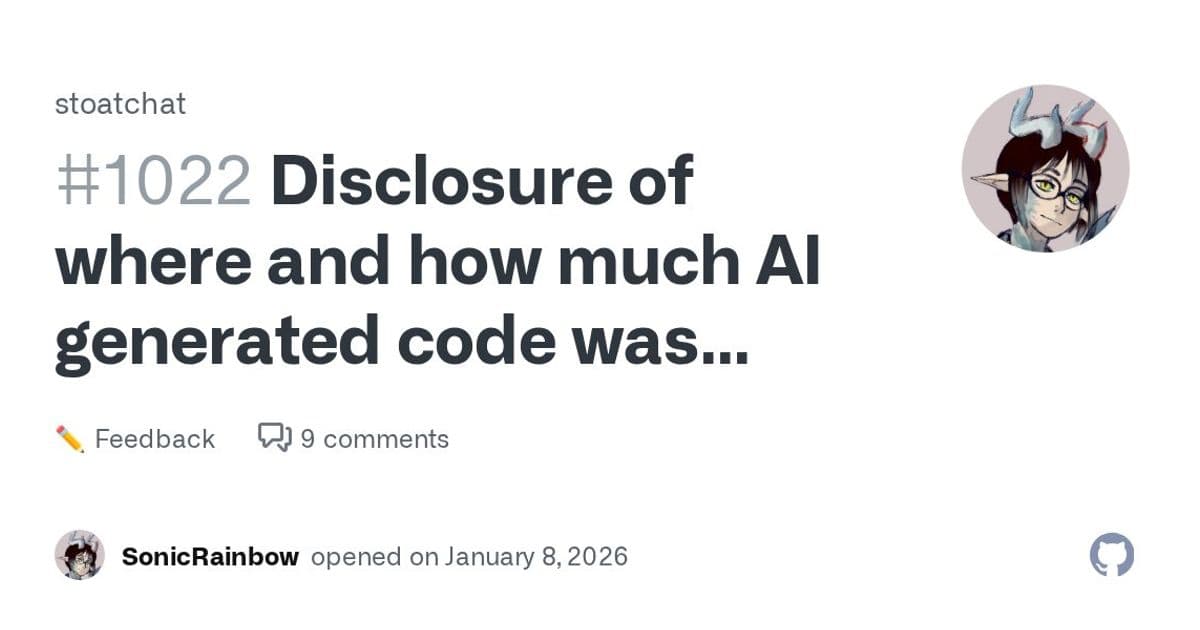
Open source project Stoat addresses community concerns about AI-generated code, revealing minimal usage and committing to transparency.
The open-source project Stoat has addressed community concerns about the use of AI-generated code in its development, revealing that only minimal AI-generated code was ever incorporated and has since been removed.
Community Raises Questions
The discussion began when a community member noticed Claude AI listed as a contributor in the main GitHub repository. This sparked concerns about the extent of AI-generated code in the project, with some users expressing that AI-generated code would be a "dealbreaker" for their use or recommendation of the platform.
Project Leadership Responds
Project maintainer insertish provided a detailed response clarifying the situation:
- Current Status: At the time of the discussion, Stoat was not using any generative AI (GenAI) tools
- Historical Usage: The maintainer acknowledged having "played with it at a very small scale a few times" but saw "no reason to continue to use it for any core component"
- Transparency: All AI-generated contributions were clearly labeled and tracked
Specific AI Contributions Identified
The maintainer provided a complete accounting of AI-generated code:
- for-web: Single commit, configuration change (
stoatchat/for-web@f75eb3a) - for-desktop: Single commit, configuration change (
stoatchat/for-desktop@3eb9b8e) - auxiliary service: Zammad sync, single commit with "tiny code gen" (
stoatchat/service-openproject-zammad-sync@46ba6d7)
Project History Context
Several community members pointed out that Stoat entered public beta in 2021, predating the launch of ChatGPT in late 2022. This timeline suggests the project's foundation was built entirely by human developers before generative AI tools became widely available.
Complete Removal of AI Code
In response to community feedback, the maintainer decided to completely remove the AI-generated code:
"I'm happy to revert the commits since it's not all that much, once GitHub starts working anyways, since it's not all that much."
This decision was met with positive reactions from the community, with one user stating: "I would heavily recommend you do and discontinue use of it at all and ban use of it in the future for the project at large. LLM slop code is the death of projects like this."
Community Perspectives
The discussion revealed a spectrum of opinions about AI-generated code in open-source projects:
- Strong Opposition: Some users view any AI-generated code as unacceptable, comparing it to keeping kosher or religious dietary restrictions
- Pragmatic View: Others see AI tools as helpful assistants for debugging and finding solutions, similar to how Wikipedia changed research practices
- Security Concerns: Several users expressed concerns about AI-generated code potentially introducing security vulnerabilities
- Business Perspective: Some argued that avoiding AI-generated code could help attract users who have strong anti-LLM views
Project Transparency Moving Forward
The incident has led to calls for Stoat to establish a formal policy on AI usage. One community member suggested this would "assure people who may worry it does have LLM code that that is not the case, ensure that new contributors are aware that they should not do so, and (of course, IANAL, TINLA) would likely help you as the status of LLM-generated code legally is dubious to say the least."
Key Takeaways
- Stoat had minimal AI-generated code, limited to configuration changes and a small service
- The project leadership responded transparently and removed all AI-generated code
- The incident highlights growing community concerns about AI-generated code in open-source projects
- Clear communication and policies around AI usage may become increasingly important for open-source projects
The thread was eventually locked by maintainers as it "devolved into unrelated arguments," but the core issue of transparency around AI usage in open-source development has been addressed.
For more information, visit the Stoat GitHub repository.
Comments
Please log in or register to join the discussion