
Survey reveals growing developer interest in TanStack alternatives as Next.js faces criticism over complexity and vendor lock-in, while React Server Components fail to win over the community.
The React ecosystem continues to fragment as developers express growing dissatisfaction with Next.js while showing increasing interest in alternatives like TanStack, according to the 2025 State of React survey from Devographics.
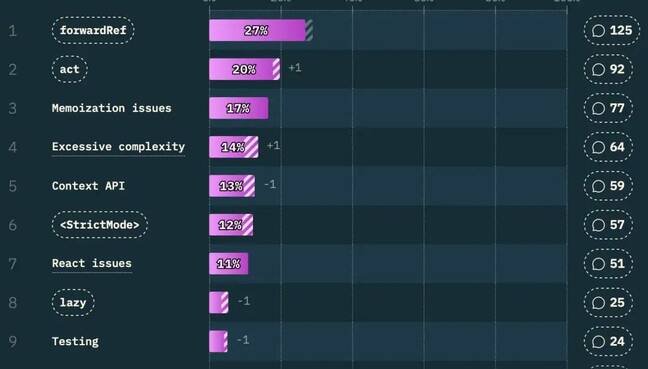
With over 3,700 developers participating, the survey paints a picture of a community grappling with complexity and seeking better solutions. While React usage remains robust—potentially bolstered by AI's reliance on existing codebases—the surrounding ecosystem has become a source of frustration for many practitioners.
Next.js faces backlash over complexity and vendor lock-in
Next.js, once positioned as the de facto full-stack React framework, is showing signs of wear. While 80 percent of respondents have used it, only 27 percent expressed positive sentiment. The framework faces criticism on multiple fronts:
- Vendor lock-in concerns: Developers worry about the tight integration with Vercel, Next.js's main sponsor and hosting provider
- Complexity issues: "Vendor lock in, complex APIs, and too much noise in the Next.js ecosystem make it a no-go for me," one respondent stated
- Mixed adoption: 17 percent reported negative sentiment, with complaints centering on excessive complexity
TanStack emerges as the alternative
TanStack appears positioned to capitalize on Next.js's vulnerabilities. The project, created by Tanner Lindsey and sponsored by Netlify in March 2025, offers a suite of tools focused on type-safety using TypeScript and file-based routing.
Key TanStack components showing strong adoption:
- TanStack Query: 68 percent usage with 42 percent positive sentiment and only 1 percent negative
- TanStack Start: While only 15 percent usage (likely due to its release candidate status), nearly half of those aware of it expressed favorable opinions
The TanStack ecosystem includes several sub-projects at various development stages:
- TanStack Query (data fetching)
- TanStack Start (full-stack framework using React, Solid.js, and Vite)
- TanStack DB (data store, beta)
- TanStack AI (alpha)
- TanStack CLI with MCP server for AI agents
Server Components face lukewarm reception
Perhaps most tellingly, React Server Components—a feature both Next.js and TanStack Start implement—are failing to win over the community. Survey authors describe the "cool response to both server component and server functions" as "troubling for a set of new APIs that was supposed to pave the way towards React's next big evolution."
One respondent was blunt: "Completely not interested in this feature."
React Compiler gains traction
In contrast to Server Components, the React Compiler—a tool designed to eliminate the need for manual memoization with useMemo and useCallback—received positive feedback from 62 percent of respondents. Aurora Scharff, certification lead and React educator, noted that "We can stop littering our code with useMemo and useCallback."
Foundation moves and AI implications
Looking ahead, the planned React Foundation, introduced in October 2025 to maintain React's infrastructure and organize ReactConf, received positive responses from survey participants. This move appears aimed at addressing concerns about vendor dominance that have plagued the ecosystem.
The survey also highlights React's growing importance in AI-assisted development. "React has... become the default output when you prompt for UI," noted Sacha Greif, introducing the survey. This AI-driven adoption could further entrench React's position despite its ecosystem challenges.
Ecosystem complexity remains a pain point
Throughout the survey, developers consistently cited ecosystem complexity as a major pain point. "Getting a build and testing harness and CI system and IDE tools to all play nicely together is reliably a nightmare," one respondent complained.
This fragmentation creates opportunities for streamlined alternatives like TanStack, which promises to address these pain points through focused, type-safe tools that integrate well with modern development practices.
Despite the challenges and fragmentation, React's future appears secure. The combination of high usage, AI-driven adoption, and the community's investment in the ecosystem suggests that while the landscape may continue to fracture, React itself will remain a dominant force in web development for the foreseeable future.

Comments
Please log in or register to join the discussion