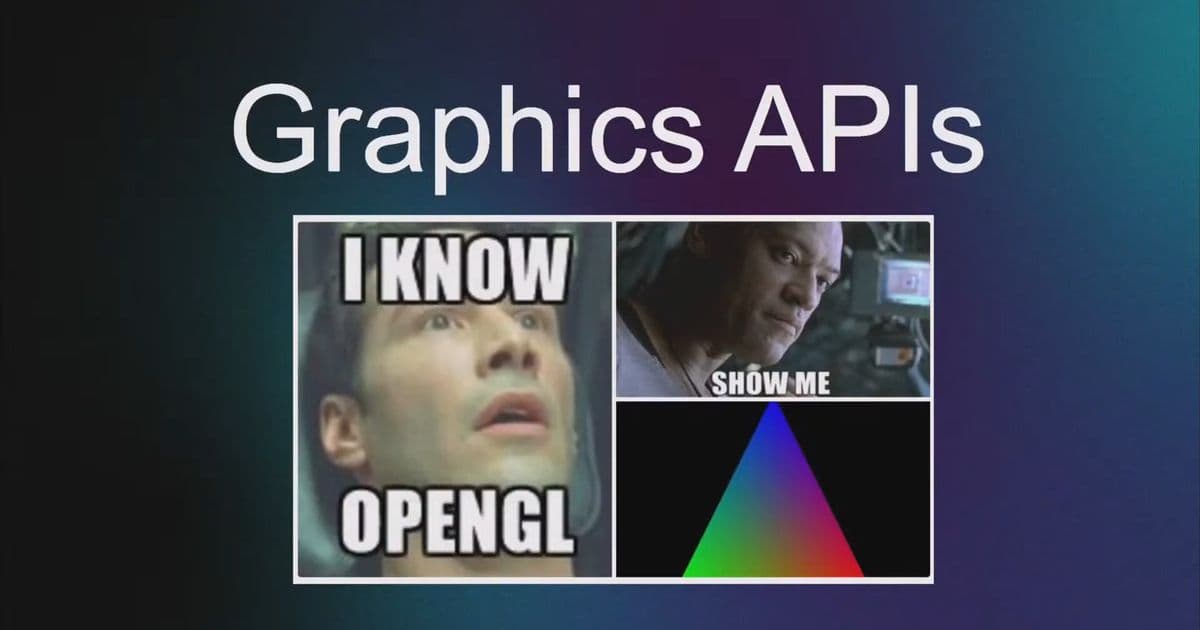
Mason Remaley challenges the perception of Vulkan as overly complex, arguing that its real value lies in the creative freedom and performance optimization it enables for developers willing to embrace its paradigm.
When developers first encounter Vulkan, the reaction is often one of intimidation. The API's explicit nature, verbose setup, and seemingly endless state management can make even experienced graphics programmers hesitate. But what if this complexity isn't the point at all?
In a thought-provoking presentation from February 7, 2026, Mason Remaley, a seasoned game developer, argues that the conversation around Vulkan has been fundamentally misdirected. The API's complexity isn't a bug—it's a feature that unlocks unprecedented creative and performance possibilities.
The Complexity Myth
The prevailing narrative suggests that Vulkan's complexity is a barrier to entry, particularly for indie developers with limited resources. This perception isn't entirely unfounded. Compared to older APIs like OpenGL or even higher-level frameworks, Vulkan demands more upfront investment in understanding memory management, synchronization primitives, and explicit rendering pipelines.
However, Remaley contends that this view misses the forest for the trees. The complexity isn't about making developers' lives harder—it's about giving them complete control over the rendering process. When you're not fighting an abstraction layer, you can optimize for your specific use case rather than the lowest common denominator.
The Real Value Proposition
What makes Vulkan genuinely revolutionary isn't its API design, but what that design enables. By requiring developers to be explicit about every aspect of rendering, Vulkan eliminates hidden costs and unpredictable performance characteristics. This transparency allows for optimizations that would be impossible with more abstracted approaches.
Consider the implications for game development. With Vulkan, you can:
- Precisely control memory layouts to maximize cache efficiency
- Optimize draw call submission based on your specific rendering patterns
- Implement custom synchronization strategies that match your game's needs
- Reduce CPU overhead by eliminating driver guesswork
These aren't just theoretical benefits. Games like Doom Eternal and Red Dead Redemption 2 have demonstrated what's possible when developers have this level of control over the rendering pipeline.
The Learning Curve as an Investment
Remaley acknowledges that the learning curve is real, but reframes it as an investment rather than a barrier. The time spent understanding Vulkan's concepts pays dividends in performance, flexibility, and the ability to implement rendering techniques that would be impractical or impossible with higher-level APIs.
This perspective shifts the question from "Is Vulkan too complex?" to "What can I achieve with this level of control?" For many developers, particularly those working on performance-critical applications or pushing the boundaries of real-time graphics, the answer is transformative.
Beyond Games: Broader Implications
The principles Remaley discusses extend far beyond game development. Any application that requires high-performance graphics rendering—from scientific visualization to architectural rendering to virtual production—can benefit from Vulkan's explicit approach.
Even web developers are beginning to see the benefits. WebGPU, which draws significant inspiration from Vulkan, brings many of these concepts to the browser, suggesting that the industry is moving toward more explicit graphics APIs across the board.
The Future of Graphics Development
As hardware continues to evolve and the demands on graphics APIs grow more complex, the trend toward explicitness seems likely to continue. The question isn't whether developers should learn Vulkan, but rather how quickly they can adapt to this new paradigm of graphics programming.
Remaley's presentation serves as a call to action for developers who might be intimidated by Vulkan's reputation. The API isn't about complexity for its own sake—it's about empowerment. By embracing that complexity, developers gain the tools to create experiences that were previously out of reach.
Conclusion
The next time you hear someone dismiss Vulkan as "too complex," remember that they might be asking the wrong question. The real question isn't about the API's complexity, but about what that complexity enables. For developers willing to climb the learning curve, Vulkan offers a level of control and performance that can transform their creative possibilities.
As Remaley's presentation suggests, the future of graphics development belongs to those who are willing to engage with these more explicit, more powerful tools. The complexity isn't the point—the freedom it enables is.
Comments
Please log in or register to join the discussion