
A deep dive into why seemingly simple improvements to government document accessibility took 20 years to implement, revealing fundamental challenges in institutional innovation.
It's 2026, and two journalists approached me with simple questions. Why can't you click on references in Dutch Parliamentary documents? And why can't I find motion numbers used during parliamentary debates anywhere? Innovation is not as easy as it seems.
This isn't a complaint about the Dutch Parliament—I hadn't spotted these problems either, let alone solved them. Here are the two cases, followed by some reflection on why such things take so long.
Hyperlinks, Anno 2026
A typical Parliamentary document looks like this, officially distributed as a Word document (!):

On my site opentk.nl, I've already converted these documents into regular web pages, which works much better than constantly downloading Word documents. Highly recommended.
But what ARE those references "21501-32-1740" or "21 501-32, nr. 1703"? And where do you search for them?
Last Friday, Jan Daalder from FTM approached me with a simple request: can't those references be made clickable? By Saturday evening, it was done, and now we have this:
The members Boomsma (JA21) and van der Plas (BBB) submitted a motion on December 9, 2025, about a follow-up to the national glass eel node list (Parliamentary document 21501-32-1740). This is in response to a report from Wageningen Marine Research (WMR[1]) on this matter that was sent to your Chamber last year (Parliamentary document 21 501-32, nr. 1703).
And suddenly we can look up with one click what's in that motion and that report. I bet that following up on these references now happens 100 times more often because it's just become a click. Instead of an epic search quest. And we can more easily keep track of what's happening in The Hague.
It only took 20 years for someone to come up with this idea and ask for it!
Motion 8?
Earlier, Mark Beekhuis from BNR told me how difficult it is to find motions mentioned during debates. And there's something very strange going on there too.
During debates, ministers and members of parliament talk about 'motion 8,' as you can hear in this video of a recent debate where the minister advises against motion 8. But in the official minutes (the official report), something very different appears: 'I must advise against the Dobbe et al. motion on document no. 626.'
What's going on?
It turns out that during debates, motions are simply numbered in the order they're submitted. Motion 8 is the eighth motion that was spoken. But depending on which parliamentary document dossier the motion ends up in, it also gets another number (626), and that's how it also appears in the report:
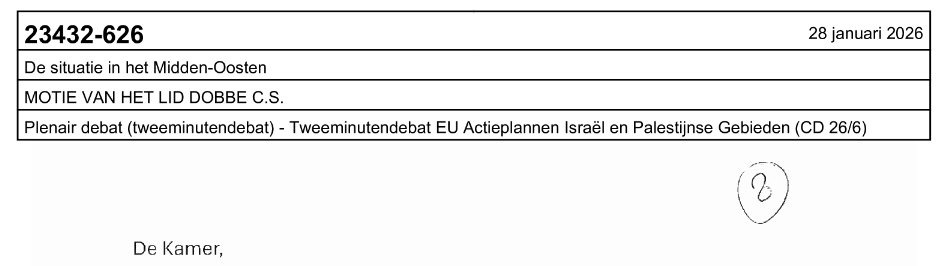
Note the 626 in the top left and the 8 in the bottom right!
It's a nightmare for people listening to or watching the debate to figure out what ministers and members of parliament mean when they talk about motion 8. Because 'motion 8' never appears in the report—everyone's been edited as if they'd always been talking about 'document no. 626'!
To make this easier, I've now included the sequential numbering with a bit of a hack:
The chairperson: This motion was proposed by the members Dobbe, Piri, and Teunissen. It gets no. 626 (23432) (#8).
If you're now listening to the debate and thinking, "What is motion 8?" you can do Ctrl+F in the report for #8 and then find a link.
This must save reporters and other interested parties hours and hours of work. Yet I wasn't aware of the problem, and it's only now been solved, once again "after 20 years"!
Innovation Is Really Not That Easy
I've been wondering about this for a long time. In 2014, I wrote a somewhat rambling story about why the can opener was only invented decades after the invention of the can. You'd think something like that would be obvious, but we collectively find it very difficult.
Now this isn't a new observation. Science fiction author (and problematic guy) Isaac Asimov already noted, "The history of human thought would make it seem that there is difficulty in thinking of an idea even when all the facts are on the table." He wrote an insightful piece about it.
In "How about some actual innovation," I also wondered about this. How is it that some organizations can land an enormous robot on Mars in one attempt while we find it incredibly difficult to, say, make documents clickable for our democracy within 20 years?
I don't have all the solutions either, but I'm very grateful to Jan Daalder and Mark Beekhuis for telling me about the problems they encountered.
And I'll end this piece with this: if you see something that's not convenient somewhere, do try to pass it on. Sometimes there's a chance that someone will do something with it! Especially don't count on someone else having already said it.
Comments
Please log in or register to join the discussion