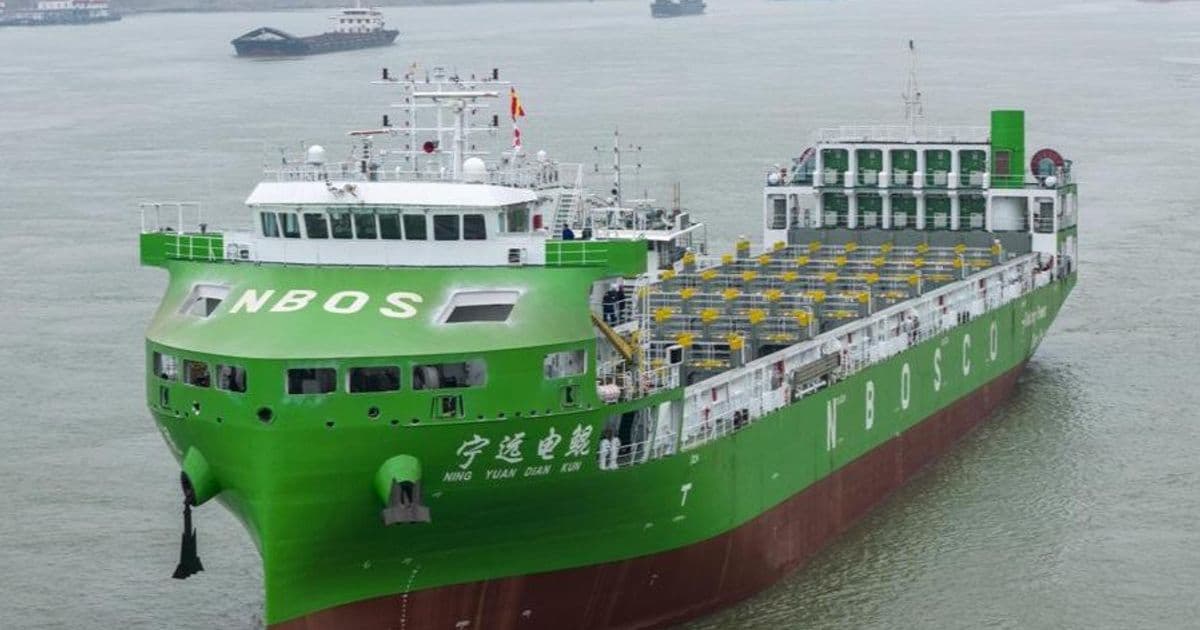
China's 10,000-ton Ning Yuan Dian Kun electric container ship has begun sea trials, featuring 19,000 kWh battery capacity, autonomous navigation, and swappable battery containers for minimal downtime.
China has officially kicked off sea trials for the Ning Yuan Dian Kun, the world's largest fully electric container ship. Built by Jiangxi Jiangxin Shipbuilding, the 10,000-ton vessel departed its dock in Hukou County on February 1 after completing initial mooring tests. It is currently undergoing rigorous performance assessments near Shanghai, scheduled to run from February 6 through February 13.
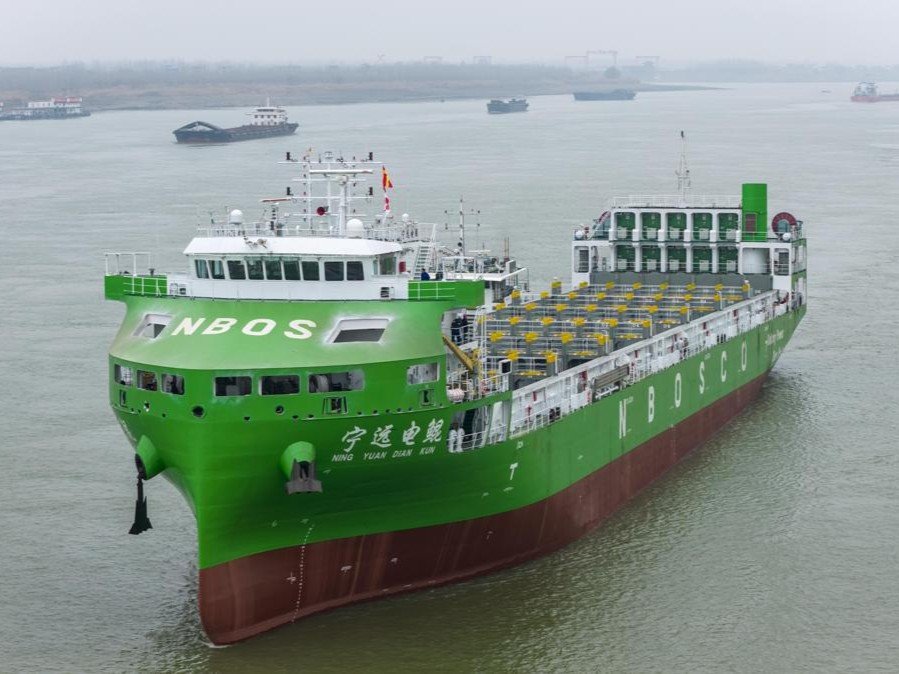
Measuring 127.8 meters (420 feet) in length with a capacity of 740 TEU, the open-top vessel represents a significant leap in green short-sea shipping. It is powered by 10 containerized batteries with a total capacity of 19,000 kWh, driving two 875 kW permanent magnet motors to a top speed of 11.5 knots.
A standout feature is the ship's flexibility: it can recharge via high-voltage shore power or simply swap out the battery containers for fresh ones to minimize downtime. It also utilizes a photovoltaic system to harvest solar energy for auxiliary power.
Beyond its propulsion, the ship is highly intelligent. Trials will test its autonomous navigation suite, which handles route planning and collision avoidance. Once delivered, the vessel will join the fleet of Ningbo Ocean Shipping Co., Ltd., serving feeder routes at the Ningbo-Zhoushan port. It will be the first of two such ships commissioned by the company, with a sister vessel, the Ning Yuan Dian Peng, to follow.
This development marks a significant milestone in maritime electrification, as the 10,000-ton capacity far exceeds previous electric vessels. The containerized battery approach offers practical advantages for commercial operations, allowing rapid turnaround times that could make electric shipping economically viable for short-haul routes.
The autonomous navigation capabilities being tested during these trials could further reduce operational costs while improving safety. As ports worldwide invest in shore power infrastructure, vessels like the Ning Yuan Dian Kun could become increasingly common on feeder routes connecting major shipping hubs.
China's aggressive push into electric shipping technology positions the country as a potential leader in maritime decarbonization efforts. The success of these trials could accelerate the adoption of similar vessels globally, particularly in regions with strict emissions regulations.
For the shipping industry, this represents a potential paradigm shift. While long-haul shipping remains dependent on traditional fuels due to current battery limitations, short-sea routes could see rapid electrification. The combination of swappable batteries, autonomous systems, and renewable energy integration demonstrates how maritime transport might evolve to meet climate goals without sacrificing operational efficiency.
The two-ship order from Ningbo Ocean Shipping Co., Ltd. suggests confidence in the technology's commercial viability. If these trials prove successful, we may see similar vessels deployed across China's extensive network of inland waterways and coastal routes in the coming years.
Comments
Please log in or register to join the discussion