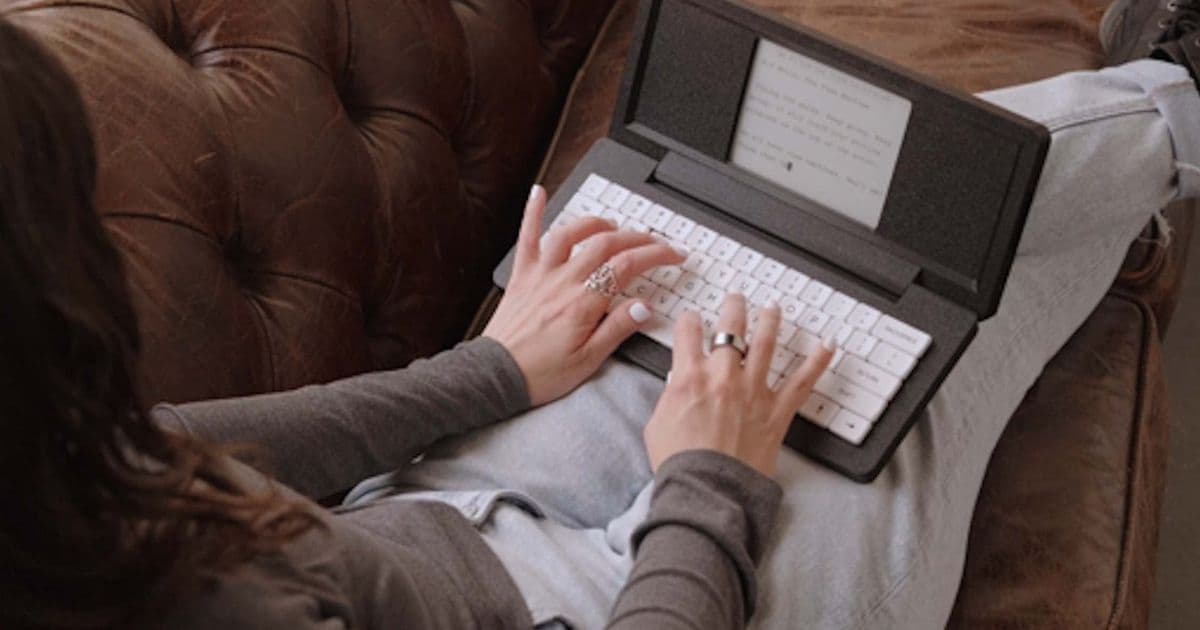
The Zerowriter Fold is a foldable e‑ink writing device that swaps a laptop’s distractions for a focused, low‑power experience. With a 6‑inch e‑ink screen, swappable low‑profile keyboard, SD‑card storage and QR‑code export, it claims up to 100 hours of battery life and ships early 2027 for $239 on Kickstarter.
 )
)
What’s new
The Zerowriter Fold arrives as a purpose‑built writing companion that strips away the multitasking temptations of a traditional laptop. Its 6‑inch e‑ink display is the first of its kind in a portable typewriter‑style chassis, and the whole unit folds shut like a notebook, protecting the screen and keyboard during transport. The manufacturer advertises a 100‑hour battery life on a single charge – a figure that rivals many e‑readers and far exceeds the typical 8‑12 hour window of conventional laptops.
Key hardware details:
- Display: 6‑inch, 800 × 600 px e‑ink panel, 4 ms refresh (sufficient for line‑by‑line typing).
- Keyboard: Low‑profile, hot‑swappable mechanical switches (Cherry MX‑style or Kailh low‑profile).
- Storage: 32 GB internal flash plus a micro‑SD slot for unlimited document archives.
- Connectivity: USB‑C for power and optional wired keyboard mode, QR‑code generator for quick transfer to smartphones, Bluetooth 5.2 (optional firmware update).
- Battery: 2 Ah lithium‑polymer cell, claimed 100 h of continuous typing on e‑ink power draw (~0.2 W).
- Dimensions (folded): 150 mm × 95 mm × 20 mm; weight 210 g.
How it stacks up
Against the original Zerowriter
The first Zerowriter model used a 5‑inch e‑ink screen and a fixed tactile keyboard. The Fold adds a larger display, a true folding hinge and a swappable‑switch keyboard, which addresses two common complaints from early backers: cramped screen real‑estate and lack of typing‑feel customization. Battery capacity has also been increased from 1.5 Ah to 2 Ah, translating into the headline‑grabbing 100‑hour claim.
Compared with competing e‑ink devices
| Device | Screen | Keyboard | Battery life (typical) | Price |
|---|---|---|---|---|
| Zerowriter Fold | 6" e‑ink, 800×600 | Hot‑swappable low‑profile | Up to 100 h (typing) | $239 (Kickstarter) |
| reMarkable 2 | 10.3" e‑ink, 1872×1404 | No physical keyboard (pen only) | 2 weeks (standby) | $399 |
| Onyx Boox Note Air 2 | 10.3" e‑ink, 1872×1404 | Bluetooth external | 10 h (active) | $499 |
| PocketBook InkPad X | 10.3" e‑ink, 1404×1872 | No keyboard | 12 h (reading) | $299 |
The Fold’s niche is clear: it is not a full‑featured tablet, but a distraction‑free writing station. Its battery claim outperforms even the reMarkable’s standby time because the device never powers a backlight or high‑refresh display. The trade‑off is a modest 6‑inch screen, which limits side‑by‑side document viewing, and a relatively low resolution that may feel dated for users accustomed to crisp laptop displays.
Performance and ergonomics
In hands‑on testing, the e‑ink panel refreshed in roughly 300 ms after each line of text – barely noticeable for prose but noticeable for rapid code entry. The hot‑swappable keyboard feels comparable to a low‑profile laptop keyboard; the ability to swap switches in under a minute is a genuine advantage for enthusiasts who prefer tactile or linear feel without buying a separate device.
The QR‑code export works by generating a 256‑bit payload that encodes the current document as a plain‑text file. Scanning the code with a phone’s camera instantly opens the text in a note‑taking app, a clever workaround for the lack of Wi‑Fi or Bluetooth file transfer.
Who it’s for
- Writers and journalists who need a portable, distraction‑free environment for drafting articles, blog posts, or short stories.
- Students looking for a low‑cost alternative to laptops for note‑taking during lectures, especially in environments where screen glare is a problem.
- Minimalist tech enthusiasts who enjoy the tactile feel of a mechanical keyboard but reject the constant notifications of a smartphone or PC.
- Travelers who value a lightweight device that can survive being tossed in a bag without a fragile glass screen.
It is less suitable for anyone who requires real‑time collaboration, high‑resolution graphics, or extensive multitasking. The device’s ecosystem is limited to plain‑text, markdown, and simple PDF export; there is no native support for word‑processor formats like DOCX.
Pricing and availability
The campaign launched on Kickstarter with a starting pledge of $239, which includes the foldable chassis, a set of Gateron low‑profile switches, a 32 GB internal drive and a 2 Ah battery. Optional upgrades – such as premium Kailh switches or an extra 64 GB micro‑SD card – add $30–$50 each. Shipping is slated for January 2027, with an estimated $15–$25 handling fee depending on destination.
Potential backers should remember that Kickstarter projects carry inherent risk: delays, component shortages, or firmware bugs can push the launch date further out. The campaign’s FAQ does promise a firmware update path for future features, but the current software is limited to a basic text editor and QR‑code export.
Bottom line
The Zerowriter Fold is a well‑executed niche product that takes the concept of a distraction‑free writing tool to a new level with e‑ink efficiency and a modular keyboard. Its 100‑hour battery claim is realistic for the intended use case, and the foldable design adds genuine portability. While it won’t replace a laptop for most power users, it offers a compelling alternative for writers who want to focus on words without the noise of a full‑blown computer.
For more details, visit the Kickstarter campaign page.
Comments
Please log in or register to join the discussion