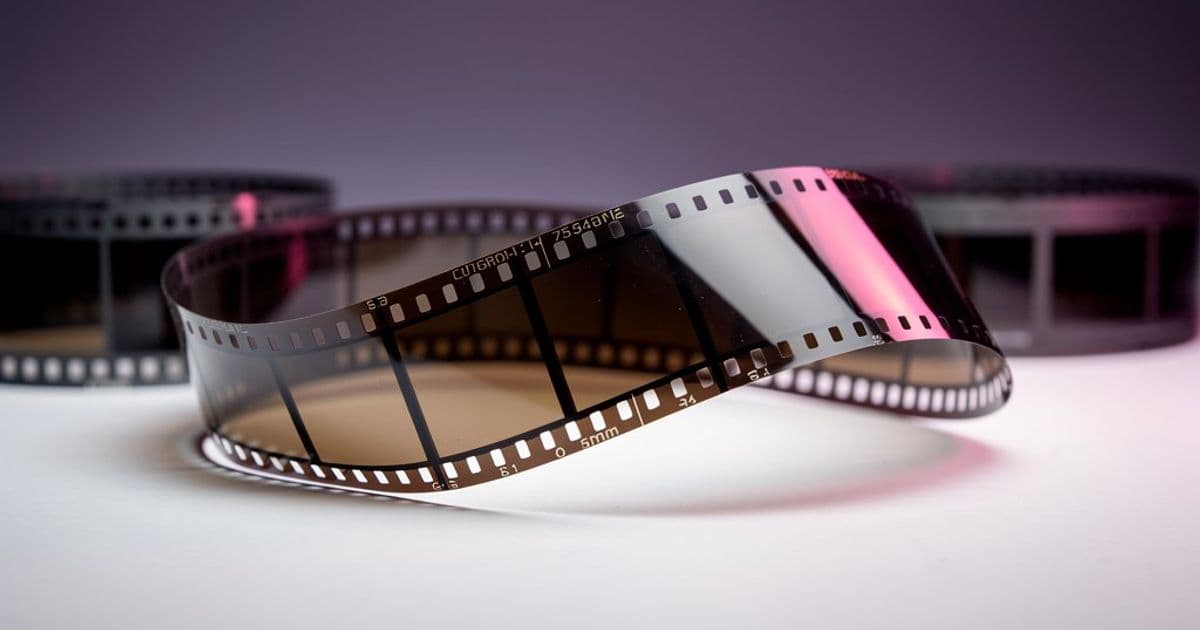
Over 100 film widths and perforation formats were tested during cinema's first century, yet 35mm emerged as the universal standard – a victory of corporate collaboration over fragmentation.
The history of cinema is punctuated by a relentless experimentation with physical film formats. Between 1887 and the digital era, manufacturers tested nearly 100 distinct film widths and perforation patterns. This fragmentation mirrored early video format wars, yet unlike video's ongoing evolution, film achieved remarkable stability through the unlikely dominance of 35mm – a standard that persisted for over a century despite continuous challenges.
Thomas Edison's 1889 collaboration with Eastman Kodak proved foundational. After experimenting with Kodak's 70mm still photography film, Edison's technician W.K.L. Dickson ordered 35mm-wide celluloid strips. This halved-width format, initially called the "Edison size," featured four rectangular perforations per frame. Simultaneously, the Lumière brothers developed their Cinématographe using 35mm film with a single circular perforation per frame. Early alternatives ranged widely: Friese-Greene's 54mm paper film (1887), Demeny's 60mm Phonoscope (1893), and Biograph's 68mm format (1897).
The lack of standardization became untenable as the industry grew. Film projection placed immense mechanical stress on perforations, causing frequent tearing. Eastman addressed this by doubling nitrate base thickness in 1896. By 1909, nine major producers – including Edison and Pathé – formed the Motion Picture Patents Company (MPPC) to consolidate patent rights. This controversial trust enforced Bell & Howell's 35mm specifications as the universal standard, ratified internationally that same year. Kodak became the primary supplier, leveraging economies of scale.
Despite this, amateur markets became battlegrounds for substandard gauges. Early attempts like Birt Acres' 17.5mm Birtac (1898) and Gaumont-Demeny's 15mm Chrono de Poche (1900) failed due to technical complexity. Safety concerns accelerated innovation after the 1897 Paris cinema fire killed 124 people. Pathé's 28mm safety film (1912) gained traction with its non-flammable acetate base and unique three-perforation design, selling 10,000 projectors by 1918. Edison countered with the 22mm Home Kinetoscope (1912), projecting triple image rows on safety film – though its rental-only model limited adoption.
Pathé revolutionized amateur filmmaking in 1922 with the 9.5mm Pathé Baby system. By slitting 35mm stock into three strips with central perforations, it offered affordable cameras and projector rentals. Over 300,000 units sold in Europe, supported by Pathé's library of downsized theatrical films. Kodak responded in 1923 with 16mm film, promoting its reversal processing (eliminating costly negatives) and dual-edge perforations for stability. Kodak's acquisition of Pathé in the late 1920s strategically marginalized 9.5mm outside Europe.
Professional formats continued evolving. Super 16mm (1971) expanded the image area by removing one perforation row, improving widescreen compatibility. Super 8 (1965) used narrower perforations for a 50% larger frame, while Fuji's Single 8 (1973) offered superior cassette loading. Large-format systems like Todd-AO's 65mm (1956) and IMAX (1970) used horizontal frame alignment and specialized transport mechanisms for immersive projection.
Today, collectors preserve obscure formats like Pathé's 17.5mm Rural projectors or China's Cold War-era 8.75mm educational films. Only Kodak's corporate consolidation and the MPPC's enforced standardization prevented cinema from fracturing into incompatible systems. As film historian Michael Rogge notes: "One hundred years of cinema yielded almost one hundred gauges. That 35mm endured is less about technical superiority than industry collaboration."
Further technical details on historical formats:
Comments
Please log in or register to join the discussion