San Francisco-based AdenHQ releases Hive, an open-source framework that generates autonomous AI agents from natural language goals, featuring self-healing capabilities and real-time monitoring.
San Francisco-based startup AdenHQ has publicly released Hive, an open-source framework designed to fundamentally change how developers build production-grade AI agents. Unlike traditional approaches requiring manual workflow coding, Hive enables engineers to define objectives in natural language while its underlying system autonomously generates executable agent graphs and connection logic.
The core innovation addresses a critical industry pain point: the brittleness of conventional agent frameworks. Where most solutions demand developers hardcode complex workflows—resulting in fragile systems requiring constant maintenance—Hive employs a specialized coding agent that dynamically constructs node connections based on stated goals. When execution fails, the framework automatically captures error data, recalibrates the agent structure, and redeploys improved versions without developer intervention.
Key technical differentiators include:
Goal-Driven Architecture: Developers describe desired outcomes in plain English (e.g., "Process customer support tickets and escalate urgent cases"), while Hive's coding agent generates the required node graph and connection code. This eliminates the need for predefined workflow diagrams.
Self-Healing Mechanism: During execution failures, the system autonomously analyzes errors, modifies the agent's structure through its coding agent, and redeploys updated versions. This creates a closed-loop improvement system absent in frameworks like LangChain or AutoGPT.
Dynamic SDK-Wrapped Nodes: Every component automatically receives shared memory, local reinforcement learning memory, monitoring hooks, tool access, and LLM connectivity—functionality typically requiring manual implementation in other frameworks.
Human Oversight Integration: Configurable intervention nodes pause execution for human input with timeout thresholds and escalation policies, enabling controlled human-AI collaboration.
Real-Time Observability: Developers monitor executions via WebSocket streams or a terminal-based dashboard showing live graph visualizations, decision logs, and cost metrics.
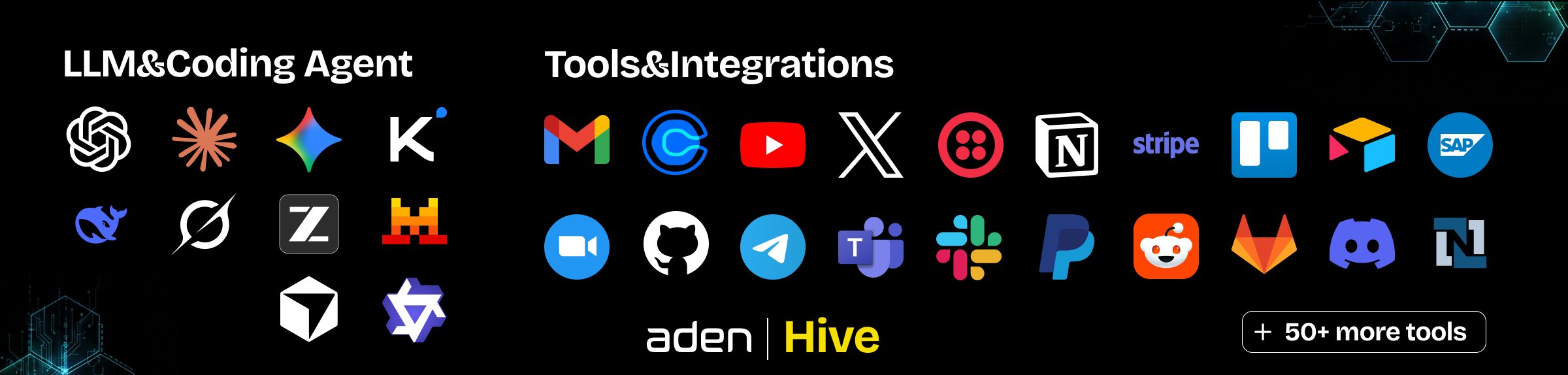
The framework operates as a model-agnostic system, supporting over 100 LLM providers through LiteLLM compatibility—including OpenAI, Anthropic, local models via Ollama, and open-source alternatives. Its modular design facilitates connections to external business systems like CRMs, messaging platforms, and internal APIs through Aden's Message Control Protocol (MCP).
Production readiness features include granular cost controls with budget limits per agent/team, automatic model degradation policies during budget overages, and horizontal scaling capabilities. The Apache 2.0-licensed project includes comprehensive documentation and prioritizes contributions addressing real-world business automation scenarios.
While avoiding hype, the approach represents a tangible shift toward outcome-driven development in AI agent construction. By automating workflow generation and implementing failure-driven evolution, Hive reduces the manual engineering overhead currently hindering agent deployment in production environments. The framework is now available on GitHub with setup guides for local development and integration with AI coding environments like Cursor and Antigravity IDE.
Comments
Please log in or register to join the discussion