
McKinsey research spotlights agentic AI as the linchpin among 13 frontier technologies transforming business in 2025, acting as both a standalone force and a multiplier for innovations like autonomous systems and quantum computing. The study reveals AI's role in accelerating human-machine collaboration while exposing critical scaling and ethical hurdles. Companies leveraging this hybrid workforce model, including Salesforce's deployment of over one million AI conversations, are poised to unlock

A seismic shift is underway in enterprise technology, driven by artificial intelligence's dual role as both a disruptor and an enabler. According to McKinsey's 2025 research, 13 frontier technologies—led by agentic AI—are reshaping competitive landscapes, with AI serving as a foundational amplifier that accelerates advancements in robotics, quantum systems, and sustainability tech. This convergence isn't merely about incremental efficiency; it's redefining how businesses architect innovation amid escalating global infrastructure demands.
The Agentic AI Catalyst
At the forefront is agentic AI—systems capable of independently executing multi-step tasks, adapting dynamically to new inputs, and collaborating across digital ecosystems. McKinsey data underscores its economic gravity, projecting a $450 billion market by 2028. Real-world implementations are already proving transformative:
"Companies like Salesforce have scaled over one million AI-driven customer conversations, achieving unprecedented response times and personalization at scale,"
This evolution moves beyond chatbots to systems that plan research, optimize logistics, and even self-correct—essentially enabling businesses to operate with the precision of "a stealth aircraft."
AI as the Universal Amplifier
McKinsey identifies five core themes where AI magnifies adjacent technologies:
- Autonomous Systems Surge: Physical robots and digital agents transition from pilots to production, handling complex real-world scenarios with minimal human oversight.
- Human-Machine Symbiosis: Natural language interfaces and multimodal inputs (voice, gesture, contextual data) create fluid collaboration, reducing cognitive load.
- Infrastructure Scaling Pressures: Generative AI and robotics workloads strain global compute resources, intensifying demand for application-specific semiconductors and edge solutions.
- Geopolitical Tech Arms Race: Nations prioritize sovereign capabilities, from quantum labs to localized chip fabs, amid supply chain vulnerabilities.
- Trust as Adoption Gatekeeper: Responsible AI frameworks become non-negotiable as technologies grow more pervasive and personal.
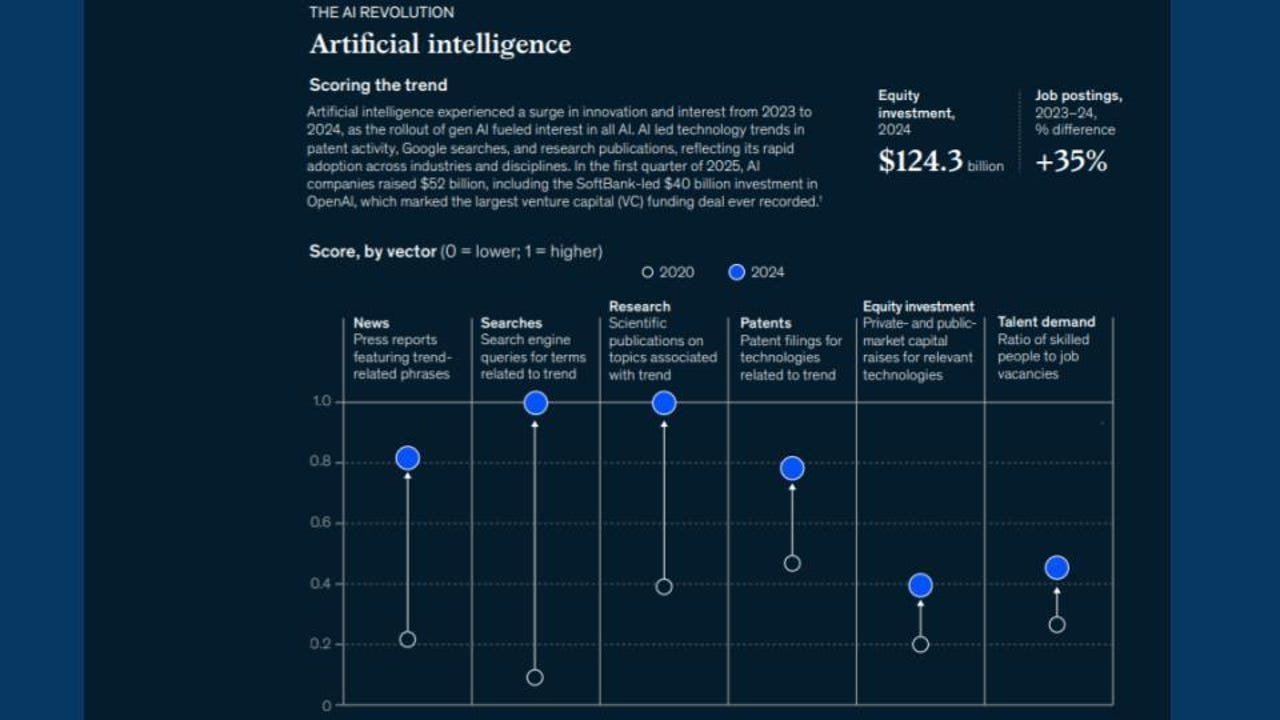 McKinsey data showing AI's accelerating dominance among 2025 tech priorities, with agentic systems driving cross-sector impact.
The 13 Frontier Technologies Reshaping Business
While AI anchors the ecosystem, McKinsey's analysis details how it interlinks with other critical innovations:
- Application-Specific Semiconductors: Custom chips optimized for AI inference slashing latency and energy use.
- Quantum Technologies: Solving intractable problems in encryption and material science.
- Digital Trust Architectures: Blockchain and zero-trust models securing AI-augmented workflows.
- Cloud-Edge Hybrids: Distributed computing balancing data sovereignty and real-time processing.
- Bioengineering & Space Tech: AI-driven breakthroughs in gene editing and satellite networks.
For developers and tech leaders, this signals urgent priorities: architecting for AI-agent interoperability, investing in ethical guardrails, and mastering hybrid infrastructure. The scaling challenges alone—like managing GPU shortages for AI training—demand novel approaches to resource allocation.
The most forward-thinking enterprises aren't just adopting AI tools; they're evolving into autonomous organizations where digital labor handles routine complexity, freeing human talent for high-impact innovation. As these agentic systems mature, they promise not just efficiency but entirely new value chains—if we navigate the ethical and operational rapids wisely.
Comments
Please log in or register to join the discussion