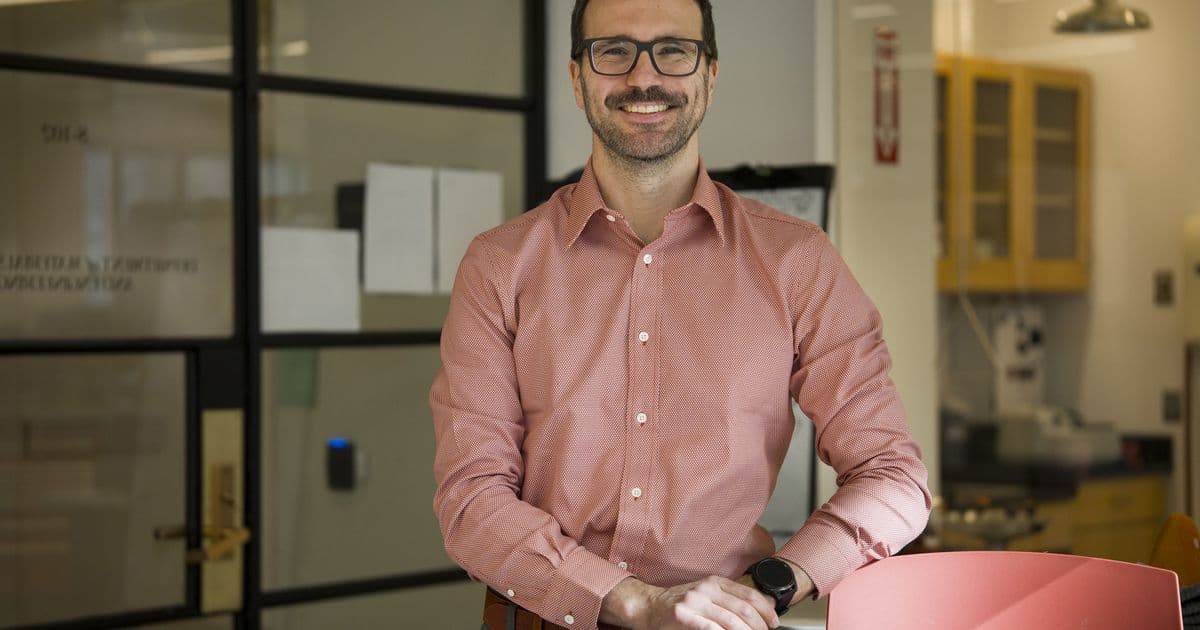
MIT's Rafael Gómez-Bombarelli sees AI reaching an inflection point in scientific research, combining language models with physics-based simulations to accelerate discovery across materials science and beyond.
For more than a decade, MIT Associate Professor Rafael Gómez-Bombarelli has been at the forefront of applying artificial intelligence to scientific discovery. Now, he believes we're entering a transformative era where AI will fundamentally reshape how research is conducted across multiple scientific disciplines.
"AI for science is one of the most exciting and aspirational uses of AI," Gómez-Bombarelli says. "Other applications for AI have more downsides and ambiguity. AI for science is about bringing a better future forward in time."
The Evolution of AI in Scientific Research
Gómez-Bombarelli identifies two major inflection points in AI's application to science. The first came around 2015 with the emergence of representation learning, generative AI, and high-throughput data analysis in scientific domains. The second, he argues, is happening now with the convergence of language models and multi-modal AI systems.
"We're going to have all the model classes and scaling laws needed to reason about language, reason over material structures, and reason over synthesis recipes," he explains. This convergence represents a fundamental shift in how AI can approach scientific problems.
From Lab Bench to Computer Screen
Gómez-Bombarelli's journey into computational science began during his PhD at the University of Salamanca in Spain. Initially focused on experimental chemistry, he discovered the power of simulation and computer science midway through his doctoral work.
"I like the way programming organizes your brain; it felt like a natural way to organize one's thinking," he recalls. "Programming is also a lot less limited by what you can do with your hands or with scientific instruments."
This computational approach led him to Harvard University for postdoctoral work with Alán Aspuru-Guzik, where he became one of the pioneers in applying deep learning to chemistry. In 2016, he was among the first to use generative AI for chemistry, and in 2015, part of the first team to use neural networks to understand molecular structures.
High-Throughput Discovery and Real-World Impact
One of Gómez-Bombarelli's most significant contributions has been developing methods to eliminate manual parts of molecular simulations, enabling high-throughput computational experiments. His team has run hundreds of thousands of calculations across materials, discovering hundreds of promising candidates for real-world applications.
This work has led to new materials for batteries, catalysts, plastics, and organic light-emitting diodes (OLEDs). Beyond academia, he has co-founded multiple companies and served on scientific advisory boards for startups applying AI to drug discovery, robotics, and other fields.
His latest venture, Lila Sciences, aims to build a scientific superintelligence platform for the life sciences, chemical, and materials science industries. The goal is to create a more seamless and productive research ecosystem than exists today.
The Power of Physics-Based Simulations
At the core of Gómez-Bombarelli's approach is the integration of physics-based simulations with machine learning and generative AI. This combination creates what he calls "virtuous cycles" between AI and simulations.
"Physics-based simulations make data and AI algorithms get better the more data you give them," he explains. This synergy allows for more accurate predictions and more efficient discovery processes.
Unlike many research groups, Gómez-Bombarelli's lab is purely computational—they don't run physical experiments. This approach provides significant advantages.
"It's a blessing because we can have a huge amount of breadth and do lots of things at once," he says. "We love working with experimentalists and try to be good partners with them. We also love to create computational tools that help experimentalists triage the ideas coming from AI."
Bridging the Gap Between Discovery and Application
Despite the computational focus, Gómez-Bombarelli remains deeply committed to real-world applications. His lab works closely with companies and organizations like MIT's Industrial Liaison Program to understand the material needs of the private sector and the practical hurdles of commercial development.
This connection to industry ensures that the materials his team invents have practical value beyond academic interest. It's a philosophy that has guided his career from his time running a startup to his current academic work.
The Current Inflection Point
As excitement around artificial intelligence has exploded, Gómez-Bombarelli has witnessed the field mature dramatically. Companies like Meta, Microsoft, and Google's DeepMind now regularly conduct physics-based simulations that were cutting-edge just a few years ago.
In November, the U.S. Department of Energy launched the Genesis Mission to accelerate scientific discovery, national security, and energy dominance using AI. This institutional recognition reflects the growing consensus around AI's potential in scientific research.
"AI for simulations has gone from something that maybe could work to a consensus scientific view," Gómez-Bombarelli notes. "We're at an inflection point. Humans think in natural language, we write papers in natural language, and it turns out these large language models that have mastered natural language have opened up the ability to accelerate science."
Building the Next Generation of Computational Scientists
When Gómez-Bombarelli joined MIT in 2018, he was impressed by the collaborative, non-competitive atmosphere among researchers. He strives to foster that same positive-sum thinking in his own research group, which includes about 25 graduate students and postdocs.
"We've naturally grown into a really diverse group, with a diverse set of mentalities," he says. "Everyone has their own career aspirations and strengths and weaknesses. Figuring out how to help people be the best versions of themselves is fun."
This mentorship approach has come full circle—Gómez-Bombarelli now finds himself encouraging his students to pursue faculty positions, just as his own mentor once did for him.
The Future of Scientific Discovery
The convergence of AI, simulations, and scientific research represents more than just a technological advancement—it's a fundamental reimagining of how discovery happens. By combining the reasoning capabilities of large language models with the precision of physics-based simulations, researchers can tackle problems that were previously intractable.
As Gómez-Bombarelli sees it, we're not just improving existing scientific methods; we're creating entirely new ways to understand and manipulate the world around us. The materials of tomorrow, the drugs of the future, and the technologies we can't yet imagine will likely emerge from this new paradigm of AI-enhanced scientific discovery.
The journey from experimental chemistry to computational materials science has been transformative for Gómez-Bombarelli, and his work suggests it will be equally transformative for the broader scientific community. As AI continues to mature and integrate with traditional scientific methods, the pace and scope of discovery may accelerate in ways we're only beginning to comprehend.
Comments
Please log in or register to join the discussion