
A developer's experiment building an enterprise-scale wildlife platform reveals AI's dual nature: accelerating development while increasing technical debt, security risks, and the need for deeper engineering oversight.
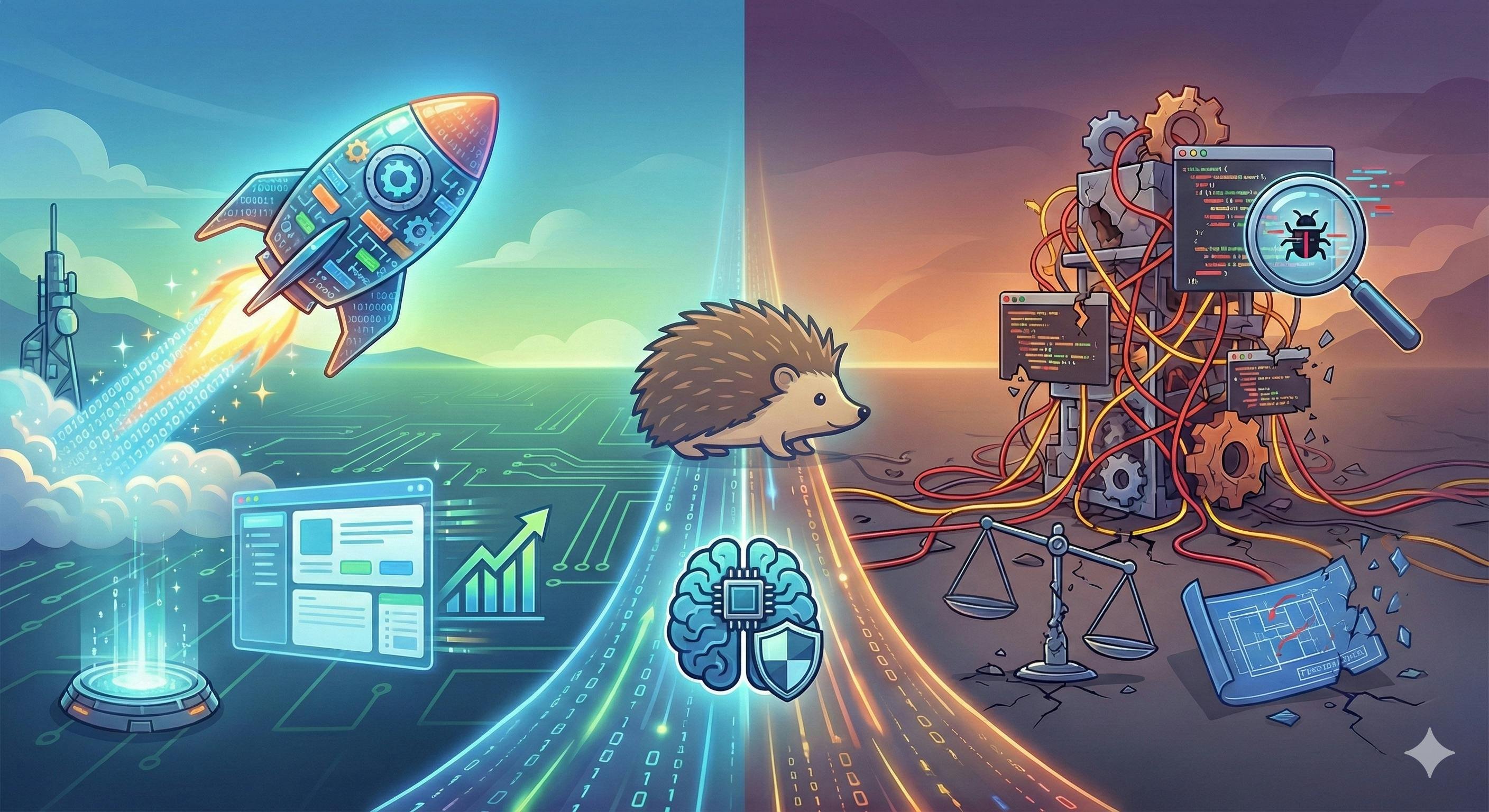
When Leon Revill set out to build Under The Hedge - an enterprise-scale wildlife observation platform comparable to Instagram/Strava for nature enthusiasts - he aimed to test AI's real-world impact on software development. The results expose critical tradeoffs in the AI-assisted development era.
The Enterprise-Scale Test Case
Under The Hedge incorporates complex capabilities that mirror commercial platforms:
- AI-Powered Analysis: Gemini identifies species and behaviors in user-uploaded photos
- Geospatial Processing: Location tracking via EXIF data and geohashing
- High-Performance Data Layer: AWS DynamoDB single-table design
- Scalable Media Infrastructure: Global content delivery via CloudFront
- Social Features: User/species/location following systems

Industry Data Reveals Systemic Patterns
Recent studies contextualize Revill's findings:
- Throughput vs. Stability (2025 DORA Report):
- 62% faster feature delivery
- 28% increase in production incidents
- Quality Decline (GitClear Analysis of 211M LOC):
- Copy/pasted code (12.3%) exceeds refactored code (9.5%)
- 8x increase in duplicated blocks
- Security Gaps (Veracode 2025):
- 45% of AI-generated samples contained vulnerabilities
- Java security pass rates as low as 29%
The Developer's Firsthand Experience
Revill's month-long development process revealed AI's dual nature:
Accelerators
- Complex UI components built in minutes instead of days
- Continuous progress maintained developer motivation
- Effective learning tool for new technologies like Next.js
The Stability Tax
- Defaulted to fastest solutions, not optimal ones
- Systematic duplication instead of DRY principles
- Backward-compatibility workarounds bloating code
- Required explicit security prompting

Mitigation Strategies for Engineering Teams
Based on his experiment, Revill recommends:
- Specification-First Development: Use tools like Gemini's deep research feature for detailed architecture planning before coding
- Explicit Quality Gates: Prompt AI for security audits, performance optimizations, and duplication checks
- AI-Assisted QA: Automate code analysis for refactoring opportunities
- Full SDLC Integration: Generate test plans alongside feature code
The New Developer Paradigm
"We're transitioning from bricklayers to site foremen," Revill observes. AI handles syntax, but human value now resides in:
- Semantic understanding
- Architectural oversight
- Quality enforcement
- Security validation
The experiment confirms AI's role as an amplifier rather than a replacement. Teams that approach it as a "brilliant but reckless junior intern" - with rigorous specifications and review - stand to gain the most from this transformative technology without drowning in technical debt.
Comments
Please log in or register to join the discussion