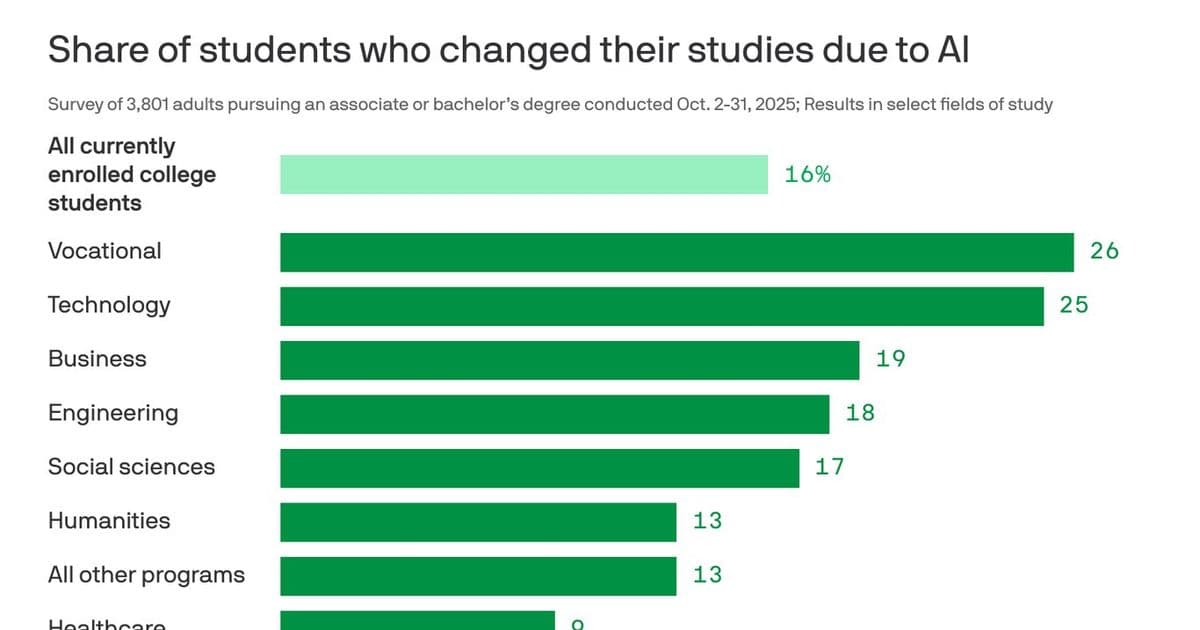
A new poll reveals that the AI boom is causing college students to reconsider their academic paths, with many shifting to technology-focused majors to align with the rapidly evolving job market.
The artificial intelligence revolution is reshaping not just industries but also the academic choices of college students across the country. A recent poll conducted by Axios has revealed a significant trend: students are increasingly changing their majors to align with the growing demand for AI and technology skills.
According to the survey, which included responses from over 1,000 college students, nearly 40% of respondents indicated that they have either changed their major or are considering doing so because of the AI boom. This shift is particularly pronounced among students who were initially pursuing degrees in fields such as humanities, social sciences, and even some STEM disciplines that are less directly related to AI.
The Numbers Behind the Shift
The poll found that the most popular new majors among students making the switch are computer science, data science, and machine learning. These fields have seen a 25% increase in enrollment over the past year alone. Additionally, interdisciplinary programs that combine technology with other fields, such as computational biology or digital humanities, are also gaining traction.
One student, who wished to remain anonymous, shared their experience: "I started out as an English major, but after seeing how AI is transforming industries, I realized I needed to pivot. I’m now majoring in computer science with a focus on natural language processing. It’s a big change, but I feel like it’s the right move for my future."
Why the Shift?
The driving force behind this trend is clear: job security and opportunity. The AI industry is projected to grow exponentially in the coming years, with the global AI market expected to reach $1.3 trillion by 2030, according to a report by Bloomberg Intelligence. This growth is creating a surge in demand for professionals with AI and machine learning skills.
Moreover, the poll highlighted that students are acutely aware of the changing job landscape. Over 60% of respondents believe that AI will significantly impact their future careers, and many are proactively seeking to equip themselves with the skills needed to thrive in this new environment.
The Broader Implications
This shift in academic focus has broader implications for the workforce and the economy. As more students gravitate toward AI and technology-related fields, we may see a decline in enrollment in traditional humanities and social sciences programs. This could lead to a shortage of professionals in these areas, potentially impacting sectors such as education, healthcare, and public policy.
On the flip side, the increased focus on AI and technology could drive innovation and economic growth. Companies across industries are already investing heavily in AI, and a workforce that is well-versed in these technologies could accelerate advancements in fields such as healthcare, finance, and manufacturing.
What Colleges Are Doing
In response to this trend, many colleges and universities are expanding their AI and technology programs. Some institutions are introducing new majors and minors, while others are integrating AI courses into existing curricula. For example, Stanford University recently launched a new undergraduate major in Symbolic Systems, which combines computer science, linguistics, and philosophy to prepare students for careers in AI.
Additionally, colleges are partnering with tech companies to offer internships, co-op programs, and research opportunities that provide students with hands-on experience in AI. These initiatives are designed to bridge the gap between academic learning and industry needs, ensuring that graduates are job-ready upon completion of their degrees.
The Future of Education
The AI boom is not just changing what students study; it’s also transforming how they learn. Online learning platforms, coding bootcamps, and AI-driven educational tools are becoming increasingly popular among students looking to supplement their traditional education with practical skills.
For instance, platforms like Coursera and edX offer courses in AI and machine learning from top universities, allowing students to gain expertise in these areas without committing to a full degree program. Similarly, coding bootcamps like General Assembly and Flatiron School provide intensive, short-term training in tech skills, making it easier for students to pivot into AI-related careers.
Conclusion
The AI boom is undeniably influencing the academic choices of college students, with many opting to change majors to align with the demands of the future job market. This trend reflects a broader shift in how we think about education and career preparation in the age of AI.
As the AI industry continues to grow, it will be crucial for educational institutions to adapt and provide students with the skills and knowledge they need to succeed. At the same time, students must remain agile and open to change, as the rapid pace of technological advancement means that the skills required for success today may not be the same tomorrow.
For now, one thing is clear: the AI revolution is not just transforming industries—it’s transforming the very fabric of higher education.
Comments
Please log in or register to join the discussion