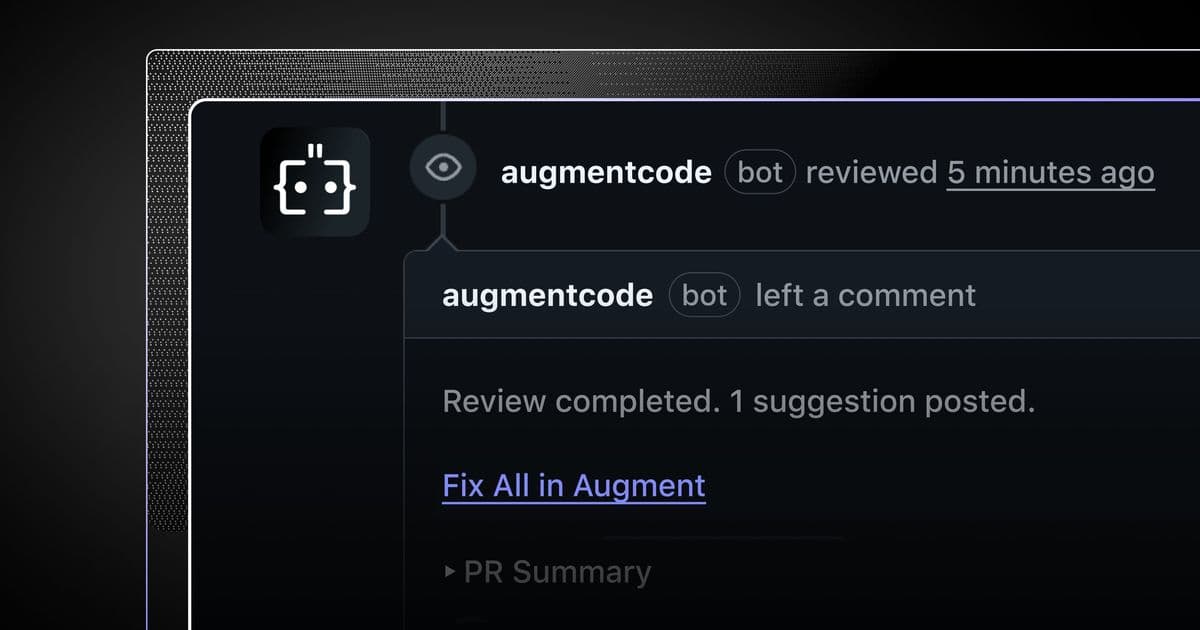
As AI-generated code proliferates, code review bottlenecks are crippling development teams. Augment Code Review claims to solve this with a GPT-5.2-powered agent that focuses on high-impact issues while dramatically reducing noise, outperforming competitors in benchmarks.
AI Code Review at Scale: Augment's New Tool Tackles the Signal-to-Noise Problem
As AI-generated code continues to proliferate—now accounting for over 25% of new code at Google and 30% at Microsoft—development teams are facing an unprecedented bottleneck: code review capacity hasn't kept pace with AI's acceleration of code creation. This mismatch is creating operational risks, with software errors and incomplete reviews contributing to outages that can cost enterprises up to $1 million per hour.
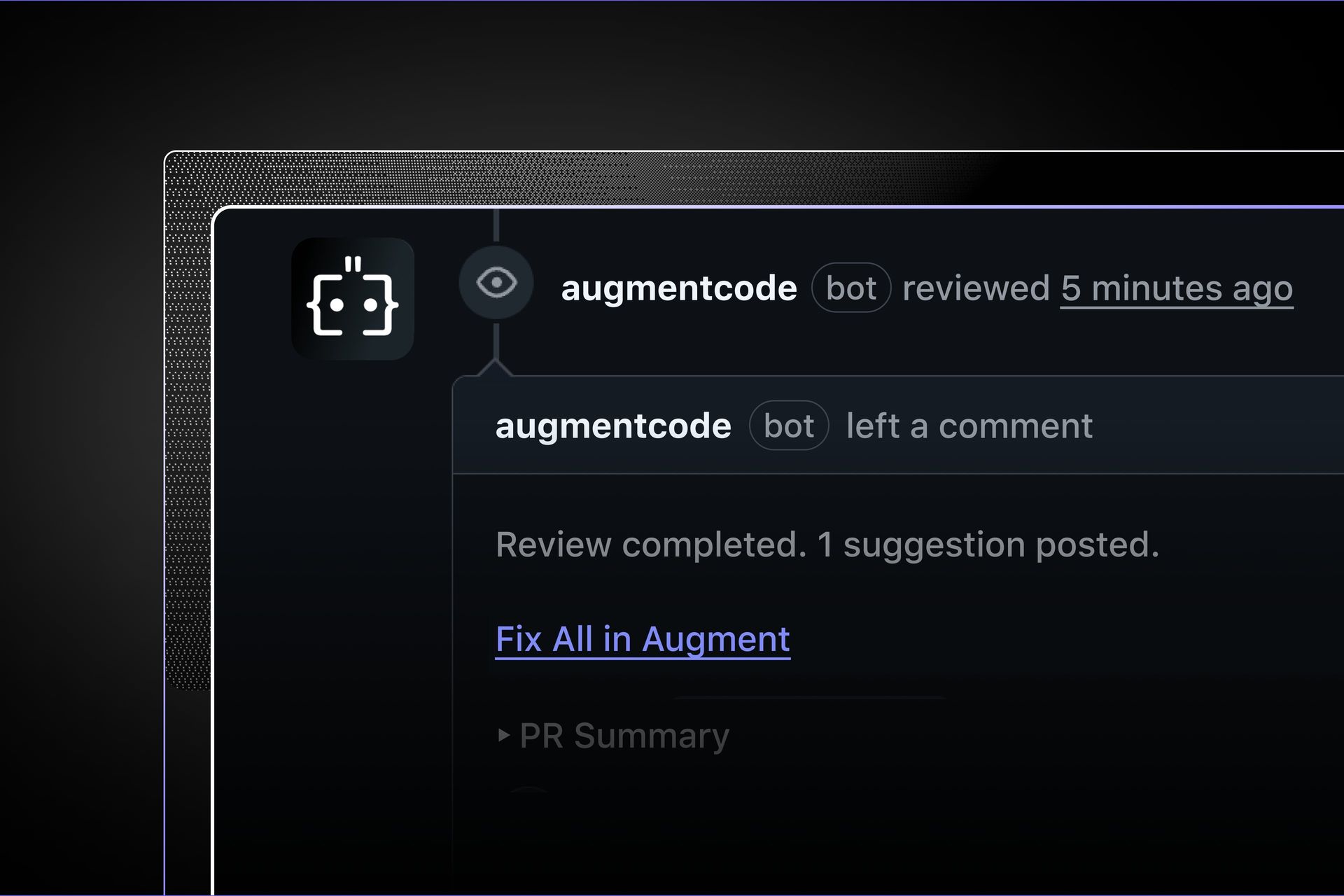
Enter Augment Code Review, a new AI-powered tool designed specifically for large, long-lived codebases. Built on GPT-5.2, it aims to catch correctness, architectural, and cross-system issues that existing tools miss while dramatically reducing the noise that plagues current AI review solutions.
The Broken State of AI-Assisted Code Review
The GitHub Marketplace now lists over 77 AI review bots, but most follow the same flawed pattern: extract the diff, send it to a large language model, and generate dozens of shallow, often irrelevant comments. This approach results in:
- Low precision: Too many suggestions that don't matter
- Low recall: Real bugs missed due to lack of context
- Shallow reasoning: No understanding of architecture or cross-file behavior
The consequence? Developers tune these tools out, rendering them ineffective at improving code quality and creating a vicious cycle where the tools become less useful over time as engineers learn to ignore their comments.
Augment's Philosophy: Signal Over Noise
"The core principle behind our approach is simple," explains Akshay Utture, engineering lead at Augment Code. "If a comment won't likely change a merge decision, we don't post it."
This focus on high-impact comments rather than exhaustive nitpicking sets Augment apart. The system prioritizes:
- Correctness and architectural issues: Bugs, security vulnerabilities, cross-system pitfalls, invariants, and missing tests—not style nits.
- Full codebase context: Unlike tools that only see the diff, Augment retrieves dependency chains, call sites, type definitions, tests, fixtures, and historical changes to evaluate changes properly.
- Custom team expertise: Teams can define their own rules in YAML format that Augment enforces consistently across the codebase.
- Adaptive learning: The system learns which comments developers address or ignore, improving precision over time.
Benchmark Results: Outperforming the Competition
To validate their approach, Augment evaluated seven widely used AI code review tools using the only public dataset of "golden comments"—ground-truth issues a competent human reviewer would catch.
The results, sorted by F-score (a balanced measure of precision and recall), show:
| Tool | Precision | Recall | F-score |
|---|---|---|---|
| ⭐ Augment Code Review | 65% | 55% | 59% |
| Cursor Bugbot | 60% | 41% | 49% |
| Greptile | 45% | 45% | 45% |
| Codex Code Review | 68% | 29% | 41% |
| CodeRabbit | 36% | 43% | 39% |
| Claude Code | 23% | 51% | 31% |
| GitHub Copilot | 20% | 34% | 25% |
Augment achieved the highest accuracy, outscoring the next-best tool by approximately 10 points in overall quality. Most competing tools must choose between high recall with low signal-to-noise ratio or high precision with shallow coverage. Augment is the only system to maintain both high precision and high recall by retrieving the full context needed for deep reasoning.
Customer Results: Faster Reviews, Fewer Bugs
Early adopters are reporting significant improvements. Tekion, with 1,400 engineers, saw:
- Average time to merge drop from 3 days 4 hours to 1 day 7 hours—a 60% improvement
- Time to first human review reduced from 3 days to 1 day
- 21% more merge requests merged with the same number of engineers
"Augment has become a valuable part of our code review process," said Tyler Kaye, Lead Engineer at MongoDB. "It doesn't replace human review; it enhances it by giving authors a thoughtful first pass before their teammates ever see the code. Its custom guideline integration combines MongoDB's best-practice recommendations with our own organization-specific guidance, making the feedback both relevant and actionable."
Pricing for Scale
Augment Code Review is priced at approximately $1.50 per PR review (2,400 credits). For context, a senior engineer's time costs $75-150+ per hour, with even a 10-minute review running $12-25 in fully-loaded costs. At $1.50 per PR, Augment pays for itself if it saves just 90 seconds per review or catches a single production bug.
The tool is free for open-source projects, reflecting Augment's commitment to supporting the OSS community that powers modern software.
The Evolution of Code Quality in the AI Era
As AI continues to transform software development, tools like Augment Code Review represent a critical evolution in how we maintain code quality at scale. By focusing on high-impact issues rather than exhaustive nitpicking, and by deeply understanding entire codebases rather than just diffs, these systems promise to restore flow to development teams working in complex systems.
The ultimate goal isn't to replace human reviewers but to enhance them—providing that thoughtful first pass that ensures code enters the review process cleaner and more ready for human scrutiny. In an era where AI writes a third of new code, this enhancement may be the key to keeping our software systems reliable and our development teams productive.
As we stand at this inflection point, one thing is clear: the future of code review will be less about human eyes catching every mistake and more about intelligent systems ensuring that human reviewers can focus on the nuanced architectural and business decisions that truly matter.
Comments
Please log in or register to join the discussion