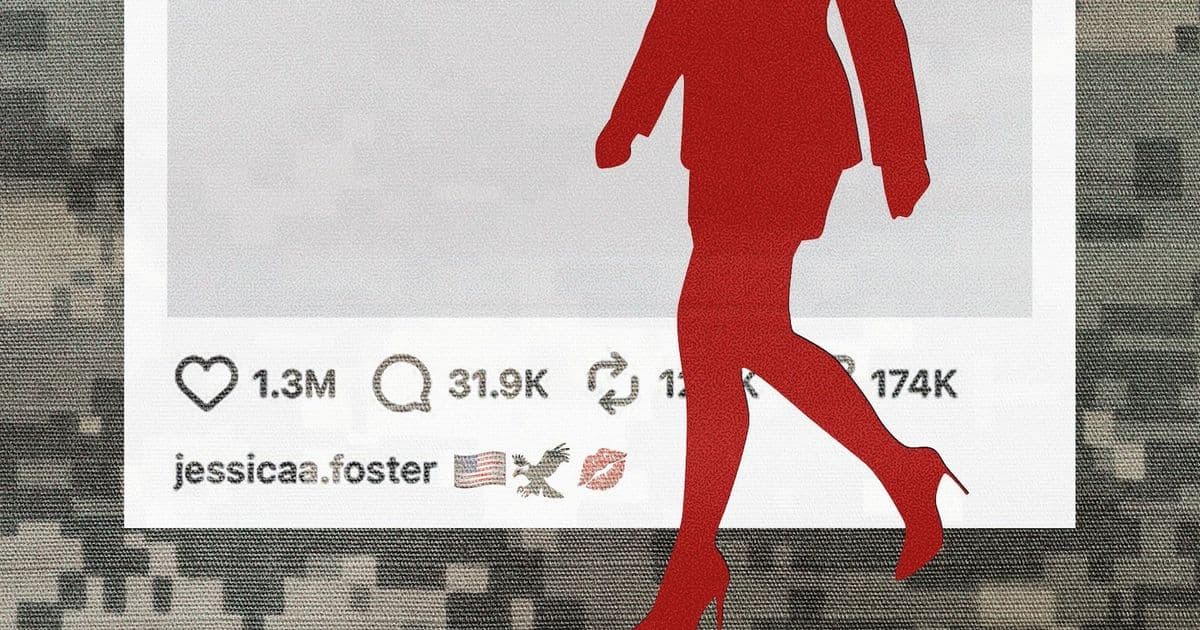
Fake social media accounts featuring AI-generated women posing as pro-Trump soldiers, truckers, and cops have gained massive followings, with thousands of users believing they are real people.
Social media platforms are being flooded with AI-generated images of women posing as pro-Trump soldiers, truckers, and law enforcement officers, with these fake accounts gaining thousands of followers who appear to believe they are real people.
The phenomenon, documented by Washington Post reporter Drew Harwell, reveals a troubling new frontier in political misinformation where artificial intelligence makes it easier than ever to create convincing fake personas that spread partisan content.
One of the most prominent accounts features "Jessica Foster," a beautiful blonde woman who appears in photos wearing military camouflage in desert settings, posing with an F-22 Raptor fighter jet, and wearing Army uniforms. The account has amassed thousands of followers who engage with posts promoting pro-Trump messaging and conservative political content.
Similar accounts have emerged featuring AI-generated women posing as patriotic truckers with American flag imagery, police officers in uniform, and other traditionally conservative-leaning professions. The images are often professionally styled and include convincing backgrounds that make them appear authentic at first glance.
What makes this trend particularly concerning is the scale of engagement these accounts receive. Many followers comment as if they're interacting with real people, expressing admiration for the women's patriotism and sharing their posts widely. Some accounts have developed cult-like followings where users defend the authenticity of the personas when questioned.
The technology behind these fake accounts has become increasingly sophisticated. Modern AI image generators can create photorealistic portraits that are nearly indistinguishable from real photographs, complete with natural-looking lighting, realistic textures, and convincing backgrounds. When combined with basic social media management skills, bad actors can create entire networks of fake personas that appear to represent real people.
This trend represents a significant evolution in online misinformation. Unlike previous efforts that relied on stolen photos or crude Photoshop jobs, these AI-generated accounts create entirely fictional people who can be customized to fit specific narratives. The women are often depicted as young, attractive, and conventionally patriotic - qualities that make them more likely to gain trust and engagement from certain audiences.
Social media platforms have struggled to combat this type of content. While they have policies against impersonation and misinformation, AI-generated content that doesn't directly impersonate real people falls into a gray area. The accounts often mix political content with lifestyle posts, making them appear more authentic and harder to flag as purely political propaganda.
The timing of this trend is particularly notable given the current political climate. With the 2024 election cycle underway and political tensions running high, these fake accounts can be used to amplify specific messages, create the appearance of grassroots support for certain positions, or simply sow confusion about what information is real.
Experts warn that this is likely just the beginning of AI-generated influence operations. As the technology becomes more accessible and easier to use, we can expect to see more sophisticated campaigns that blend AI-generated content with real information to create compelling but misleading narratives.
The Washington Post's investigation highlights how thousands of social media users are being deceived by these fake accounts, raising questions about digital literacy and the ability of the average person to distinguish between real and AI-generated content. In an era where seeing is no longer believing, the challenge of maintaining informed public discourse becomes even more complex.
This trend also raises ethical questions about the use of AI to create fake personas for political purposes. While creating a fictional character for entertainment is one thing, using AI to manufacture the appearance of real people supporting specific political positions crosses into deceptive territory that could undermine democratic processes.
As AI technology continues to advance, the line between real and fake online content will likely become increasingly blurred. The success of these pro-Trump AI influencer accounts suggests that political actors on all sides may begin experimenting with similar tactics, potentially leading to an arms race of AI-generated content designed to manipulate public opinion.
The viral spread of these accounts demonstrates how easily misinformation can take root when it confirms people's existing beliefs and is presented in an appealing, relatable format. Even when some users suspect the accounts might be fake, the engaging content and confirmation of their political views often leads them to engage anyway, inadvertently helping to spread the misinformation further.
This phenomenon represents a new challenge for social media platforms, fact-checkers, and anyone concerned about the integrity of online information. Traditional methods of identifying fake accounts - such as reverse image searches or checking for inconsistencies - may not work as effectively against AI-generated content that is specifically designed to be convincing.
As we move forward, the ability to create and distribute convincing fake personas using AI will likely become a standard tool in the misinformation arsenal, requiring new approaches to digital verification and media literacy education to help people navigate an increasingly artificial online landscape.
Comments
Please log in or register to join the discussion