New Microsoft research reveals a 28-point gap between leaders and individual contributors in perceived AI support, showing that while transformational leadership principles remain vital, their application must evolve for the AI era.
A new Microsoft research drop reveals a critical leadership challenge in the AI era: while employees who feel supported to integrate agentic AI are 1.8x more likely to be high-frequency users, there's a 28-percentage point gap in perceived support between leaders and individual contributors. This gap suggests that even as organizations rush to adopt AI, the human elements of leadership that drive successful transformation are being lost in translation.
The Leadership Support Gap
The research surveyed 1,800 global employees and found that 78% of leaders feel they have adequate support to integrate agentic AI, compared to only 50% of individual contributors. This disparity is particularly concerning given that only 19% of managers have provided one-on-one coaching or mentoring on AI use. The data suggests that what leaders believe is sufficient support often doesn't match what employees actually experience in practice.
Evolving Transformational Leadership for AI
The study examines how the four dimensions of transformational leadership must adapt for the AI era:
Intellectual Stimulation: Teaching Critical Thinking With AI
Traditional intellectual stimulation involves encouraging critical thinking and novel problem-solving. In the AI context, this means teaching employees how to think with AI rather than simply providing answers. The research found that 60% of employees skip accuracy checks when using AI, and 56% close AI tools if they feel responses are inaccurate rather than adjusting their prompts.
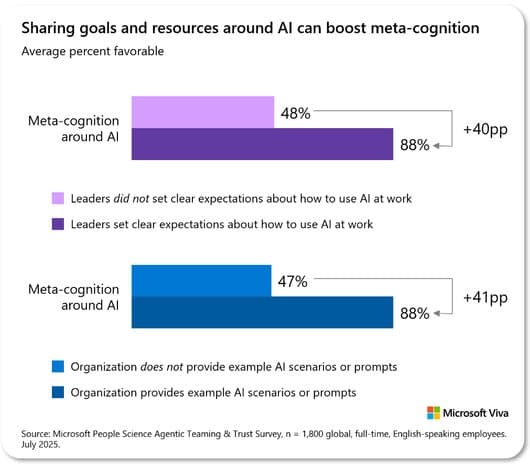
When leaders set clear expectations about AI use, employees nearly double their self-reported meta-cognition around AI. This includes defining what "good" AI use looks like, naming moments where human judgment should override AI, and asking reflective questions that build habits over time.
Individualized Consideration: Personal Support Beyond Automation
While AI can deliver personalized content at scale, the human touch of individualized consideration becomes more critical. The research shows that only half of individual contributors feel supported to integrate agentic AI, despite AI's ability to surface trainings and suggest resources.
Leaders must connect these resources to employees' broader goals and address genuine human concerns that AI transformation surfaces. This includes acknowledging fears about job security, the pressure to learn new ways of working, and helping employees make sense of where to focus their attention amid AI uncertainty.
Inspirational Motivation: Creating Authentic Purpose
Rather than frequent AI messaging, employees crave tangible modeling experiences where leaders transparently show the what, when, why, and how of their own AI use. The research found an 85% motivation rate among leaders to integrate agentic AI, compared to only 56% of individual contributors.
When messaging feels like "lip service," employees see through it. They want leaders to share their own AI uncertainty, moments of discovery, and how AI is changing their own work. This authenticity creates the compelling vision that motivates adoption.
Idealized Influence: Leading by Example in Human-AI Collaboration
Employees are watching how leaders engage with AI, and their adoption actions will mirror their leaders' approach. When leaders model thoughtful, intentional AI use—showing when they use it, when they override it, how they acknowledge its limits—it creates conditions for teams to experiment with confidence.
The research shows that employees who agree their leaders role model effective AI use report a 17-percentage point uplift in realized value from agentic AI.
The Business Impact
These leadership behaviors have measurable effects:
- Nearly doubling employees' meta-cognition around AI
- 30-percentage point boost in trust in agentic AI
- 17-percentage point uplift in realized value from agentic AI
What This Means for Organizations
AI transformation is not just a technological shift but a leadership one. While the "what" of effective leadership hasn't changed, the "how" has evolved significantly. Organizations need to:
- Bridge the support gap between leaders and individual contributors
- Focus on meta-cognition rather than just tool usage
- Personalize support beyond what AI can deliver
- Model authentic AI use rather than just communicating about it
- Address human concerns that AI transformation surfaces
The research makes clear that employees are already watching how their leaders engage with AI. The question is whether what they see encourages critical thinking, confidence, and growth—or hesitation and disengagement.
The full implications of this leadership evolution will continue to unfold as organizations navigate AI-driven change. Leaders who focus not just on adoption but on how people experience and make sense of that change will be best positioned to unlock meaningful and lasting impact.
Comments
Please log in or register to join the discussion