Princeton University researchers have developed a breakthrough 3D bioelectronic device that combines living brain cells with advanced embedded electronics, demonstrating pattern recognition capabilities while consuming significantly less power than traditional AI systems.
Researchers at Princeton University have created a revolutionary three-dimensional neural network device that merges living brain cells with advanced embedded electronics, achieving computational capabilities with remarkably low energy consumption. According to a recent study published in Nature Electronics, this biohybrid system represents a significant advancement in neuromorphic computing.
Technical Architecture and Performance
The Princeton team constructed their device using a 3D mesh of microscopic wires and electrodes supported by a thin layer of epoxy. This scaffold supports tens of thousands of neurons organized into a vast 3D network capable of performing computational tasks. The 3D electronic mesh design enables researchers to record and stimulate the neurons' electrical activity at a scale approximately 10 times finer than previous 2D approaches that used petri dishes or external monitoring.
Over a six-month development period, the researchers observed how the neural network matured, implementing techniques to reinforce or weaken synaptic connections between specific neurons. They successfully trained an algorithm to identify recurring pulse patterns, with the system demonstrating 95% accuracy in differentiating between two distinct patterns presented during separate experiments.
Energy Efficiency Breakthrough
The most significant aspect of this research lies in its potential to address one of artificial intelligence's most pressing challenges: energy consumption. According to the research team, the human brain performs similar computational tasks using approximately one millionth of the power consumed by today's AI systems.
"The real bottleneck for AI in the near future is energy," said Tian-Ming Fu, assistant professor of Electrical and Computer Engineering and member of the research team. "Our brain consumes only a tiny fraction — about one millionth — of the power consumed by today's AI systems to perform similar tasks."
This energy disparity represents a critical challenge for the semiconductor industry as it approaches physical limits in traditional transistor scaling. Current AI systems require massive data centers with thousands of processors, consuming megawatts of power for tasks that biological systems perform with milliwatts.
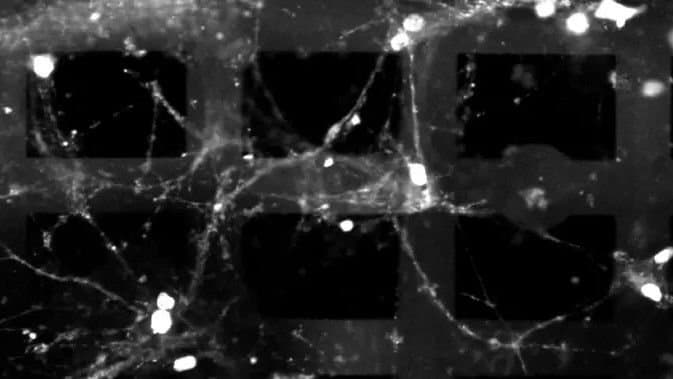
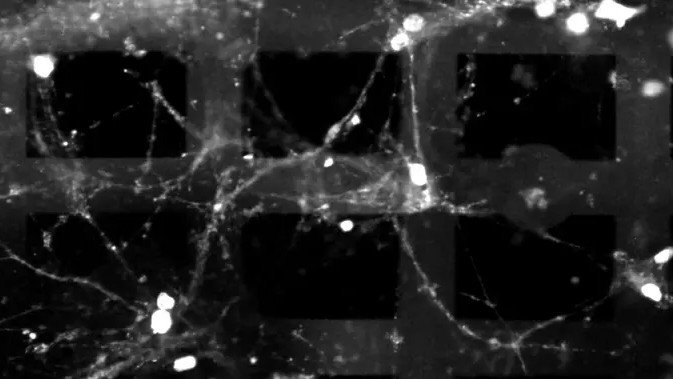 Biological neurons growing over and through a layer of a 3D electronic mesh. (Image credit: Princeton University)
Market Implications and Future Applications
The Princeton biohybrid device opens several potential pathways for technological advancement:
Neuromorphic Computing: The technology could lead to new hardware architectures that mimic the brain's energy-efficient processing methods, potentially extending Moore's Law through biologically-inspired design rather than traditional semiconductor scaling.
Medical Applications: According to Kumar Mritunjay, the paper's first author, the technology "can not only help uncover the computing secrets of the brain but can also assist in understanding and possibly treating neurological diseases." This could accelerate research into conditions like Alzheimer's, Parkinson's, and epilepsy.
AI Efficiency: As AI models continue to grow in complexity and computational requirements, biohybrid systems could provide a path toward more sustainable AI implementations with dramatically lower energy footprints.
The research team plans to progressively scale the device to perform increasingly complex tasks, with potential applications ranging from pattern recognition to decision-making systems. The next phase of development will focus on expanding the neural network size and implementing more sophisticated learning algorithms.
Supply Chain and Manufacturing Considerations
The fabrication of these biohybrid systems presents unique manufacturing challenges compared to traditional semiconductor production. The process requires:
- Precision 3D printing of electronic scaffolds at microscopic scales
- Sterile culturing environments for neural tissue
- Integration of biological and electronic components without damaging either system
These manufacturing requirements may initially limit commercial scalability, but the Princeton team has outlined potential pathways for standardization and mass production. The research could eventually influence semiconductor manufacturing processes, particularly in the growing field of bioelectronics.
As the semiconductor industry continues to grapple with the end of Moore's Law and increasing power constraints, biohybrid computing represents one of the most promising alternative approaches. While still in early research stages, the Princeton device demonstrates the potential for fundamentally new computing architectures that could redefine the relationship between biological systems and electronic hardware.
The research team's findings have already attracted interest from both academic institutions and industry partners, with several semiconductor companies reportedly exploring potential collaborations to further develop the technology.
 Etiido Uko, News Contributor
Etiido Uko is an engineer and technical writer with over nine years of experience in documentation and reporting. He is deeply passionate about all things gadgets, technology, and engineering.
Comments
Please log in or register to join the discussion