Machine learning has revolutionized earthquake detection, enabling scientists to identify seismic events 10 times smaller than previously possible—including tremors as subtle as a passing truck. This 'like putting on glasses for the first time' moment is transforming volcanic imaging and deep-earth analysis while raising questions about AI's future role in geoscience.
On January 1, 2008, a magnitude -0.53 earthquake—equivalent to a truck’s vibration—occurred near Calipatria, California. Undetectable by humans, this minuscule event symbolizes a seismic shift in geoscience: AI-powered detection now identifies earthquakes traditional methods missed, revealing Earth’s hidden rhythms.
The Detection Revolution
For decades, seismologists relied on manual analysis or rudimentary algorithms to detect quakes. "Traditionally, labs like the USGS would have an army of interns staring at seismograms," explains University of Texas professor Joe Byrnes. These methods struggled with small quakes, especially in noisy urban environments. Template matching—comparing new seismic signals to known earthquake patterns—yielded breakthroughs but demanded massive computing power: identifying Southern California’s 1.6 million small quakes required 200 GPUs running for days.
How AI Cracks the Code
Modern neural networks like the Earthquake Transformer (developed at Stanford) use 1D convolutional layers—adapted from image recognition—to analyze seismograms in progressive time windows. Like audio models identifying syllables then words, they detect vibration patterns across escalating time scales:
- 0.1-second chunks: Identify basic waveform features
- Longer sequences: Recognize P-wave/S-wave sequences
- Attention mechanisms: Contextualize events within full seismograms
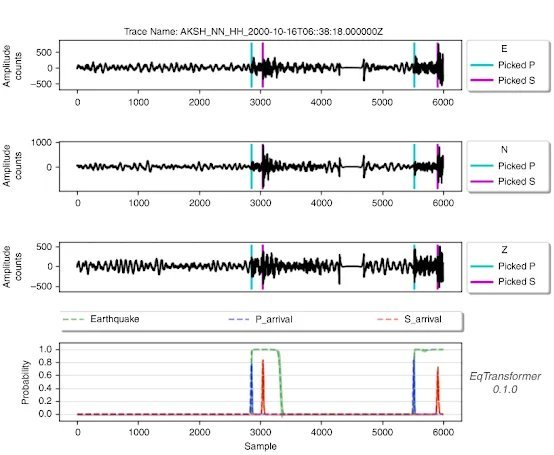
Trained on the Stanford Earthquake Dataset (STEAD)—1.2 million labeled seismogram segments—these models achieve near-perfect accuracy. They’re lightweight (350k parameters vs. GPT-4’s billions), running on consumer CPUs while performing simultaneous earthquake detection and phase picking (timing P/S wave arrivals).
Scientific Paydirt
- Volcanic Plumbing Revealed: AI-processed quake data mapped Hawaii’s magma systems with unprecedented detail, confirming theorized connections between deep magma chambers and surface volcanoes.
- Urban Fiber Networks as Sensors: Distributed Acoustic Sensing (DAS) uses city fiber optics for seismic monitoring, generating terabytes daily. AI makes this data usable. "Without AI, much of our work would be impossible," says University of Houston’s Jiaxuan Li.
- Global Accessibility: Unlike template matching, AI models generalize to regions lacking historical quake catalogs, democratizing advanced seismology.
The AI Fault Line
Despite successes, seismologists warn of overhyped applications. Cornell’s Judith Hubbard notes pressure to "put AI in front of everything" risks producing technically sound but scientifically hollow research. Graduate students focusing solely on ML may lack fundamental geophysics knowledge, potentially leading to models that "reveal a misunderstanding of how earthquakes work."
Yet the core achievement stands: AI detection has automated a foundational scientific task, revealing millions of hidden quakes. As Kyle Bradley co-author of Earthquake Insights newsletter observes, it’s akin to suddenly seeing "the leaves on the trees"—transforming how we perceive our planet’s whispers.
Source: Ars Technica
Comments
Please log in or register to join the discussion