As AI revolutionizes software development, the cost of carrying technical debt has plummeted to near zero, mirroring the financial world's zero interest rate policy (ZIRP). This article explores how developers can now embrace rapid iteration and 'slop' over perfectionism, fundamentally reshaping coding standards and productivity.
In a world where artificial intelligence can refactor code in seconds, the traditional dread of technical debt is undergoing a radical transformation. Drawing a parallel to the Zero Interest Rate Policy (ZIRP) that once flooded markets with cheap capital, software development is entering an era where the cost of maintaining messy, experimental code has effectively vanished. This shift isn't just about efficiency—it's a manifesto for what Scott Werner dubs 'slop driven development,' where velocity trumps vigilance, and the old rules no longer apply.
The Tortoise and the Tower of Debt
The source article opens with a vivid parable: a tortoise, emboldened by ZIRP, layers shell upon shell simply because carrying the extra weight costs nothing. In software terms, this mirrors how developers now stack technical debt—unoptimized code, half-baked features, or redundant modules—without immediate penalty. As Werner writes, 'Why have one shell layer when I could have thirty?' With AI tools like Claude automating fixes, the 'interest' on this debt has dropped to zero. Fear of breaking builds or untangling legacy code, once a paralyzing force, dissipates when AI can resolve issues in milliseconds.
Key Insight from Orta Therox: 'If you understand what you are doing, the capacity for building and handling the breadth of tasks which typically live within the remit of 'technical debt' do not need to be treated as debt and you can just do it as you are working on other things.'
This isn't chaos; it's calculated leverage. Just as ZIRP encouraged businesses to borrow aggressively, AI enables developers to accumulate debt strategically, knowing refactoring is instant and near-free.
The Rise of Slop-Driven Development

Critics decry 'slop' as AI-generated garbage, but Werner reframes it as a chef's controlled chaos—flour on sleeves, multiple pans sizzling, all part of a rhythm that yields brilliance. In coding, this means prioritizing quantity and speed: 'Cut 50 times, measure never. Get it wrong fast, then get it wrong better.' Traditional mantras like 'measure twice, cut once' or treating technical debt as 'cancer' are obsolete. When AI handles grunt work, perfectionism becomes inefficiency. Quality emerges from volume—akin to evolution, where AI generates 'mutations' and filters them in real-time, drawing from vast knowledge bases.
The implications are profound. Standards crafted for an era of manual, weeks-long refactoring must adapt. A hare fretting over 3% code coverage or sprint velocity, as in Werner's fable, misses the point: in a ZIRP world, those metrics are relics. The real currency is experimentation.
Why This Changes Everything for Developers
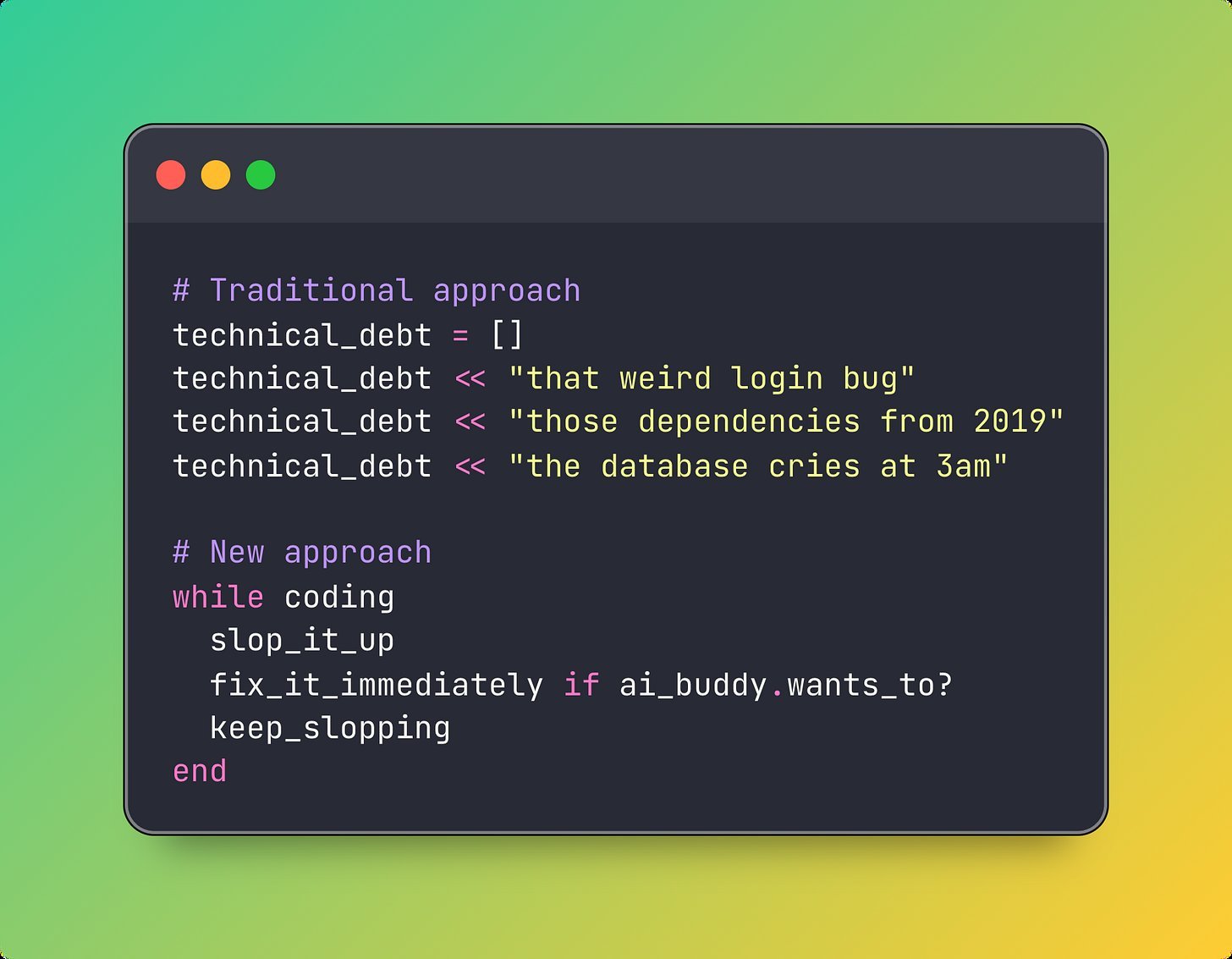
We're not at the endpoint but in a 'messy middle.' Today, AI fixes code as you type; tomorrow, it might preempt errors or write flawless code from scratch. This acceleration reduces barriers for startups and innovators, allowing small teams to iterate at scale without drowning in debt. However, it demands a mindset shift—from debt aversion to debt utilization. As Werner argues, 'When refactoring is free, when AI can untangle any mess, when the cost of change approaches zero... the winners will be those who slop the most.'
In embracing this, developers gain freedom but face new challenges: ensuring AI outputs align with business goals and avoiding over-reliance that stifles human ingenuity. The ZIRP era isn't about recklessness; it's about harnessing infinite leverage to build faster and smarter, turning technical debt from a liability into an engine of innovation.
Source: Adapted from Scott Werner's 'Entering Technical Debt's ZIRP Era' on Works on My Machine.
Comments
Please log in or register to join the discussion