
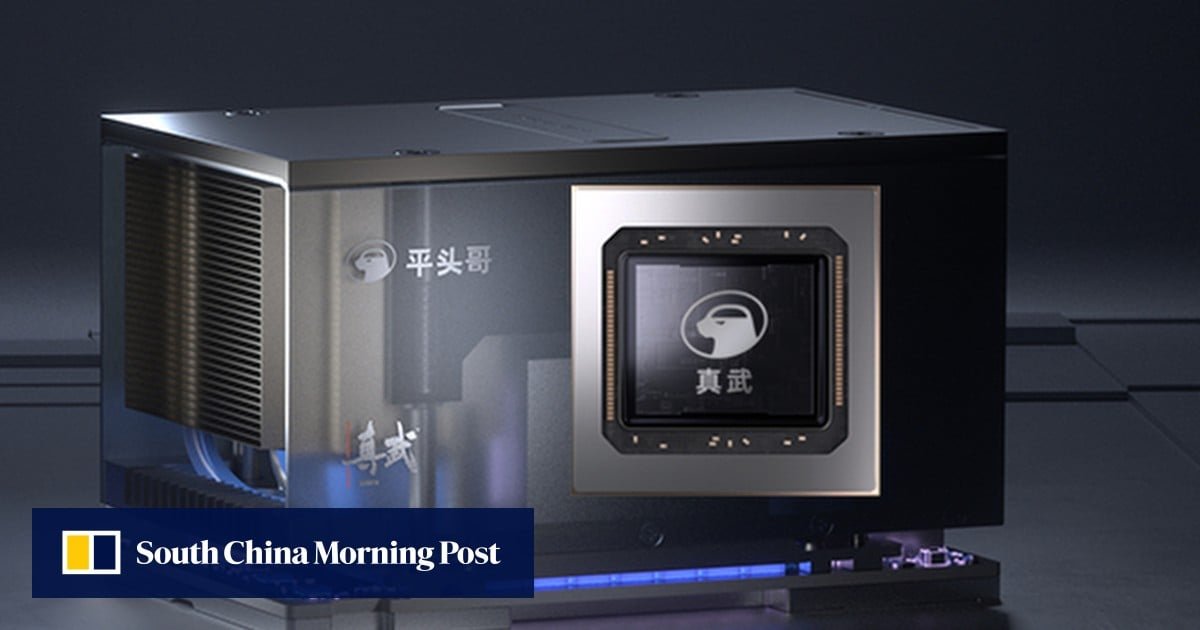
Alibaba has delivered over 100,000 units of its Zhenwu 810E AI ASIC, surpassing domestic rival Cambricon and marking a significant milestone in China's semiconductor self-reliance efforts.
Alibaba has achieved a significant milestone in China's semiconductor industry, delivering more than 100,000 units of its Zhenwu 810E AI ASIC for training and inference applications. This output surpasses that of its domestic rival Cambricon, underscoring Alibaba's growing footprint in AI hardware as Chinese firms accelerate efforts to build home-grown processors amid ongoing technological decoupling from Western suppliers.
The Zhenwu 810E represents Alibaba's strategic push into custom silicon design, targeting the rapidly expanding AI market where demand for specialized chips continues to surge. ASICs (Application-Specific Integrated Circuits) offer performance advantages over general-purpose processors for specific workloads like AI model training and inference, making them increasingly attractive to cloud providers and enterprises deploying large-scale AI systems.
This development comes as China intensifies its semiconductor self-sufficiency drive, seeking to reduce dependence on foreign chip technologies amid export controls and geopolitical tensions. The milestone positions Alibaba as a key player in China's domestic AI chip ecosystem, competing with established firms like Cambricon while potentially challenging international players in the long term.
Industry analysts note that achieving 100,000+ unit deliveries represents significant manufacturing scale and market validation for Alibaba's chip design capabilities. The company's success could accelerate China's broader ambitions to develop a complete domestic semiconductor supply chain, from design through manufacturing to deployment in data centers and edge computing applications.
The timing is particularly relevant as global demand for AI infrastructure continues to expand exponentially, with companies worldwide racing to deploy specialized hardware to support increasingly complex AI workloads. Alibaba's progress suggests China is making tangible advances in closing the technology gap in critical semiconductor capabilities.
Market Context:
- The global AI chip market is projected to grow from $18.6 billion in 2022 to $64.3 billion by 2027, according to industry forecasts
- China's semiconductor imports exceeded $400 billion in 2023, highlighting the strategic importance of domestic chip development
- Alibaba's cloud division, which likely drives much of this chip demand, reported $12.7 billion in revenue for Q3 2025
What This Means: Alibaba's achievement represents more than just a sales milestone—it signals China's maturing capabilities in custom silicon design and manufacturing. As the company scales production of the Zhenwu 810E, it could potentially offer competitive alternatives to NVIDIA and other established AI chip providers, particularly for customers seeking to avoid geopolitical supply chain risks. This development may accelerate the fragmentation of the global semiconductor market into distinct technological spheres, with implications for pricing, performance standards, and innovation trajectories across the AI industry.
Comments
Please log in or register to join the discussion