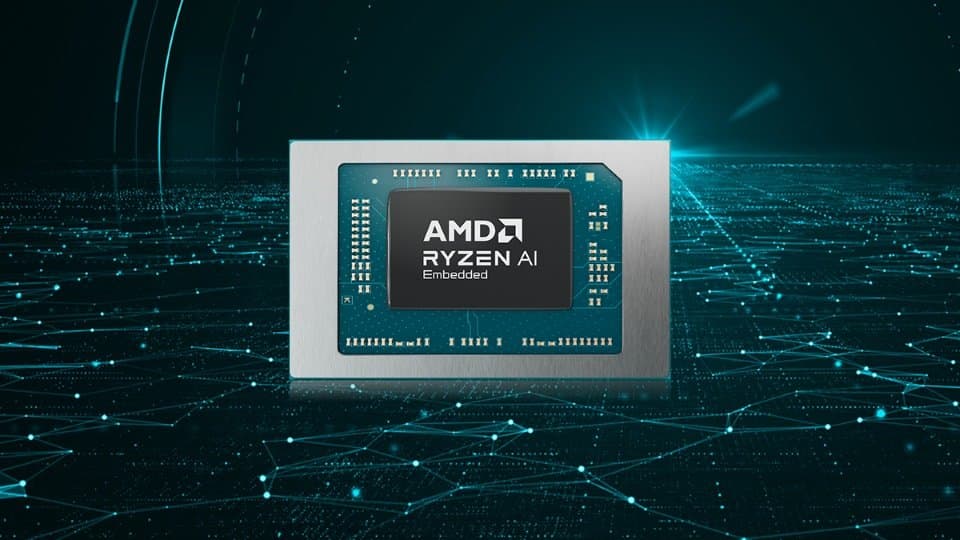
AMD is expanding its Ryzen AI Embedded P100 processor family with new 8, 10, and 12-core variants based on Zen 5 architecture, targeting industrial automation, robotics, and healthcare applications with significantly improved CPU, GPU, and NPU performance.
AMD this morning is expanding its recently launched P100 family of Ryzen AI Embedded Processors with the addition of more powerful 8, 10, and 12 CPU core chips. Joining the existing 4 and 6-core P100 chips that were first introduced back at CES, today's announcement serves to fully flesh out the Ryzen AI Embedded P100 family by delivering the higher-performing chips that were not ready at the time of the initial P100 announcement.
Though, as with the initial P100 chips, the target market for these higher-performing P100 chips remains roughly the same: the automotive and industrial markets, as well as any other device manufacturers who are building a non-PC edge device and want a chip with more long-term support.
Overall, AMD is currently in the process of overhauling its entire Ryzen Embedded lineup with a fresh set of chip SKUs based on various Zen 5 CPU architecture designs. As with AMD's consumer hardware offerings, from which these chips are derived, the switch to AMD's newest architectures should bring significant performance improvements in CPU performance, GPU performance, and NPU performance, as all of those blocks are getting significant architectural upgrades versus the current Zen 4-generation Ryzen Embedded 8000 series.
Ryzen AI Embedded P100: Now Up to 12 Zen 5 CPU Cores & 16 GPU CUs
For the release of the P100 series, AMD is essentially working bottom-to-top, starting with low-end chips (4-6 cores), then releasing mid-range chips (8-12 cores), and in the future will be releasing the high-performance X100 series with up to 16 CPU cores.
Under the hood, the Ryzen AI Embedded P100 chips serve as industrial-qualified versions of AMD's mobile silicon. While the low-end parts are based on Krackan Point, these newly added high-performance P100 parts serve as the introduction of AMD's Strix Point silicon to the industrial market.
AMD Ryzen Embedded Generations
| Series | CPU Arch | GPU Arch | NPU Arch | Silicon |
|---|---|---|---|---|
| Embedded 8000 | Zen 4 (up to 8 cores) | RDNA 2 | XDNA (1) | Phoenix |
| AI Embedded P100 | Zen 5 (up to 12 cores) | RDNA 3.5 | XDNA 2 | Krackan Point / Strix Point |
| AI Embedded X100 | Zen 5 (up to 16 cores) | RDNA 3.5 | XDNA 2 | Strix Halo |
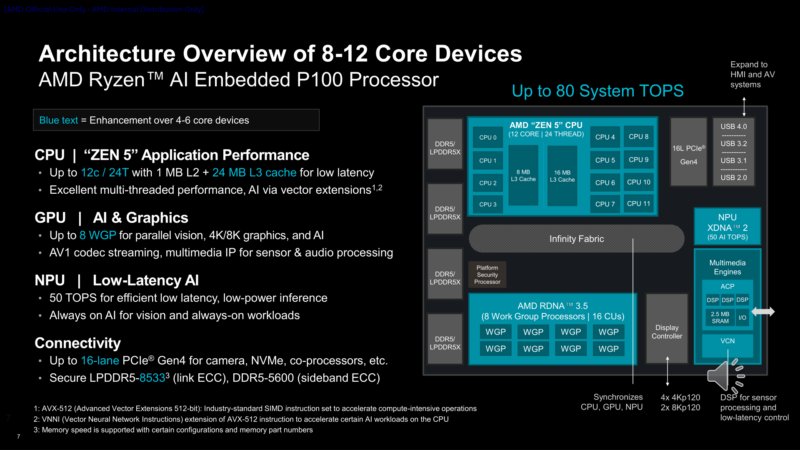
Compared to the first wave of P100 processors, these higher-performing P100 parts serve as more of the same from an architectural standpoint, but with upwards of twice the CPU performance and four times the GPU performance thanks to the much larger number of CPU and GPU cores, respectively.
Ryzen AI Embedded P100 Architecture Overview
These higher-performing P100 chips, in turn, are going to be aimed at a more performance-demanding section of the embedded market that the four and six-core parts are not powerful enough to serve. Industrial automation is a key focus point for AMD, but the company is also making an extended play at the physical AI (robotics) and healthcare markets with these more powerful chips.
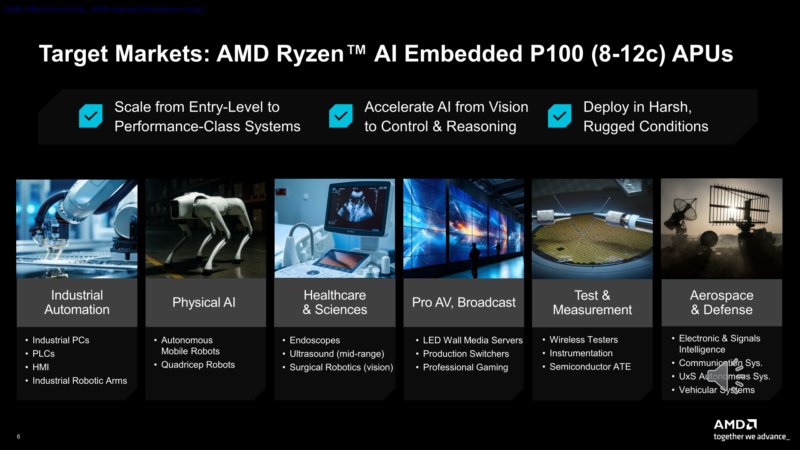
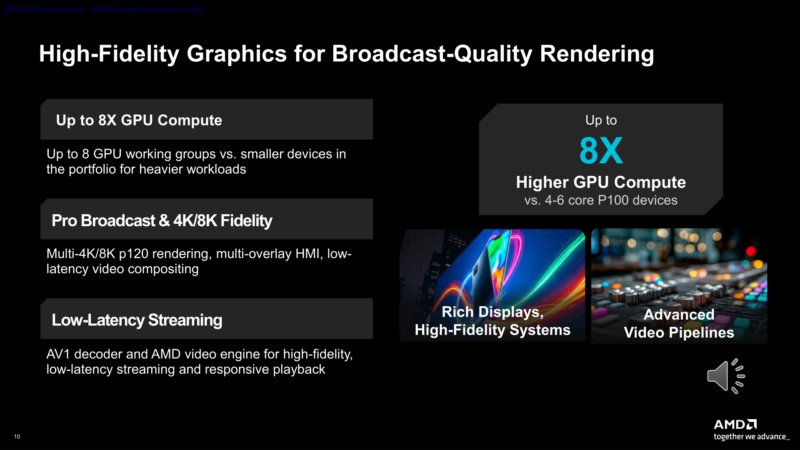
And there is even some overlap into the professional broadcast market, thanks in part to the far more powerful GPU configurations available with the top chip SKUs.
Overall, the updated Ryzen AI Embedded P100 SKU stack looks a lot like AMD's Ryzen AI 300/400 stack – which is fitting, given the underlying hardware. All told, AMD is introducing 6 new chip SKUs: 3 "vanilla" SKUs with 8, 10, and 12 CPU cores, respectively, and industrial versions of those SKUs that are fully qualified to operate at sub-zero temperatures down to -40C.
Do note that AMD does not explicitly distinguish between full-fat Zen 5 and compact Zen 5c cores in its official product literature, but all of these chips will have a mix of both core types – topping out at 4 Zen 5 and 8 Zen 5c cores in the 12-core SKUs.
Aside from the CPU core bump, the new chip SKUs also get a much more powerful GPU. Whereas the low-end P100 chips topped out at 4 graphics CUs, the high-end chips start at 12 CUs, and for the top SKUs, that goes to 16 CUs.
As a result, while AMD is pitching the higher-end P100 SKUs for all customers who need more performance, there is an especially big push for any customers who need more graphics performance, or these days, it seems, more AI performance.
Ryzen AI Embedded P100 Scalability
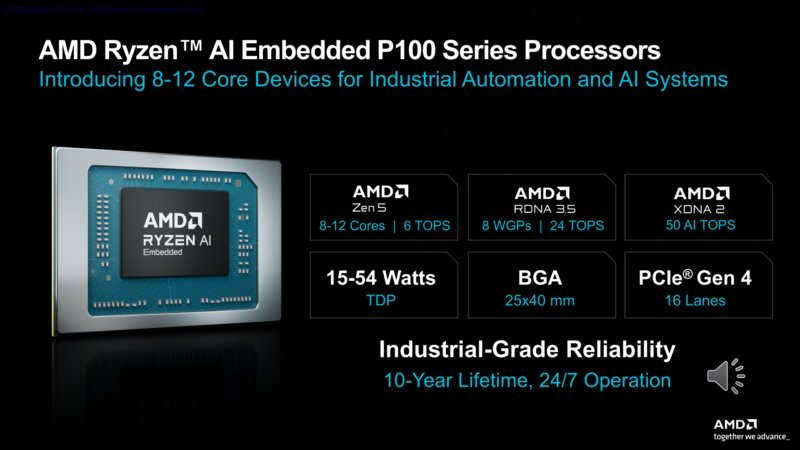
Otherwise, as the P100 chips share a common platform, a lot of the ancillary features remain the same. Vendors can pair the chips with either LPDDR5X-8533 memory or DDR5-5600 memory – the former favoring bandwidth and soldered-down use cases, while the latter favors swappable components and full (sideband) ECC support.
Meanwhile, the nominal TDP on the new SKUs remains at 28 Watts, though the cTDP range is 15 to 54 Watts. System assemblers will generally need higher TDPs to get the most performance out of the higher-end chips.
Every non-automotive SKU gets support for a pair of USB4 ports.
Chips aside, AMD is also briefly showing off the reference board it will release later this year for system developers. The pre-validated P100 boards will ship with DDR5 SO-DIMM slots, a PCIe x4 slot, USB ports, DisplayPorts, and virtually every other input or output a P100 developer could need to get their embedded-class hardware and software projects up and running.
These types of boards help designers test solutions faster and, ultimately, integrate chips faster.
Final Words
Looking at the full launch schedule for the new Ryzen AI Embedded P100 chips, AMD tells us that they are already sampling the new chips to customers now. The documentation and tools for those chips are similarly available. The chips themselves will not go into full production until Q3 of this year, however, one quarter after the low-end chips, while the reference boards will become available in the second half of the year.
Comments
Please log in or register to join the discussion