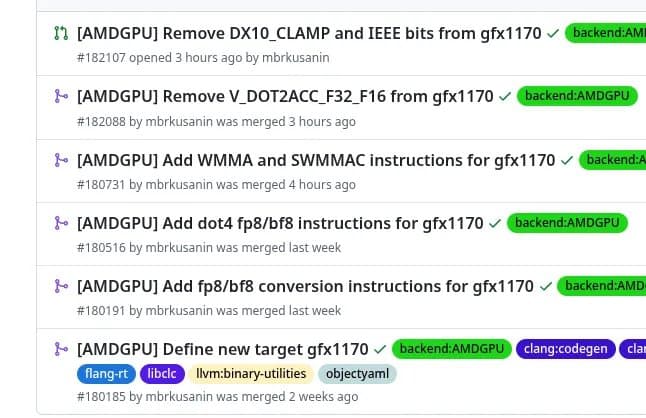
AMD's GFX1170 GPU target in LLVM now shows significant ISA differences aligning it with RDNA4 rather than RDNA3, confirming its position as a mobile-focused RDNA 4m architecture.
AMD's GFX1170 GPU target continues to reveal significant architectural details through ongoing changes in the AMDGPU LLVM back-end, with recent commits showing instruction set differences that firmly position this APU/SoC part as a mobile variant of RDNA4 rather than a continuation of RDNA3.
The GFX1170 target, initially spotted earlier this month, has been marked as "RDNA 4m" while residing in the GFX11 series that typically encompasses RDNA3 GPUs. This apparent contradiction has been clarified through recent instruction set architecture (ISA) changes that demonstrate AMD's strategy of aligning mobile graphics with their desktop counterparts.
Wave Matrix Multiply Accumulate (WMMA) Enhancements
The most significant recent changes involve new WMMA and SWMMAC instructions specifically tailored for GFX1170 hardware. The LLVM code now includes dedicated WMMA128bInsts for both GFX1170 and GFX12 (RDNA4) targets, while maintaining separate WMMA256bInsts for GFX11 (RDNA3) instructions.
This architectural separation is particularly noteworthy because WMMA instructions are crucial for AI/ML workloads and other GPU compute operations. By aligning GFX1170's WMMA capabilities with RDNA4 rather than RDNA3, AMD ensures that mobile APUs will have comparable matrix multiplication performance to their desktop counterparts, albeit potentially with different implementation details suited for power efficiency.
Dot Product Instruction Removal
Another telling change involves the removal of the V_DOT2ACC_F32_F16 instruction from the GFX1170 series. This instruction, which performs dot products of packed FP16 values with accumulation to FP32 destinations, was already dropped in RDNA4 but remained in RDNA3.
The removal of V_DOT2ACC_F32_F16 from GFX1170 represents a clear architectural alignment with RDNA4, suggesting that AMD has consolidated their dot product operations across both desktop and mobile platforms. This consolidation likely simplifies the instruction decoder and reduces power consumption in mobile implementations while maintaining computational capabilities through alternative instructions.
DirectX 10 Clamp and IEEE Mode Changes
Recent merge requests also indicate the removal of DX10_CLAMP and IEEE bits from the GFX1170 series. The amdgpu-ieee mode, which specifies whether functions expect the IEEE field of the mode register to be set, and the amdgpu-dx10-clamp mode, which controls DirectX 10 behavior around NaN values in vector ALU operations, are being dropped.
These changes mirror RDNA4's architecture, where DX10_CLAMP was already removed. The removal of these compatibility modes suggests that GFX1170 targets modern graphics APIs and doesn't need to maintain backward compatibility with DirectX 10-era behavior, further confirming its position as a contemporary architecture rather than an incremental update to RDNA3.
Architectural Implications
The accumulation of these ISA changes paints a clear picture: GFX1170 is not simply a power-optimized variant of RDNA3, but rather a mobile-specific implementation of RDNA4 principles. This architectural alignment makes sense from several perspectives:
Performance Consistency: By aligning mobile and desktop instruction sets, developers can write code that performs consistently across platforms without needing platform-specific optimizations for mobile GPUs.
Development Efficiency: AMD can maintain a single instruction set architecture across product lines, reducing the complexity of their driver and compiler development.
Future-Proofing: As graphics APIs evolve, having a unified instruction set across mobile and desktop platforms ensures that new features and optimizations can be applied universally.
The "RDNA 4m" Designation
The "RDNA 4m" marketing designation now appears to be technically accurate rather than merely promotional. The ISA changes demonstrate that GFX1170 shares more architectural DNA with RDNA4 than with RDNA3, despite its placement in the GFX11 series.
This naming strategy follows a pattern where AMD uses series numbers (GFX11) to denote GPU generation while using marketing names (RDNA 4m) to indicate the actual architectural lineage. This approach allows for flexibility in product positioning while maintaining clear technical distinctions.
Unknown APU/SoC Targets
Despite these architectural revelations, the ultimate APUs and SoCs that will feature this RDNA 4m graphics IP remain unknown. The GFX1170 target in LLVM suggests that AMD is preparing for mobile implementations, but specific product announcements have not yet been made.
Potential candidates for GFX1170 include:
- Ryzen Mobile APUs: Future laptop processors that combine Zen CPU cores with RDNA 4m graphics
- Console APUs: Next-generation gaming consoles that require efficient mobile graphics
- Embedded Systems: Automotive, industrial, or other embedded applications requiring modern graphics capabilities
- Low-Power Desktop APUs: Energy-efficient desktop processors for small form factor systems
The mobile focus suggested by the "m" designation and the architectural optimizations for power efficiency point toward laptop and portable device applications as the primary targets.
Industry Context
AMD's approach with GFX1170 reflects broader industry trends toward architectural unification across product segments. As the performance gap between mobile and desktop GPUs narrows, maintaining consistent instruction sets becomes increasingly important for software development and ecosystem health.
The emphasis on AI/ML capabilities through WMMA instruction enhancements also aligns with the industry's growing focus on heterogeneous computing and AI acceleration across all device categories, from smartphones to supercomputers.
Looking Forward
The ongoing ISA changes in the AMDGPU LLVM back-end provide valuable insights into AMD's future graphics architecture strategy. As more details emerge, developers and enthusiasts can better prepare for the capabilities and requirements of upcoming RDNA 4m products.
The technical alignment between GFX1170 and RDNA4, despite their different series designations, suggests that AMD is prioritizing architectural coherence over strict numbering conventions. This approach may continue in future generations, with mobile variants potentially sharing more architectural features with desktop counterparts than in previous generations.
As the GFX1170 target continues to evolve in the open-source LLVM code, it will likely reveal additional architectural details that further clarify AMD's mobile graphics strategy and the specific capabilities of upcoming RDNA 4m products.
Comments
Please log in or register to join the discussion