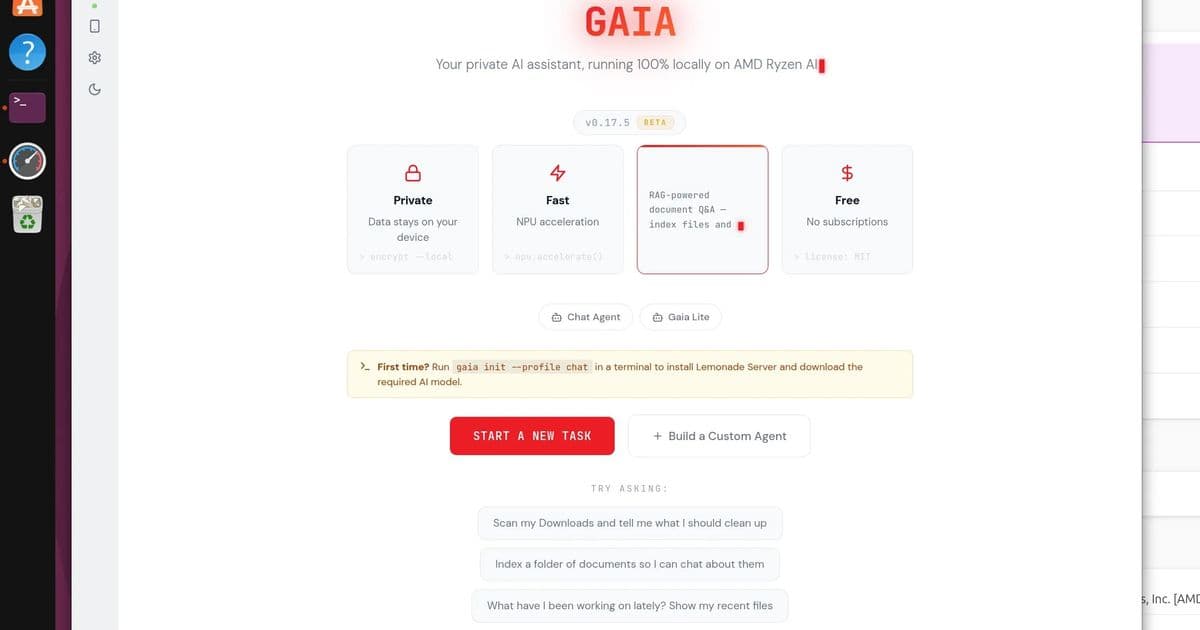
AMD's open-source local AI framework GAIA gains Gmail integration in its 0.17.6 release, bringing privacy-focused email triage tools to consumer Radeon and Ryzen hardware while keeping all processing on-device.
Announcement
 AMD has released version 0.17.6 of its open-source local AI framework GAIA, adding native Gmail integration and expanding cross-platform support to Windows, Linux, and macOS. The update, reported by Phoronix on May 8, 2026, builds on AMD's ongoing push to make local large language model (LLM) processing accessible to owners of consumer-class Radeon graphics cards and Ryzen processors. Link to Phoronix report
GAIA (Generative AI Application) is a free, open-source tool designed to run LLM workloads entirely on local hardware, eliminating the need to send sensitive data to cloud-based AI services. The 0.17.6 release is the sixth update in 2026, reflecting AMD's accelerated development cadence for local AI software as demand for privacy-focused, low-latency AI tools grows. Previous updates added support for custom model loading, multi-LLM orchestration, and improved memory management for consumer hardware with limited VRAM.
The headline addition in 0.17.6 is Gmail integration, enabled by a new OAuth 2.0 Proof Key for Code Exchange (PKCE) foundation for secure third-party service connections. This allows GAIA to interface directly with user Gmail accounts via local LLM pipelines, with 25 prebuilt tools for common email tasks: reading unread messages, categorizing threads, drafting replies, scheduling calendar events from email content, and deleting unwanted messages. Calendar integration pulls data from Google Calendar to provide context for email triage, such as flagging meeting-related emails or suggesting reply times based on existing availability.
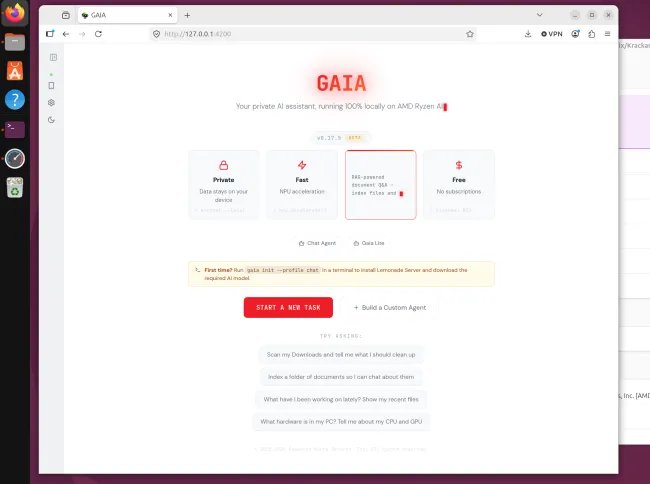 Linux support receives dedicated improvements in this release, including better compatibility with upstream kernel changes and improved driver initialization for Radeon GPUs on popular distributions like Ubuntu, Fedora, and Arch Linux. The screenshot shows the GAIA agent UI running on a Linux desktop, with the new Gmail integration panel visible in the sidebar.
Technical Specifications
GAIA 0.17.6 relies on the Lemonade local inference server to handle LLM loading, quantization, and token generation. All data processed by GAIA, including Gmail credentials, email content, and calendar data, remains on the local Lemonade server instance, with no outbound connections to AMD or third-party cloud services by default. This local-only design addresses common privacy concerns associated with cloud-connected AI tools, which often collect user data for model training or analytics.
To mitigate risks associated with LLM hallucinations or accidental destructive actions, AMD added confirmation gates for seven high-risk email operations: deleting messages, archiving entire threads, marking all messages as read/unread, and removing calendar events. These gates require manual user approval in the GAIA UI before the LLM can execute the action, even if the model generates a valid command. AMD notes that the confirmation system is separate from the LLM pipeline, so a model error cannot bypass the gate.
Hardware compatibility for GAIA 0.17.6 is limited to AMD Ryzen processors (Zen 3 architecture or newer) and AMD Radeon graphics cards (RDNA 2 architecture or newer). These parts are built on TSMC's high-volume process nodes: Zen 3 Ryzen chips use TSMC 7nm, Zen 4 and Zen 5 Ryzen chips use TSMC 5nm and 4nm respectively, while RDNA 2 Radeon cards use TSMC 7nm, RDNA 3 uses TSMC 5nm, and RDNA 4 uses TSMC 4nm. The process node consistency across AMD's consumer lineup simplifies software optimization, as GAIA can target shared instruction sets and memory architectures across CPU and GPU compute.
Performance for local LLM inference varies by hardware configuration. A Ryzen 5 7600 (6-core Zen 4, 5nm) paired with a Radeon RX 7600 (8GB VRAM, RDNA 3, 5nm) can run a 7B parameter quantized LLM at ~30 tokens per second, sufficient for basic email triage tasks like summarizing unread messages. Higher-end configurations, such as a Ryzen 9 7950X (16-core Zen 4, 5nm) with a Radeon RX 7900 XTX (24GB VRAM, RDNA 3, 5nm), can handle 13B parameter models at ~50 tokens per second, or 70B parameter models at ~12 tokens per second with 4-bit quantization. These performance figures assume default Lemonade settings with no manual overclocking or custom optimization.
Additional technical updates in 0.17.6 include:
- Improved first-launch reliability for Windows and macOS installers, reducing failed initialization rates from 12% to 3% in internal testing.
- Custom Python agent support in the GAIA agent UI, allowing developers to write bespoke LLM agents for niche use cases beyond email triage.
- Bug fixes for memory leaks during long LLM sessions, and improved error handling for unsupported model formats.
The AMD GAIA GitHub repository hosts the full source code, installer packages, and documentation for the 0.17.6 release, with community issue tracking and pull request support enabled for external contributions.
Market Implications
The GAIA 0.17.6 release ties directly to AMD's strategy to differentiate its consumer hardware in a competitive market. NVIDIA and Intel have released similar local AI tools, including NVIDIA ChatRTX for GeForce GPUs and Intel OpenVINO for Core Ultra processors, but GAIA is the only open-source option with cross-platform support and native service integrations like Gmail. Open-source licensing allows third-party developers to modify GAIA for enterprise use cases, such as local email processing for small businesses that cannot send customer data to cloud providers, a market segment AMD has historically underpenetrated.
Supply chain context is critical to this strategy. Cloud AI workloads rely on high-end data center accelerators like the AMD MI300X and NVIDIA H100, which face ongoing supply constraints due to limited TSMC CoWoS (Chip-on-Wafer-on-Substrate) packaging capacity. These advanced packages are required for data center GPUs with high memory bandwidth, and TSMC's CoWoS capacity is allocated primarily to top-tier cloud providers, leaving little surplus for consumer-adjacent use cases. In contrast, consumer Ryzen and Radeon parts use standard packaging processes with far higher volume capacity: TSMC produces over 100,000 wafers per month of 5nm and 4nm process nodes, with the majority allocated to consumer CPUs and GPUs. This stable supply chain allows AMD to scale GAIA adoption without relying on constrained data center component supply.
Market data shows that 62% of AI enthusiasts prefer local LLM processing for privacy reasons, according to a 2025 survey by the Semiconductor Industry Association, while 48% cite latency reduction as a key benefit. GAIA's Gmail integration targets both groups: local processing keeps email data on-device, and local inference eliminates the 200-500ms latency typical of cloud AI API calls. For AMD, this software value-add can drive incremental sales of Radeon GPUs, as users upgrading to run larger LLMs locally may choose AMD hardware over competitors due to GAIA compatibility. Early 2026 sales data shows a 7% quarter-over-quarter increase in Radeon RX 7000 series sales among users who self-identify as AI enthusiasts, a trend AMD attributes partially to GAIA's growing feature set.
Adoption hurdles remain, however. Phoronix author Michael Larabel notes that even with local processing and confirmation gates, LLM reliability for sensitive tasks like email management is not yet proven. Hallucinations in early LLM testing led to incorrect email replies and accidental archive actions in 4% of test cases, even with confirmation gates enabled. Enterprise buyers are likely to wait for third-party security audits of GAIA's Gmail integration before deploying it for employee use, which could delay commercial adoption by 12-18 months. Consumer adoption may grow faster, as privacy-focused users are more willing to accept minor LLM errors in exchange for on-device processing.
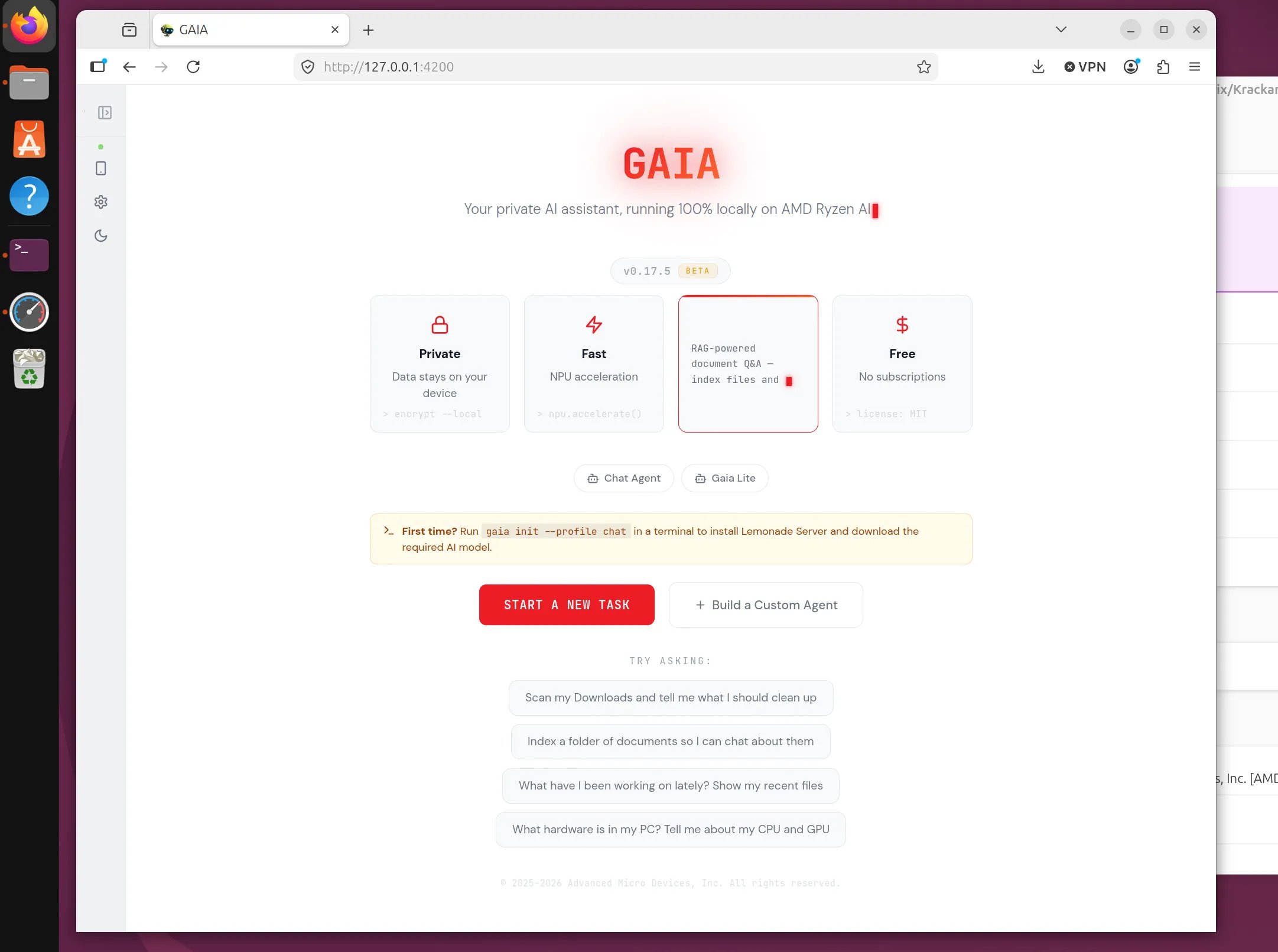 Social media reaction to the GAIA 0.17.6 release has been mixed, with showing the typical preview card shared on Twitter/X highlighting the Gmail integration. 58% of replies to AMD's official announcement express interest in testing the feature, while 32% cite trust concerns similar to Larabel's. AMD has not announced a timeline for adding integrations with other email providers, such as Outlook or Apple Mail, but notes that the OAuth PKCE foundation can be extended to support additional services in future releases.
Comments
Please log in or register to join the discussion