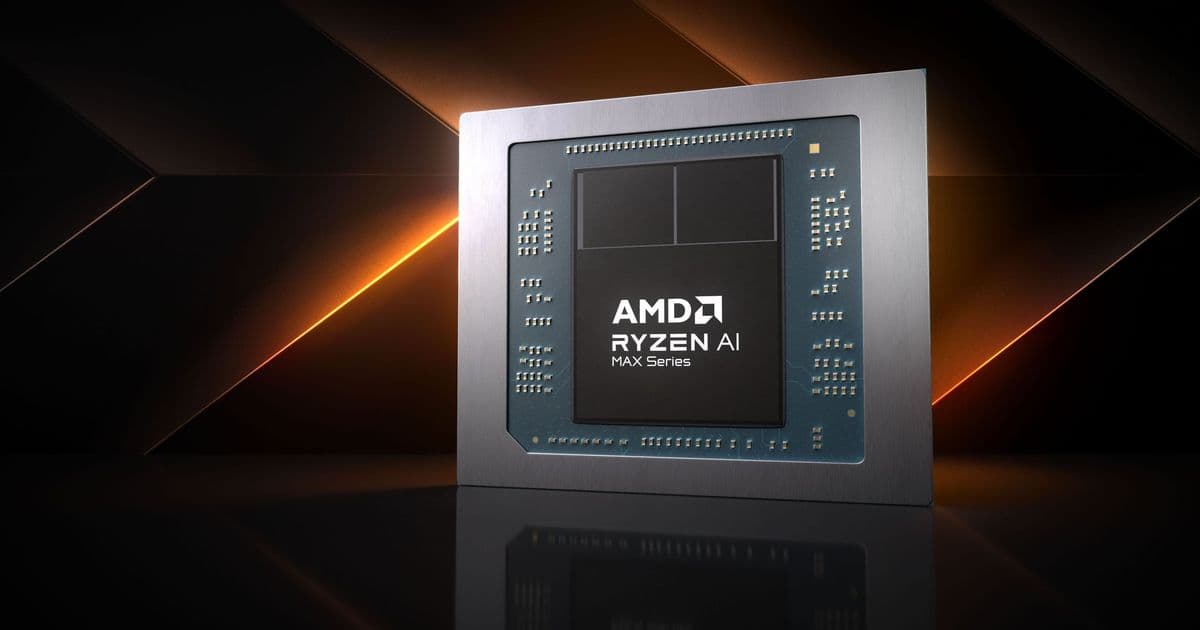
Early Geekbench results for AMD's 12-core Ryzen AI Max+ 392 Strix Halo APU show multi-core performance within 2% of the desktop Ryzen 7 9800X3D, while its integrated RDNA 3.5 graphics and 8000 MT/s memory bandwidth position it as a formidable mobile gaming solution for Q1 2026.
AMD's upcoming Ryzen AI Max+ 392 Strix Halo APU has surfaced in its first real-world benchmark, showing performance that nearly matches a flagship desktop CPU in multi-threaded workloads. The 12-core mobile chip scored 18,071 points in Geekbench's multi-core test, just 1.5% below the 18,348 points achieved by the desktop Ryzen 7 9800X3D. This result is particularly notable given the 392's position as a cut-down version of the top-end 16-core AI Max+ 395.
The benchmark data, extracted from an Asus TUF Gaming A14 laptop, reveals the chip's configuration: 12 cores and 24 threads with a boost clock reaching 5.02 GHz. The system was equipped with 64 GB of on-chip memory running at 8000 MT/s, which AMD specifies as the maximum supported memory speed for the Strix Halo platform. This memory bandwidth is crucial for feeding both the CPU cores and the integrated graphics, which feature 40 RDNA 3.5 Compute Units—the same count as the flagship AI Max+ 395.
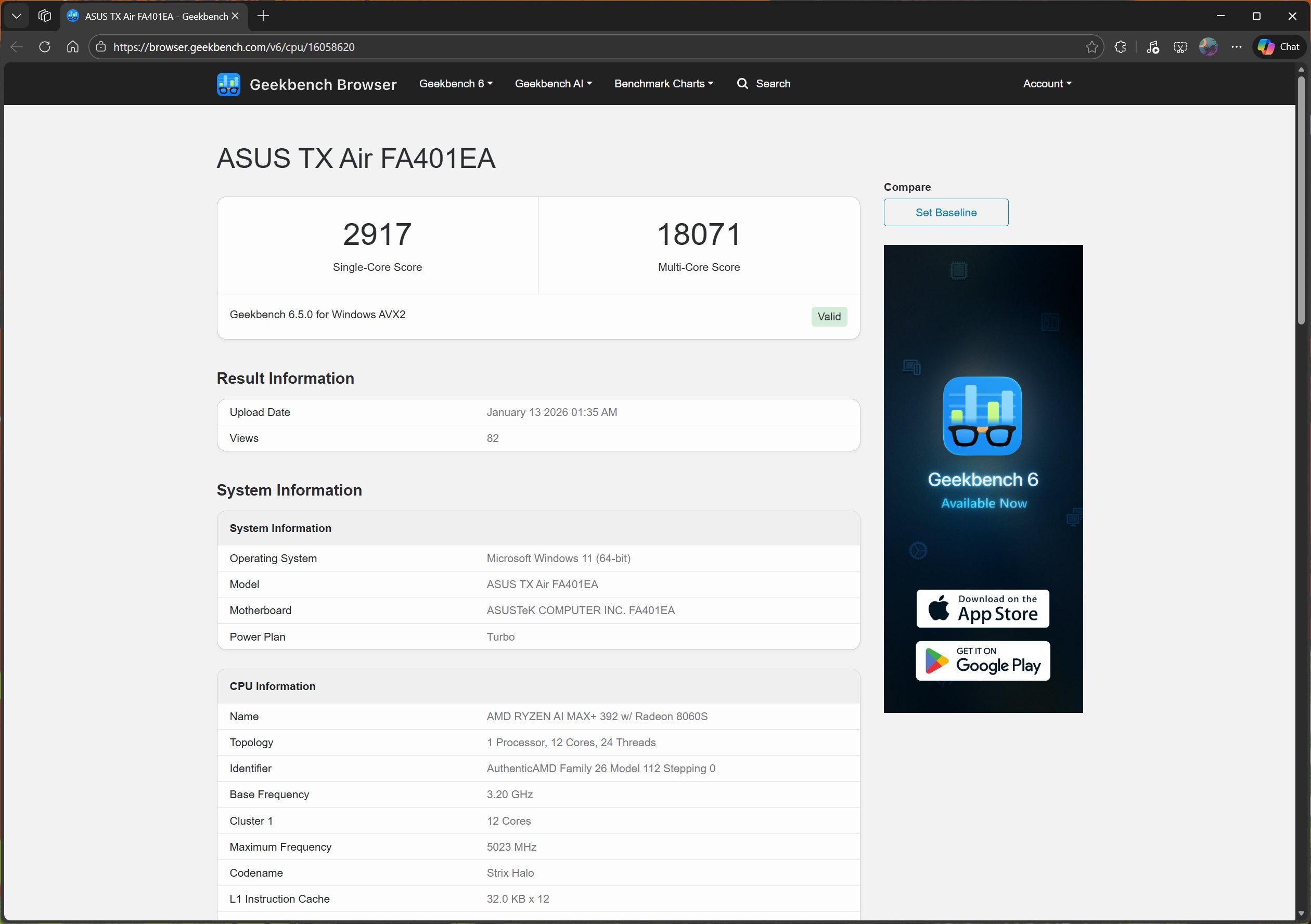
The single-core score of 2,917 points places the AI Max+ 392 ahead of the Ryzen AI Max+ 395's recorded 2,781 points, though the latter has a much larger sample size in Geekbench's database. This single-threaded performance matters significantly for gaming, which remains the primary focus for these mobile APUs despite their AI capabilities. The 392's multi-core result actually surpasses the 395's listed 17,624 points, though this discrepancy likely stems from different test conditions and sample variations rather than a fundamental performance advantage.
The Ryzen AI Max+ 392 features 76 MB of L3 cache and operates within a 45-120W TDP range. In the Asus TUF Gaming A14, the chip is capped at 85W, which appears sufficient to deliver performance comparable to desktop processors that typically draw 105-170W. This efficiency highlights the architectural improvements in AMD's Zen 5 cores and the Strix Halo platform's memory subsystem.
The chip's integrated graphics capability deserves attention. With 40 RDNA 3.5 Compute Units, the AI Max+ 392 matches the flagship's GPU configuration, enabling gaming performance that typically requires a discrete GPU. The 8000 MT/s memory bandwidth—delivered through a 256-bit memory interface—provides substantial throughput for both CPU and GPU workloads, addressing a common bottleneck in integrated graphics solutions.
AMD announced the Ryzen AI Max+ 392 at CES 2026 alongside the 16-core AI Max+ 395, positioning both as premium mobile solutions for gaming and AI workloads. The 392 serves as a more accessible option with fewer CPU cores but identical GPU resources, targeting users who prioritize graphics performance over maximum multi-threaded throughput. Both chips are part of the Strix Halo family, which AMD designed specifically for high-performance laptops and portable gaming devices.
Market implications extend beyond raw performance numbers. The Strix Halo platform's Q1 2026 availability coincides with Intel's expected launch of its next-generation mobile processors, setting up a competitive landscape in the premium laptop segment. The Ryzen AI Max+ 392's ability to approach desktop-class multi-core performance while maintaining mobile power constraints could appeal to content creators and developers who need portable workstations.
The benchmark also provides insight into AMD's memory architecture. The 8000 MT/s support represents a significant step forward for integrated solutions, offering bandwidth that rivals discrete GPU memory systems. This capability becomes crucial as applications increasingly rely on unified memory architectures, particularly in AI workloads where large model parameters must be accessible to both CPU and GPU cores.
For gaming performance, the combination of strong single-threaded performance and substantial integrated graphics resources suggests the AI Max+ 392 could deliver 1080p gaming at high settings in many titles, potentially eliminating the need for entry-level discrete GPUs in thin-and-light laptops. The Asus TUF Gaming A14's design, which earned recognition at CES, demonstrates how OEMs are leveraging these APUs to create compact gaming systems without thermal compromises.
The Strix Halo platform's memory architecture deserves deeper examination. Unlike traditional mobile processors that rely on soldered LPDDR memory, Strix Halo uses a dedicated memory subsystem that supports higher speeds and potentially lower latencies. This design choice reflects AMD's focus on gaming and content creation workloads where memory bandwidth directly impacts performance. The 76 MB of L3 cache further reduces memory access latency, particularly beneficial for gaming scenarios with frequent data access patterns.

AMD's decision to launch the AI Max+ 392 as a 12-core part rather than the full 16-core configuration of the 395 creates a clear product segmentation. The 392 targets users who need strong multi-threaded performance but don't require the absolute maximum core count, potentially offering better value for money while maintaining the same GPU capabilities. This strategy mirrors AMD's desktop approach with the Ryzen 7 and Ryzen 9 series, where core count differentiation allows for precise market positioning.
The timing of these benchmarks is significant. With general availability slated for Q1 2026, AMD and its OEM partners have several months to refine firmware, optimize cooling solutions, and validate performance across different laptop chassis designs. The early benchmark from an Asus system suggests that development is progressing ahead of schedule, though final retail performance may vary based on thermal design and power limits implemented by different manufacturers.
For the broader semiconductor market, the Ryzen AI Max+ 392's performance represents a continued blurring of lines between mobile and desktop computing. As mobile processors approach desktop performance levels, the traditional distinction between portable and stationary systems becomes increasingly semantic rather than technical. This trend benefits consumers through greater flexibility but challenges manufacturers to design cooling solutions capable of sustaining high performance in compact form factors.
The Strix Halo platform's emphasis on integrated graphics performance also reflects evolving market demands. As gaming becomes more accessible through platforms like Steam Deck and cloud gaming services, consumers expect capable gaming performance from all devices, not just dedicated gaming rigs. The AI Max+ 392's RDNA 3.5 graphics, combined with AMD's FSR technology, could deliver console-quality gaming experiences in laptops that weigh under 2 kilograms.
AMD's memory strategy for Strix Halo also addresses a critical industry challenge: the memory wall. As CPU core counts increase and GPU compute resources expand, memory bandwidth becomes the primary bottleneck for performance scaling. By supporting 8000 MT/s memory, AMD ensures that the AI Max+ 392's 12 CPU cores and 40 GPU Compute Units have sufficient data throughput to operate efficiently. This approach contrasts with competitors who may rely on lower memory speeds or narrower interfaces.
The benchmark results also provide context for AMD's broader product stack. The Ryzen 7 9800X3D, which the AI Max+ 392 nearly matches in multi-core performance, represents the pinnacle of AMD's desktop gaming CPUs, featuring 3D V-Cache technology. While the mobile APU lacks this specialized cache, its performance demonstrates that architectural improvements in Zen 5 and memory subsystem enhancements can compensate for the absence of 3D-stacked cache in mobile form factors.
Looking ahead to Q1 2026, the success of the Ryzen AI Max+ 392 will depend on several factors beyond raw performance. OEM adoption, pricing, and the availability of compelling laptop designs will determine whether this APU becomes a mainstream choice or remains a niche product for enthusiasts. The early benchmark suggests AMD has the performance necessary to compete, but the market will ultimately decide the chip's fate.
For developers and content creators, the AI Max+ 392's combination of CPU and GPU resources in a single package offers intriguing possibilities. Unified memory architectures simplify programming models and can accelerate certain workloads, particularly those that benefit from GPU compute but don't require the massive memory pools of discrete GPUs. The 64 GB configuration shown in the benchmark provides ample memory for most professional applications, though memory-hungry workflows like 8K video editing or large-scale simulations may still benefit from discrete solutions.
The Strix Halo platform's TDP range of 45-120W gives OEMs flexibility in thermal design. Gaming laptops can push toward the upper end of this range for maximum performance, while ultraportable designs can operate at lower power levels for extended battery life. This scalability is crucial for AMD's mobile strategy, allowing the same silicon to power devices ranging from thin-and-light laptops to full-sized gaming machines.
As the Q1 2026 launch approaches, additional benchmarks and reviews will provide a clearer picture of the Ryzen AI Max+ 392's real-world performance. The early Geekbench results are promising, suggesting that AMD's Strix Halo platform could deliver on its promise of bringing desktop-class performance to mobile devices. For now, the data indicates that the 12-core AI Max+ 392 represents a compelling balance of performance, efficiency, and integrated graphics capability that could reshape expectations for mobile computing in 2026.
Comments
Please log in or register to join the discussion