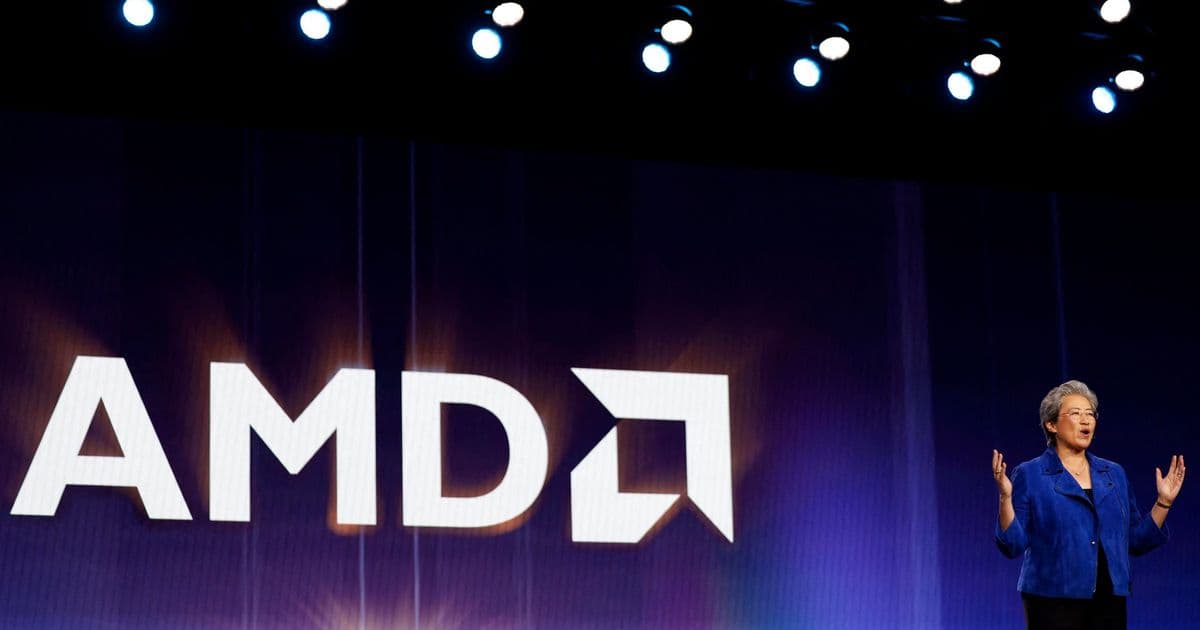
AMD CEO Lisa Su acknowledges PC market contraction in 2026 but remains confident in growth through enterprise focus and premium offerings, while the company reports strong Q4 2025 results with data center leading revenue growth.
AMD is recalibrating its PC strategy in response to market pressures, with CEO Dr. Lisa Su signaling a deliberate pivot toward enterprise customers and premium-tier products as memory pricing continues to squeeze the broader client segment.
Memory Crunch Reshapes AMD's PC Approach
Speaking during AMD's Q4 2025 earnings call, Su addressed the ongoing memory pricing crisis that has seen DRAM and SSD costs remain stubbornly high. "Our focus areas are enterprise," Su stated, "and just continuing to grow at the premium, you know, higher-end of the market."
The memory pricing situation has created significant headwinds for PC builders. In our tracking of RAM pricing, many kits have quadrupled in price compared to their lowest-ever levels, with most tripling since September 2025. Despite some stabilization, prices show no signs of returning to pre-crisis levels.
This pricing pressure has led AMD to expect an overall contraction in the PC market for 2026. "I think the PC market is an important market," Su noted. "Based on everything we're seeing today, we're probably seeing the PC [Total Addressable Market] down a bit."
However, AMD maintains confidence in its ability to grow its PC business even in a declining market. "Even in that environment, with the PC market down, we believe we can grow our PC business," Su said, emphasizing the company's strategy to capture market share through premium offerings rather than competing in the value segment.
Enterprise Becomes AMD's Largest Business Segment
AMD's strategic shift toward enterprise solutions appears well-timed, as the data center segment has now overtaken all others to become the company's largest business unit. For Q4 2025, AMD reported $5.4 billion in data center revenue, representing 39% year-over-year growth.
Full-year data center revenue reached $16.6 billion, up 32% year-over-year. While impressive, these figures still trail significantly behind Nvidia's data center business, which posted $51.2 billion in its most recent earnings, showing 66% growth year-over-year.
Gaming Segment Shows Signs of Recovery
The gaming segment, which encompasses AMD's semi-custom business for consoles like PlayStation 5 and handheld devices such as the Steam Deck, along with Radeon GPUs, posted $843 million in Q4 revenue—a 50% increase year-over-year. This marks a notable recovery from the segment's sharp decline in 2024, when revenue fell below $1 billion for the first time in years.
AMD attributes this growth to increased semi-custom revenue, likely driven by the proliferation of handheld gaming devices, and stronger demand for Radeon GPUs. The latter point is particularly noteworthy given that recent AMD GPUs like the RX 9070 XT haven't experienced the same severe price increases and availability issues that have plagued Nvidia's offerings.
Financial Performance Remains Strong
Overall, AMD delivered robust financial results for Q4 2025, with total revenue of $10.3 billion, up 34% year-over-year. Full-year revenue reached $34.6 billion.
The company reported a gross margin of 54% for the quarter and net income of $1.5 billion. For the full year, AMD's gross margin was 52% on a non-GAAP basis with net income of $6.8 billion.
Embedded Segment Lags Behind
AMD's embedded segment continues to be its smallest business unit, reporting $950 million in Q4 revenue, up 3% year-over-year. However, the full-year picture is less positive, with embedded revenue down 3% to $3.5 billion.
Looking Ahead: Next-Gen Xbox and Market Positioning
During the earnings call, Su also hinted at a next-generation Xbox launching in 2027, suggesting continued strength in AMD's semi-custom business. This aligns with the company's broader strategy of focusing on high-value segments where it can maintain pricing power and margins.
AMD's approach reflects a pragmatic response to current market conditions. Rather than attempting to compete across all PC market segments amid component shortages and pricing pressures, the company is concentrating resources on areas where it can deliver the most value and maintain profitability.
This strategy mirrors broader industry trends, where memory pricing and component availability are forcing companies to make strategic choices about which market segments to prioritize. For AMD, the focus on enterprise and premium client segments positions the company to weather the current market contraction while building toward future growth opportunities.
The coming year will test whether this focused approach can deliver the growth AMD projects, particularly as the company navigates a PC market that Su herself acknowledges is likely to shrink. With enterprise now leading its business segments and gaming showing signs of recovery, AMD appears well-positioned to execute its premium-focused strategy, even as it contends with ongoing memory pricing challenges that continue to reshape the PC landscape.
Comments
Please log in or register to join the discussion