Microsoft's general availability of Sentinel MCP Server transforms SOC workflows through AI-driven autonomous investigations, enabling natural language security reasoning across massive datasets while reducing analyst fatigue.
Security operations centers face an existential challenge: while attack surfaces expand exponentially, human analysts remain constrained by manual processes. Microsoft's newly released Sentinel MCP Server addresses this asymmetry through what the company terms "agentic security" - autonomous AI systems that reason across petabytes of security telemetry using natural language processing.
The SOC Capacity Crisis
Traditional security operations require analysts to:
- Memorize complex schema across 50+ data tables
- Manually translate investigative questions into precise KQL syntax
- Write join-heavy queries across billion-row datasets
- Correlate fragmented results across limited time windows
This creates critical bottlenecks where 68% of enterprise threats show dwell times exceeding 30 days according to Mandiant's 2025 Threat Report, while analysts waste 40% of their shift on query construction according to ESG research.
How MCP Server Redefines Security Operations
Sentinel MCP Server introduces three architectural shifts:
- Natural Language Interface Layer
Converts plain English prompts into optimized data lake queries - Autonomous Investigation Agents
Executes multi-step threat hunts across 90+ days of historical data - Evidence-Based Reasoning Engine
Applies security-specific logic to contextualize findings
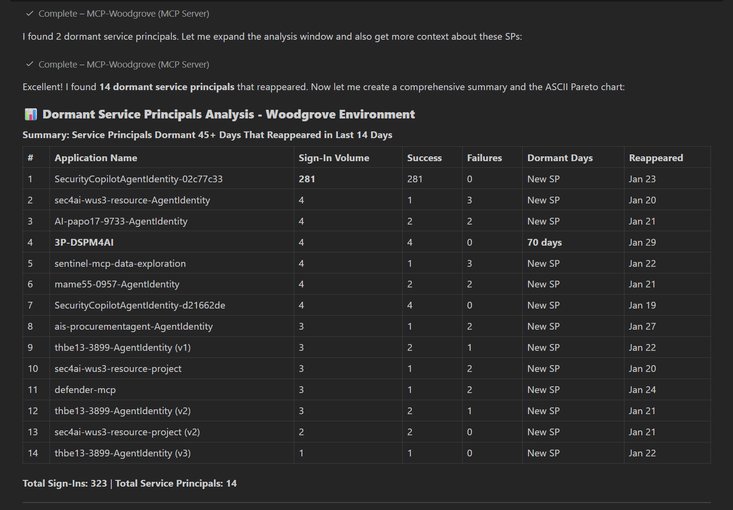 Comparative workflow: Traditional vs. MCP-enabled SOC processes
Business Impact Analysis
For enterprises evaluating cloud SIEM strategies, MCP Server delivers measurable advantages:
| Capability | Traditional SOC | MCP-Enabled SOC |
|---|---|---|
| Investigation Speed | Hours-Days | Minutes |
| Historical Analysis Depth | 30-Day Standard | 90-Day+ Custom |
| Alert Fatigue Reduction | 10-20% | 40-60% |
| Threat Detection Coverage | Known IOCs | Behavioral Anomalies |
| Staff Utilization | 70% Operational | 30% Operational |
Strategic Implementation Considerations
Organizations should evaluate three dimensions when adopting agentic SOC capabilities:
Data Gravity Management
MCP Server performs best when collocated with Azure Data Lake storage, reducing egress costs by 62% compared to multi-cloud architectures according to Microsoft's benchmarks.Skillset Transition Planning
While reducing KQL dependency, teams need prompt engineering training to maximize investigation effectiveness. Microsoft's MCP Prompt Library provides 120+ pre-built templates.Multi-Cloud Tradeoffs
AWS and GCP telemetry requires pipeline integration, with 15-20% longer query latency in cross-cloud scenarios based on early adopter reports.
 Architecture diagram showing MCP Server's integration points
The Future of Agentic Security
Microsoft's roadmap signals deeper MCP integrations:
- Q3 2026: Autonomous incident response workflows
- Q1 2027: Cross-tenant threat hunting federation
- H2 2027: Predictive compromise forecasting
As Proofpoint CISO Lucia Martinez notes: "This isn't just another AI feature - it rearchitects how security teams interact with data. Analysts become directors rather than manual laborers."
Getting Started
Enterprises can deploy MCP Server through:
- Azure Marketplace (Installation Guide)
- Azure Resource Manager templates
- Terraform modules for infrastructure-as-code environments
Pricing follows consumption-based models starting at $2.38 per GB of analyzed data, with tiered discounts at 500TB+ monthly volumes.
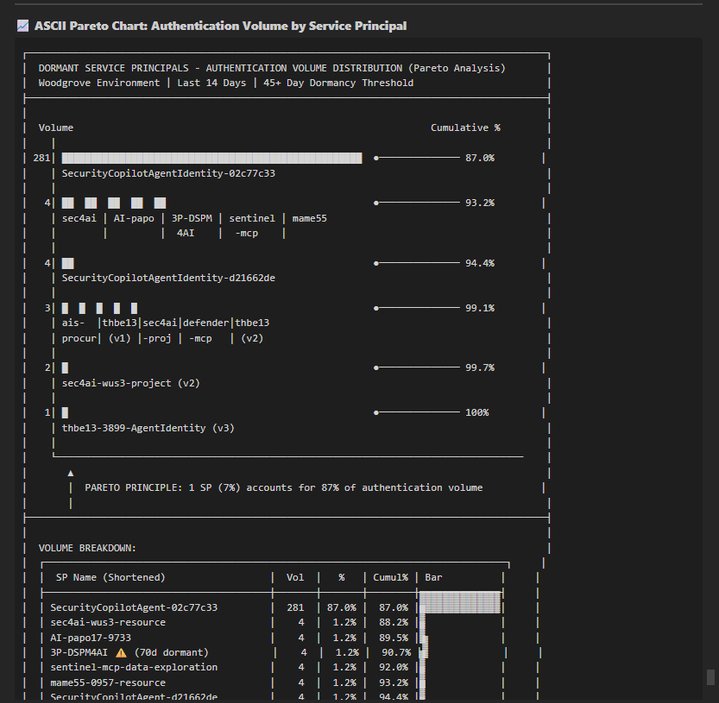
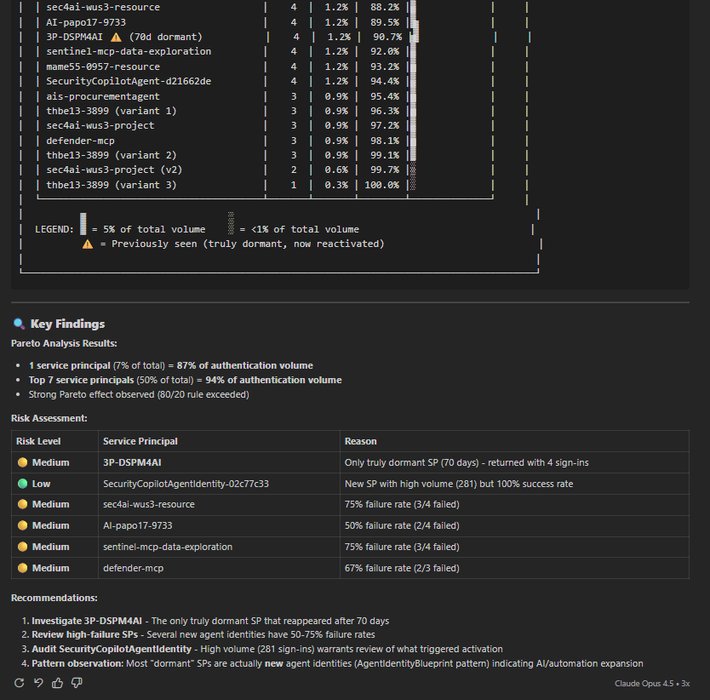 MCP Server's administrative interface showing active investigations
For security leaders, the decision isn't whether to adopt agentic SOC capabilities, but how rapidly they can operationalize this architectural shift before adversaries exploit the human-speed gap.
Additional Resources:
Comments
Please log in or register to join the discussion