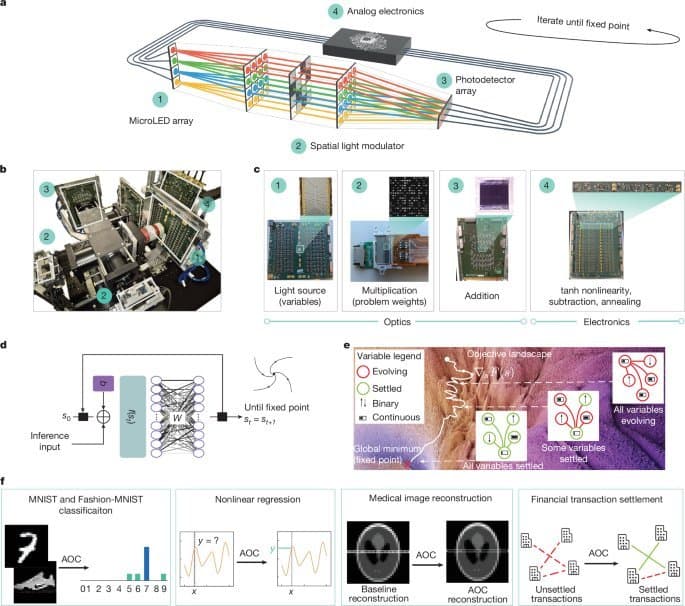
Researchers have developed an analog optical computer (AOC) that simultaneously accelerates AI inference and combinatorial optimization with unprecedented energy efficiency. By combining 3D optics and analog electronics in a noise-robust fixed-point architecture, the system achieves 100x greater efficiency than GPUs while eliminating energy-intensive digital conversions.
The Looming Energy Crisis in Computing
As artificial intelligence and large-scale optimization problems consume ever-growing computational resources, the sustainability of digital computing faces fundamental challenges. Traditional hardware struggles with:
- Memory bottlenecks in neural networks
- Inefficient mappings for real-world optimization
- Energy-intensive conversions between analog and digital domains
"Existing unconventional computing systems target either AI or optimization workloads, but none efficiently accelerate both on the same analog hardware," note the researchers in their Nature paper.
Introducing the Analog Optical Computer (AOC)
The breakthrough AOC architecture merges optical matrix multiplication with analog electronic processing in a closed feedback loop:
s_{t+1} = α(t)s_t + βW f(s_t) + γ(s_t - s_{t-1}) + b
Fixed-point update equation unifying AI inference and optimization
Key hardware innovations:
- 3D optical matrix multiplication: MicroLED arrays (inputs) interact with spatial light modulators (weights) via spherical/cylindrical optics
- Analog electronic processing: Performs nonlinear operations (tanh), subtraction, and annealing without digital conversions
- Noise-robust design: Fixed-point abstraction counters analog noise through iterative attraction
Dual Workload Acceleration
AI Inference Revolution
The AOC natively executes emerging equilibrium models (like deep-equilibrium networks) that enable:
- Dynamic computation depth: Adapts inference time to problem complexity
- Enhanced generalization: Outperforms feedforward networks on out-of-distribution data
- Recursive reasoning: Critical for next-gen AI applications
Proven results:
- 99.8% match to digital twin in MNIST/Fashion-MNIST classification
- Accurate nonlinear regression (MSE 0.0037 for Gaussian curves)
Combinatorial Optimization Breakthrough
The AOC solves Quadratic Unconstrained Mixed Optimization (QUMO) problems:
- Handles continuous + binary variables: Critical for real-world constraints
- 100% success rate on financial transaction settlement (41 variables)
- Medical imaging: Reconstructs MRI scans with 37.5% fewer measurements
"Compared to quantum solvers' 40-60% success rates on financial problems, the AOC achieves 100%," highlight the authors.
Performance and Sustainability Impact
| Metric | AOC | State-of-the-Art GPU |
|---|---|---|
| Energy Efficiency | 500 TOPS/W | 4.5 TOPS/W |
| Precision | 8-bit | 8-bit |
| Latency per Iteration | 20 ns | Microseconds |
Scalability pathway:
- Modular 3D optical design supports up to 2 billion weights
- Consumer-grade components (microLEDs, SLMs) enable manufacturing feasibility
- Projected 400 peta-OPS at 800W for 100M-weight models
The Road to Sustainable Computing
The AOC's co-design of hardware and algorithms marks a paradigm shift. By eliminating von Neumann bottlenecks and digital-analog conversions, it delivers specialized acceleration where digital systems hit fundamental limits. As iterative AI models and complex optimization permeate industries from healthcare to finance, this optical approach could redefine computational efficiency in the sustainable computing era.
Source: Kalinin, K.P. et al. Analog optical computer for AI inference and combinatorial optimization. Nature (2025). https://doi.org/10.1038/s41586-025-09430-z
Comments
Please log in or register to join the discussion