Asus enters the portable Wi-Fi 7 market with the RT-BE58 Go, offering versatile connectivity options and solid performance in a travel-friendly design that competes closely with TP-Link's offering.
Asus has expanded its Wi-Fi 7 portfolio with the RT-BE58 Go, a dual-band travel router that brings next-generation wireless capabilities to users who need reliable connectivity on the go. Priced at $129.99, this compact device enters a competitive market segment where portability and versatility are paramount.
Design and Build Quality
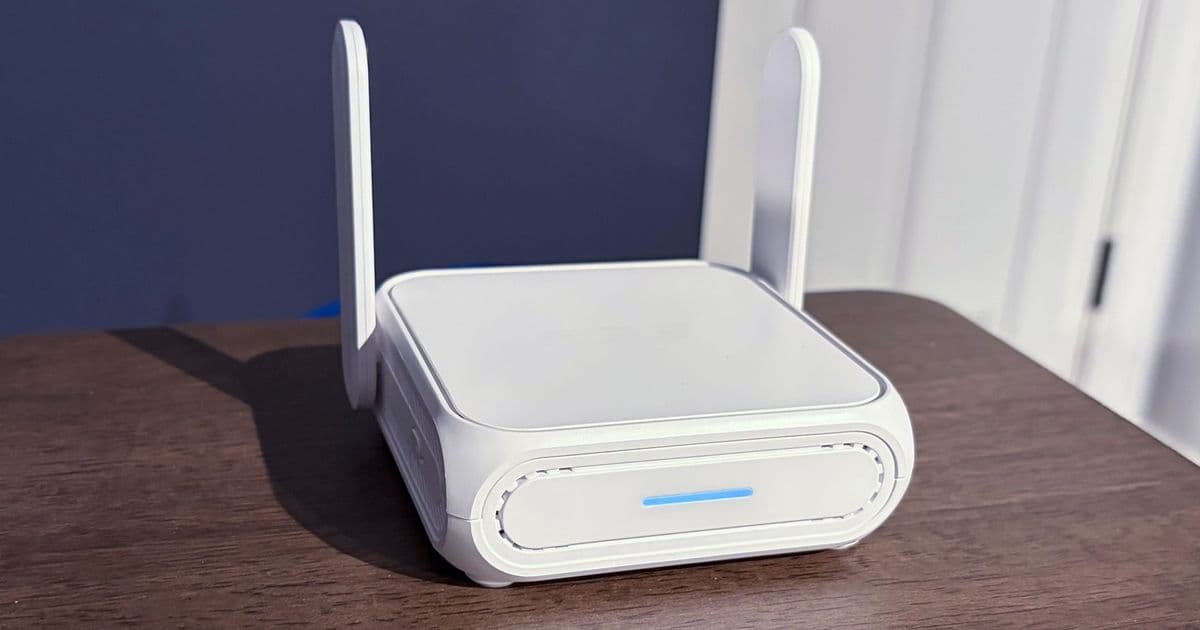
The RT-BE58 Go shares an almost identical form factor with its closest competitor, the TP-Link TL-WR3602BE. Both routers feature a distinctive cube-cut-in-half design with a square base and two retractable antennas that can be positioned upright or stowed alongside the body. The Asus model comes in a sleek black finish, while the TP-Link version opts for white.
On the front, a single horizontal status LED provides visual feedback about the router's operation. The right side houses a programmable toggle switch that, by default, doesn't control any functions but can be customized through the Asus Router app to switch between operating modes. The rear panel accommodates a 2.5 GbE WAN port, a Gigabit LAN port, and a USB 3.0 port that supports networked storage or USB cellular modem connectivity. Power is delivered through a USB-C port with Power Delivery support, allowing the router to be powered by either the included wall adapter or a portable battery pack.
Setup and Configuration
Asus has streamlined the setup process through its smartphone app, though navigation could be more intuitive. Users begin by scanning a QR code on the router's base, which automatically connects the setup device to the router's default SSID. From there, you can establish a new username and password, rename the SSID, and access the full configuration interface.
The router supports four distinct operating modes:
- Public Wi-Fi Mode: Connect to hotel or public hotspots and create a private, secure network
- Ethernet Cable Mode: Traditional connection to cable modems or fiber services
- USB Tethering Mode: Share smartphone internet connections via the USB-A port
- USB Modem Mode: Connect to USB cellular modems for dedicated mobile broadband
Software Features
The Asus Router app provides comprehensive control over the device's functionality. The main dashboard displays real-time network status, connected devices, and traffic statistics. The interface is organized into several key sections:
Home: Shows router status, primary SSID, and LAN IP address with quick access to QoS settings
Devices: Lists all connected wired and wireless clients, with historical connection data
Insight: Provides network health information, threat assessments, and registration options
Family: Enables parental controls on a per-device basis
Settings: Access to advanced configuration options including USB port management, AI Protection security suite, firmware updates, and Google Assistant integration
Performance Testing
Our testing methodology employed a dedicated client rig featuring an MSI Pro B650M-A Wi-Fi motherboard, AMD Ryzen 5 7600 processor, 32GB DDR5 memory, and an MSI Herald-BE Wi-Fi 7 adapter running Windows 11 Home. The server machine utilized a 10 GbE network card connected to the router's 2.5 GbE LAN port.
5 GHz Band Performance
At close range (6 feet), the RT-BE58 Go delivered impressive results with 865 Mbps throughput, outperforming the TP-Link TL-WR3602BE's 753 Mbps. At longer range (25 feet), the Asus router maintained 391 Mbps compared to 300 Mbps for the TP-Link. Network congestion tests showed 10-15% performance degradation for the RT-BE58 Go, but it still consistently outperformed its competitor.
2.4 GHz Band Performance
The results were more competitive on the 2.4 GHz band. At short range, the TP-Link slightly edged ahead with 97 Mbps versus 88 Mbps for the Asus. At long range, the RT-BE58 Go achieved 37 Mbps compared to 36 Mbps for the TP-Link. Under congested conditions, the performance gap narrowed to just 1-3 Mbps between the two devices.
Mobile Hotspot Performance
Testing the router in USB tethering mode using an iPhone Air as a hotspot yielded 140 Mbps download and 40.25 Mbps upload speeds. For comparison, the iPhone Air achieved 924 Mbps download and 198 Mbps upload when connected directly, demonstrating the overhead introduced by the router's processing.
Competitive Analysis
The RT-BE58 Go directly competes with the TP-Link TL-WR3602BE, which offers nearly identical specifications and form factor at a lower street price of $99 versus $119 for the Asus model. Both routers support Wi-Fi 7 with 2x2 MIMO configuration, delivering theoretical maximum speeds of 688 Mbps on 2.4 GHz and 2882 Mbps on 5 GHz.
The key differentiators come down to brand preference, software ecosystem, and current pricing. Asus offers a more mature router app with broader feature integration across its product line, while TP-Link provides better value at the current street prices.
Verdict
The Asus RT-BE58 Go represents a solid entry into the portable Wi-Fi 7 market, offering versatile connectivity options, solid performance, and a well-designed smartphone app. Its ability to accept multiple WAN inputs, support USB tethering, and operate from portable battery power makes it an excellent choice for travelers, remote workers, and anyone needing to share internet connections across multiple devices.
However, the $20 price premium over the TP-Link alternative makes the purchasing decision more challenging. Unless you're heavily invested in the Asus ecosystem or can find the RT-BE58 Go at a competitive price point, the TP-Link TL-WR3602BE remains the better value proposition.
For users prioritizing performance over price, particularly on the 5 GHz band, the RT-BE58 Go delivers measurable advantages. The router's compact size, multiple power options, and comprehensive feature set make it a capable travel companion, even if the price doesn't quite match its performance advantages.
Pros:
- Strong 5 GHz performance outperforms competitors
- Multiple WAN options including USB tethering
- Versatile smartphone app with comprehensive features
- Compact, portable design with USB-C power delivery
- Solid build quality and professional aesthetics
Cons:
- Only one LAN port limits wired device connectivity
- $20 premium over functionally equivalent competitor
- Smartphone app navigation could be more intuitive
- 2.4 GHz performance trails TP-Link in some scenarios
The Asus RT-BE58 Go is available now through major retailers and Asus's official channels, positioning itself as a premium option in the growing travel router market.
Comments
Please log in or register to join the discussion