
Microsoft's new Azure-powered transcription pipeline combines real-time speech conversion with clinical entity recognition, enabling healthcare organizations to accelerate research while ensuring HIPAA compliance.

Healthcare organizations face persistent bottlenecks in processing qualitative research and clinical documentation. Traditional transcription services often involve manual uploads, multi-day delays, and limited integration with analytics platforms - creating costly inefficiencies for research-heavy environments. Azure's new cloud-native solution addresses these gaps through an integrated AI pipeline that transforms unstructured audio and text into actionable clinical intelligence.
Core Components of Azure's Healthcare AI Stack
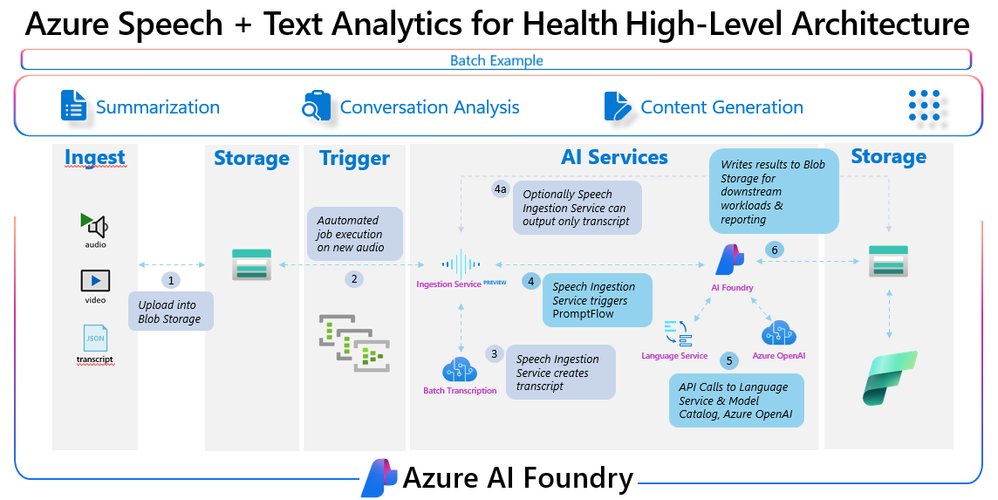
The solution combines three key Azure services:
- Speech Service: Offers real-time transcription for telehealth sessions, batch processing for research studies, and optimized fast transcription for urgent documentation
- Text Analytics for Health: Transforms raw text into structured FHIR data through:
- Clinical Named Entity Recognition (symptoms, medications, procedures)
- Relation extraction between clinical concepts
- UMLS code mapping for interoperability
- Contextual assertion detection
- Azure OpenAI: Generates clinical summaries and insights from processed transcripts
Strategic Differentiation in Healthcare AI
Compared to standalone transcription vendors, Azure provides:
- Real-time processing replacing days-long delays
- Integrated clinical analytics eliminating siloed tools
- HIPAA-compliant architecture with BAA coverage
- Elastic cost structure scaling with research volumes
- End-to-end data flow from audio ingestion to analytics
The Speech Service documentation details transcription capabilities, while Text Analytics for Health explains clinical data structuring.
Fabric Integration for Enterprise Analytics
Processed FHIR outputs integrate directly with Microsoft Fabric OneLake, enabling:
- Centralized storage of structured clinical data
- Power BI dashboards for research trend analysis
- Predictive modeling combining transcription data with EHR systems
- Operational metrics tracking across research initiatives
Implementation Pathway
The GitHub demo repository provides a deployable test environment:
- Fork repository and create Azure Service Principal
- Configure GitHub secrets for workflow automation
- Execute deployment workflow via GitHub Actions
- Integrate with Azure Function App and Static Web Apps
Business Impact Metrics
Early adopters report:
- 90% reduction in transcription turnaround (days → minutes)
- 40% less manual coding of clinical entities
- Seamless scalability during research volume spikes
- New research pathways through Fabric-based analytics

This solution exemplifies Azure's strategic advantage in healthcare AI: integrated services replacing point solutions, compliance-by-design architecture, and tangible workflow acceleration. As Hannah Abbott notes in the Microsoft Community Hub, "The end-to-end pipeline transforms transcription from documentation task to clinical intelligence catalyst."
Comments
Please log in or register to join the discussion