
Azure SRE Agent now enables automated deployment rollbacks by unifying Dynatrace observability data with Azure deployment history using the Model Context Protocol, reducing incident resolution from 75+ minutes to under 5 minutes.

Modern cloud operations teams face a critical challenge: critical observability data lives across multiple platforms while deployment controls reside in separate environments. This fragmentation creates dangerous delays when bad deployments occur. Microsoft's new integration between Azure SRE Agent and Dynatrace via the Model Context Protocol (MCP) solves this by enabling autonomous remediation workflows that correlate third-party observability data with Azure deployment history.
The Multi-Cloud Observability Gap
Consider the typical deployment failure scenario:
- Deployment ships at 9:00 AM
- Error rates spike at 9:15 AM
- Engineers spend 75+ minutes manually correlating Dynatrace logs with Azure Container Apps deployment history
- Rollback completes at 10:30 AM
This delay exists because critical signals are fragmented:
| Data Type | Location |
|---|---|
| Error logs & traces | Dynatrace |
| Deployment history | Azure Container Apps |
| Resource metrics | Azure Monitor |
| Rollback controls | Azure CLI |
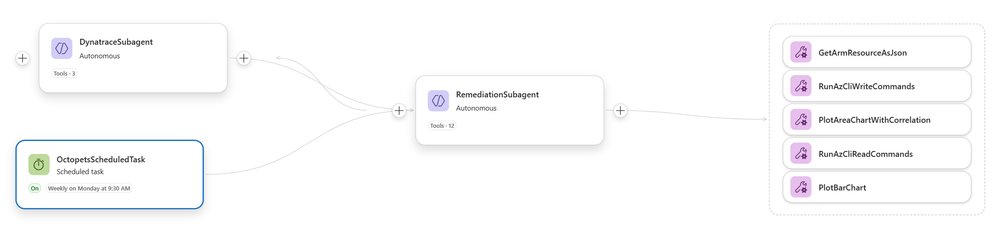
Unified Remediation Architecture
The solution combines three Azure SRE Agent components:
- MCP Connector: Bridges Dynatrace's API gateway using bearer token authentication
- Specialized Subagents:
- DynatraceSubagent: Executes DQL queries to identify error patterns
- RemediationSubagent: Correlates errors with deployments and executes rollbacks
- Scheduled Tasks: Triggers weekly health checks (e.g., every Monday at 9:30 AM)
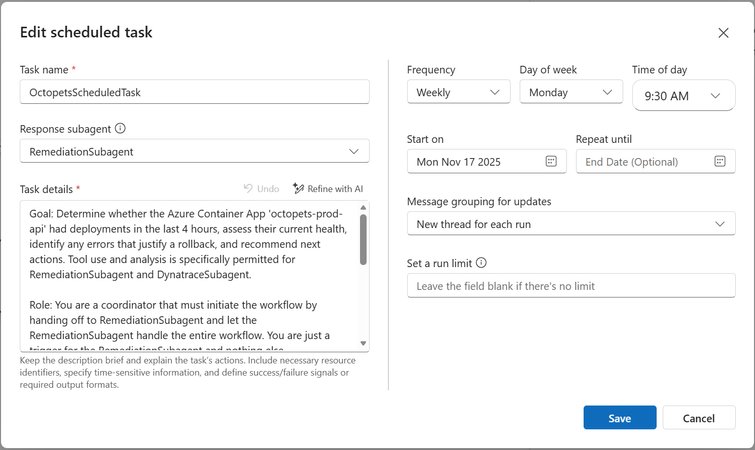
Implementation Workflow
- MCP Connection: Configure bearer token access with
entities.read,events.read, andmetrics.readscopes - Subagent Orchestration: RemediationSubagent hands analysis to DynatraceSubagent and acts on returned insights
- Confidence-Based Rollback: System triggers automated rollback when deployment-error correlation exceeds 70% confidence
Business Impact Comparison
| Metric | Manual Process | SRE Agent Automation |
|---|---|---|
| Time to detect | 15-30 minutes | < 30 seconds |
| Time to remediate | 45-60 minutes | < 5 minutes |
| Correlation analysis | Manual stitching | Automated visualization |
| Deployment frequency | Risk-averse delays | Confident continuous deployment |
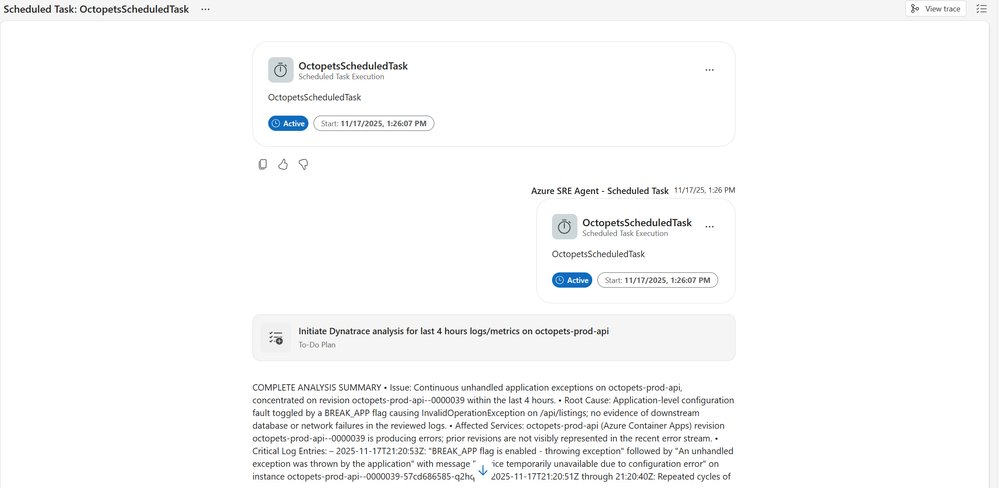
Strategic Advantages
- Multi-Cloud Flexibility: MCP supports any observability tool with gateway (Datadog, Prometheus, etc.)
- Specialization Efficiency: Dedicated subagents outperform monolithic solutions in complex diagnostics
- Proactive Operations: Weekly automated checks prevent incidents before user impact
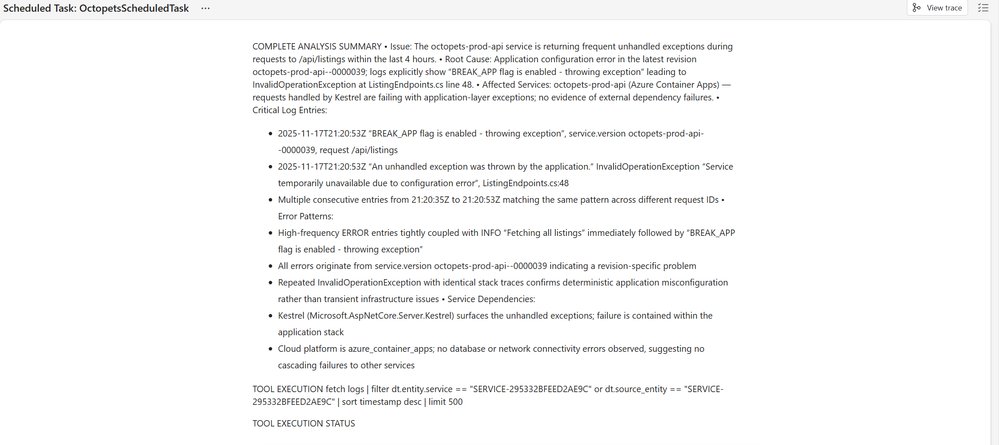
Comments
Please log in or register to join the discussion