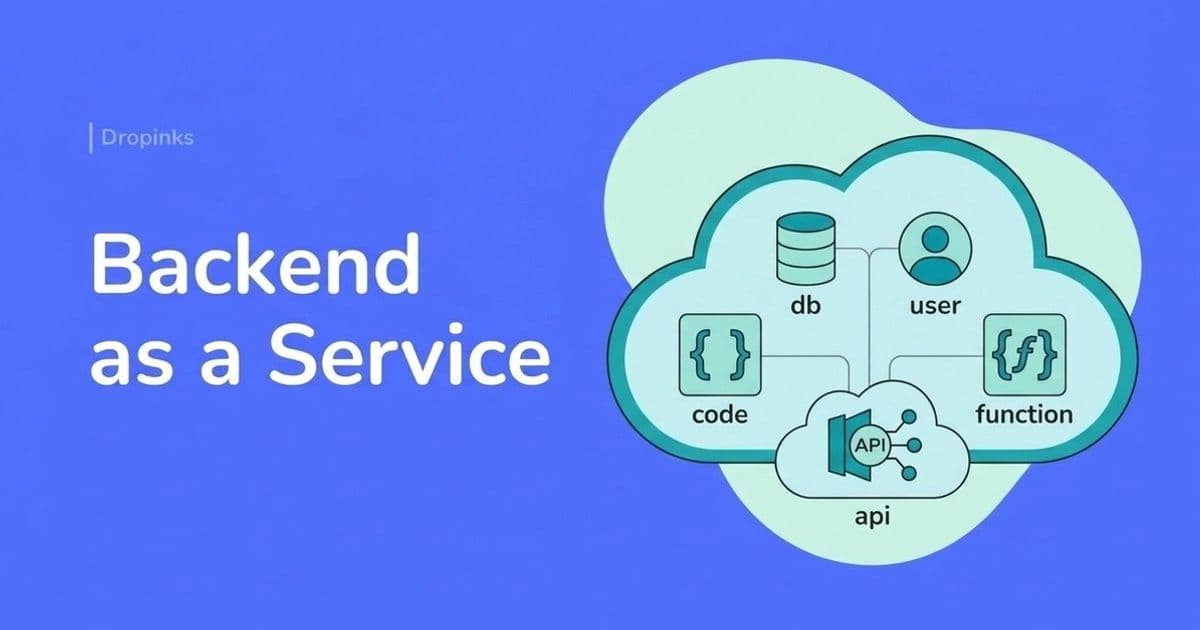
BaaS platforms eliminate backend complexity by providing pre-built infrastructure for authentication, databases, and APIs, letting developers focus on building great user experiences.
Building applications from scratch often means wrestling with the same backend challenges over and over: setting up servers, configuring databases, implementing authentication, managing file storage, and building APIs. For many developers, especially those working on MVPs or side projects, this repetitive groundwork can slow down innovation and drain resources that could be better spent on user experience and core functionality.
What Exactly is Backend-as-a-Service?
Backend-as-a-Service (BaaS) is a cloud computing model that provides developers with pre-built backend infrastructure and features through APIs and SDKs. Think of it as renting a fully-equipped backend rather than building one from scratch. BaaS platforms handle the heavy lifting of server management, database operations, authentication systems, and other common backend tasks, allowing developers to focus on what matters most: building great frontend experiences.
How BaaS Works in Practice
When you use a BaaS platform, you typically interact with their services through client-side code or lightweight backend services. The BaaS provider manages all the server infrastructure, scaling, security patches, and maintenance. You simply integrate their SDKs into your application and start using their features immediately.
For example, instead of writing your own user authentication system, you might call auth.signIn() from your BaaS SDK. Instead of setting up a database server, you might use db.collection('users').add() to store data. The BaaS platform handles all the underlying complexity.
Key Features of BaaS Platforms
Most BaaS providers offer a core set of features that cover the majority of backend needs:
Authentication and User Management: Built-in user registration, login, password recovery, and social login integration. This alone can save weeks of development time and security headaches.
Database and Data Storage: Cloud databases with RESTful APIs or GraphQL endpoints, often with real-time capabilities for live updates.
File Storage and Hosting: Image and file upload capabilities with CDN integration for fast delivery.
Push Notifications: Cross-platform notification services for mobile and web applications.
Serverless Functions: Custom backend logic that runs in response to events without managing servers.
Analytics and Monitoring: Built-in tools to track user behavior and application performance.
Popular BaaS Providers
Several platforms have emerged as leaders in the BaaS space, each with their own strengths:
Firebase (by Google) remains one of the most popular options, offering a comprehensive suite of services including Firestore database, authentication, hosting, and cloud functions. Its generous free tier makes it ideal for startups and personal projects.
Supabase positions itself as an open-source alternative to Firebase, using PostgreSQL as its database foundation. It offers similar features with more transparency and control over your data.
AWS Amplify provides a BaaS-like experience built on top of AWS services, offering deeper integration with the broader AWS ecosystem for enterprise applications.
Backendless focuses on visual development tools alongside traditional API-based development, appealing to teams with mixed technical skill levels.
When BaaS Makes Sense
BaaS shines brightest in certain scenarios:
Rapid Prototyping and MVPs: When you need to validate an idea quickly, BaaS can get you from concept to working prototype in days rather than weeks.
Small to Medium Applications: Many applications don't need the complexity of custom backend infrastructure. BaaS provides "good enough" solutions for most use cases.
Solo Developers and Small Teams: When you don't have dedicated DevOps or backend specialists, BaaS fills that gap effectively.
Projects with Tight Deadlines: The speed advantage of BaaS can be crucial when time-to-market is critical.
Trade-offs and Considerations
While BaaS offers compelling advantages, it's not without trade-offs:
Vendor Lock-in: Your application becomes dependent on the BaaS provider's APIs and pricing model. Migrating away can be challenging and costly.
Limited Customization: You're constrained by the features and limitations of the BaaS platform. Complex business logic or unique requirements might be difficult to implement.
Cost at Scale: While BaaS can be cost-effective for small applications, costs can escalate significantly as your user base grows and usage increases.
Data Privacy and Compliance: Storing user data with third-party providers requires careful consideration of privacy regulations and data sovereignty requirements.
Making the Decision
The choice between BaaS and custom backend development often comes down to your specific needs and constraints. Consider these questions:
- How quickly do you need to launch?
- What's your team's backend expertise?
- How complex are your data requirements?
- What are your scaling expectations?
- What are your compliance and data privacy requirements?
For many modern applications, especially in the startup and SMB space, BaaS provides an excellent balance of speed, cost, and functionality. The key is understanding both the benefits and limitations to make an informed decision.
As the BaaS ecosystem continues to mature, we're seeing more specialized platforms emerge that cater to specific use cases, from e-commerce backends to gaming infrastructure. This specialization trend suggests that BaaS will continue to evolve as a fundamental building block in modern application development.
Whether you're building your first application or your fiftieth, understanding BaaS and its role in the development landscape is essential for making smart architectural decisions that align with your project goals and constraints.
Comments
Please log in or register to join the discussion