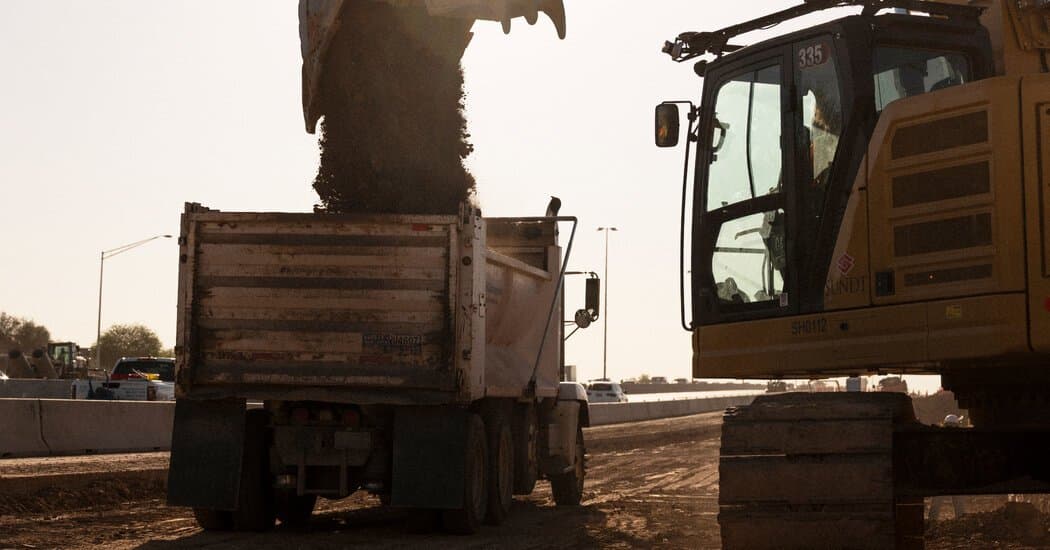
Bedrock, a year-old startup founded by Waymo veterans, has raised $270 million at a $1.75 billion valuation to automate excavators and other heavy construction equipment, marking a significant investment in industrial AI applications.
The construction industry is getting a major AI upgrade. Bedrock, a startup founded by veterans of autonomous vehicle pioneer Waymo, has raised $270 million in a funding round led by CapitalG and the Valor Atreides AI Fund, valuing the company at $1.75 billion. The company aims to automate heavy construction equipment like excavators, bringing the kind of autonomous technology that revolutionized transportation to the building sector.
This investment signals growing confidence in AI's potential to transform traditional industries beyond software and services. While much of the AI conversation focuses on chatbots and coding assistants, Bedrock represents a different frontier: applying machine learning to physical machinery that has remained largely unchanged for decades.
The Vision Behind Bedrock
The company's approach draws directly from the autonomous vehicle playbook. By leveraging the expertise of former Waymo engineers, Bedrock is applying similar computer vision, sensor fusion, and decision-making algorithms to construction equipment. The goal is to create machines that can operate with minimal human intervention, potentially increasing efficiency, reducing accidents, and addressing labor shortages in the construction industry.
Construction sites present unique challenges compared to roads. The environment is less structured, with constantly changing terrain, varying weather conditions, and complex spatial relationships between equipment and structures. Successfully automating excavators and other heavy machinery would require solving some of the most difficult problems in robotics and AI.
Why Now?
The timing of this investment reflects several converging trends. First, the technology for autonomous systems has matured significantly since Waymo's early days. Computer vision models are more robust, sensors are more affordable, and edge computing has advanced enough to handle real-time decision making on equipment.
Second, the construction industry faces mounting pressure to improve productivity. Labor shortages, rising costs, and increasing project complexity have made automation increasingly attractive. The potential for 24/7 operation and consistent performance could address some of the industry's most persistent challenges.
Third, the success of autonomous vehicles in controlled environments has demonstrated the feasibility of the approach. While full autonomy on public roads remains challenging, controlled environments like construction sites offer more predictable conditions where the technology can be deployed more quickly.
The Competitive Landscape
Bedrock isn't alone in pursuing construction automation. Several companies are working on similar technologies, though most focus on specific aspects like site mapping, equipment tracking, or partial automation. What sets Bedrock apart is its comprehensive approach to full equipment autonomy, backed by deep expertise from the autonomous vehicle sector.
The construction equipment market is dominated by established players like Caterpillar, Komatsu, and Hitachi. These companies have been adding automation features to their equipment, but Bedrock's approach of creating autonomous systems that can work with existing machinery could provide a faster path to market.
Technical Challenges
Automating heavy construction equipment presents unique technical hurdles. Unlike passenger vehicles, excavators and bulldozers operate in three dimensions, with complex mechanical systems that require precise control. The software must understand not just where the equipment is, but how it's positioned relative to the ground, structures, and other equipment.
Sensor fusion becomes particularly critical in construction environments. The system needs to combine data from cameras, lidar, radar, and other sensors to create an accurate picture of the environment, even in challenging conditions like dust, rain, or low light. The algorithms must also account for the equipment's own movement and vibration, which can complicate perception tasks.
Safety considerations are paramount. A malfunctioning autonomous excavator could cause catastrophic damage, making reliability and fail-safe systems essential. The software must be able to handle edge cases and unexpected situations that might never occur in more controlled environments.
Market Implications
The construction industry represents a massive market opportunity. Global construction equipment sales exceed $200 billion annually, and the industry is under pressure to modernize. If Bedrock can deliver on its promise of autonomous heavy equipment, it could capture a significant share of this market while potentially expanding it by making previously uneconomical projects viable.
The investment also reflects broader trends in AI deployment. As foundation models mature and become commoditized, companies are increasingly looking to apply AI to specific vertical markets where domain expertise and specialized hardware can create competitive advantages. Construction automation combines AI with mechanical engineering, creating barriers to entry that pure software companies cannot easily overcome.
Looking Ahead
The $270 million funding round provides Bedrock with substantial runway to develop and deploy its technology. The company will likely need to navigate regulatory approval processes, establish partnerships with equipment manufacturers or construction companies, and demonstrate the reliability and cost-effectiveness of its systems.
Success in this market could pave the way for similar approaches in other heavy industries like mining, agriculture, and logistics. The combination of AI expertise and domain knowledge that Bedrock represents could become a template for how traditional industries are transformed by technology.
As construction sites begin to see autonomous excavators and bulldozers operating alongside human workers, the industry may finally experience the productivity revolution that has transformed so many other sectors. Bedrock's ambitious vision, backed by significant investment, suggests that the future of construction may be more automated than many realize.
Comments
Please log in or register to join the discussion