
As AI becomes our primary gateway to information, the debate shifts from eliminating ads to designing ethical attention markets. This deep dive explores how dealer, broker, and auction models define today's ad landscape—and why AI assistants demand fundamentally new approaches to balancing user value, creator economics, and innovation.

Ask anyone if they enjoy advertisements, and you'll likely hear a resounding 'no.' Yet beneath this near-universal aversion lies an uncomfortable truth: directing attention creates immense economic value. As AI assistants rapidly evolve into humanity's primary interface with digital information, we're not heading toward an ad-free utopia. Instead, we stand at an inflection point demanding fundamentally redesigned attention markets that prioritize efficiency and ethics—a challenge requiring deep understanding of advertising's core mechanics.
Why Advertising Is a Market Design Problem
At its heart, advertising functions as a complex matching system solving two core economic dilemmas: liquidity (connecting buyers/sellers) and price discovery (determining fair value). Unlike traditional markets with three actors—buyer, seller, intermediary—advertising involves four interdependent parties:
- Users trading attention for content
- Creators trading content for revenue
- Advertisers trading money for attention
- Platforms facilitating exchanges while taking a cut
This structure creates unique dynamics mirroring financial markets. Display ads (Instagram stories, billboards) operate on a dealer model: platforms 'inventory' user attention by providing free services, then sell it to advertisers like a grocer selling produce—assuming inventory risk. Search ads (Google results) follow a broker model: real-time auctions match immediate intent (e.g., "emergency plumber") with providers, dynamically pricing supply and demand.
"Markets fail when incentives misalign, monopolies dominate, or transparency diminishes. Conversely, they succeed by matching supply with demand, helping discovery, and supporting creators sustainably." — Source analysis
The Double-Edged Sword of Attention Economies
When functioning well, ad markets generate profound value:
- Innovation Catalyst: Display ads enabled direct-to-consumer giants like Warby Parker to reach early customers without massive retail footprints.
- Content Ecosystem Fuel: YouTube creators and independent journalists monetize through platforms' ad infrastructure.
- Quality Signaling: A plumber bidding $50 for 2AM clicks signals reliability during emergencies—dynamic pricing impossible with static listings.
- Real-Time Market Reflection: Restaurants adjust bids based on table availability; advertisers reveal product confidence through spend.
Yet market failures abound:
- Attention Monopolies: Single platforms controlling eyeballs extract disproportionate value via zero-sum bidding wars.
- Metric Misalignment: Optimizing for clicks over real value damages users and brands (e.g., clickbait dominating quality content).
- Fraud: Bot networks artificially inflate competitors' costs through fake clicks.
- Privacy Erosion: Hyper-personalization crosses into surveillance without clear boundaries.
AI Assistants: The New Advertising Frontier
As ChatGPT-style interfaces become primary information gateways, advertising must evolve—not vanish. Three imperatives emerge:
- Funding Universal Access: Ad-supported models democratize advanced AI tools, avoiding paywall exclusion.
- Maintaining Innovation Pathways: Without ads, incumbents dominate organic results; auctions let new entrants compete for visibility.
- Contextual Precision: AI can integrate ads organically—e.g., answering "best productivity apps?" with "Notion (Sponsored) excels for flexibility; Todoist wins in simplicity."
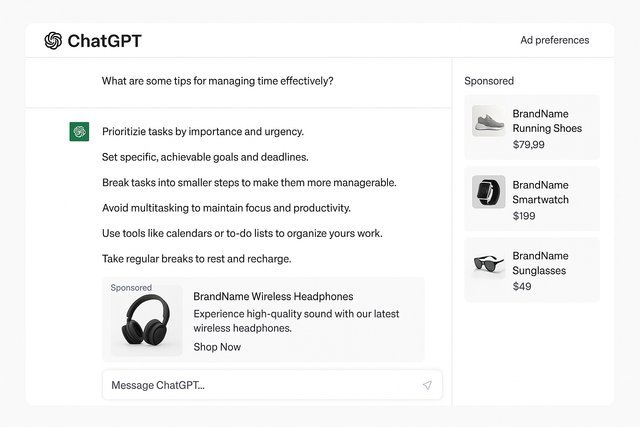
Image caption: AI-generated concept of intrusive ChatGPT ads—an approach the source argues against.
The ideal model resembles influencer-style integration: transparent, contextually relevant, and minimally disruptive. This avoids the hated "banner ad beside chat" approach while leveraging AI's ability to match user intent with commercial intent at conversational depth.
The Efficient Attention Imperative
Attention remains humanity's ultimate scarce resource. Platforms capturing it bear moral responsibility for its allocation. We shouldn't ask whether AI assistants will incorporate ads, but how to architect them as ethical market makers. This demands:
- Anti-Monopoly Safeguards: Preventing single entities from controlling attention flows
- Value-Aligned Metrics: Prioritizing user satisfaction over raw engagement
- Transparent Auction Mechanics: Clear rules for how ads enter conversations
- User Agency: Granular controls over ad frequency and categories
Viewing ads as an 'attention tax' reframes the debate: just as income taxes fund public goods, thoughtfully designed advertising sustains free access to transformative tools. The goal isn't ad-free AI, but AI that elevates market efficiency—transforming assistants into intelligent curators that respect user attention while powering sustainable innovation ecosystems.
Source: Analysis based on 'Morality of Advertising' by syin.bearblog.dev (July 2025)
Comments
Please log in or register to join the discussion