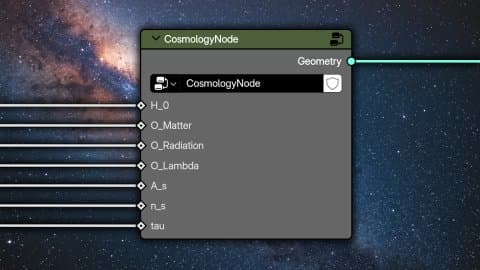
A Ph.D. student is leveraging Blender's open-source 3D creation tools to analyze Cosmic Microwave Background radiation, offering new approaches to computational cosmology that could reshape scientific visualization.
In the intersection of creative software and scientific research, an unexpected tool is making significant strides in cosmology: Blender's Geometry Nodes. MohammadHossein Jamshidi, a Ph.D. student in Physics/Cosmology at Shahid Beheshti University in Iran, has developed innovative methods to use Blender's node-based system for analyzing Cosmic Microwave Background (CMB) radiation—faint light from the early universe that holds clues to cosmic evolution.
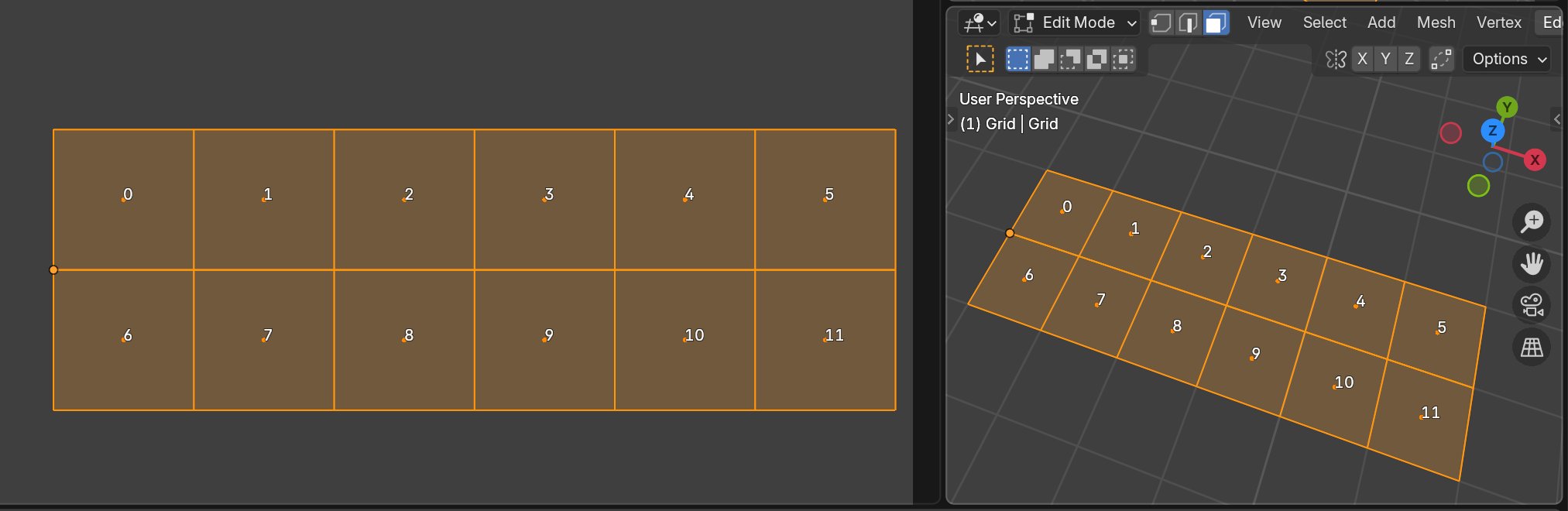
Jamshidi, who also has experience as an animation engineer in the game industry since 2012, recognized the potential of Blender's parallel processing capabilities for cosmological computations. "Geometry Nodes compute things on mesh elements in parallel," he explains. "If the mesh elements are considered 'data storage slots' and 'processing threads,' we can perfectly utilize Geo Nodes for doing 'Single Instruction Multiple Data' (SIMD) computations."
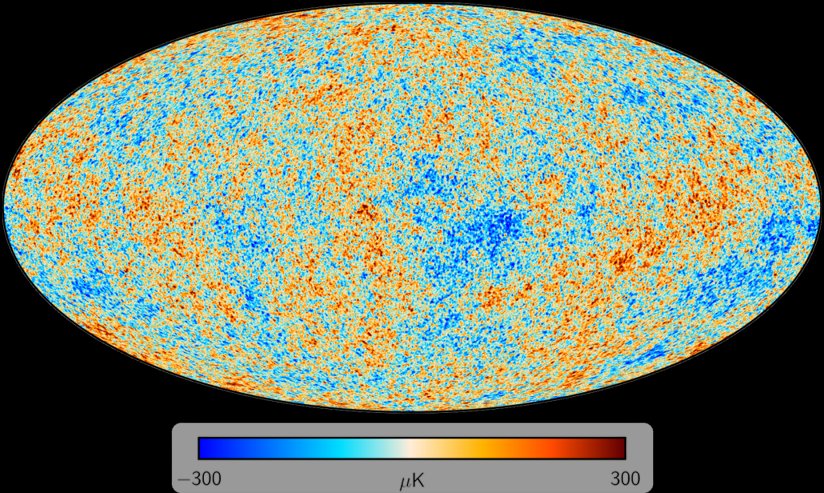
The Cosmic Microwave Background, thermal radiation filling the universe at approximately 2.7 Kelvin, contains tiny temperature fluctuations that reveal information about the early universe. These fluctuations, though minuscule (10^-6 to 10^-4 K variations), are crucial for understanding cosmic history. "These light rays are quite the last things that we can observe in the sky, coming from the farthest distance that could ever be observed," Jamshidi notes. "They have recorded numerous events in the history of the universe, and now we are fortunate enough to be able to decode some of their interesting information."
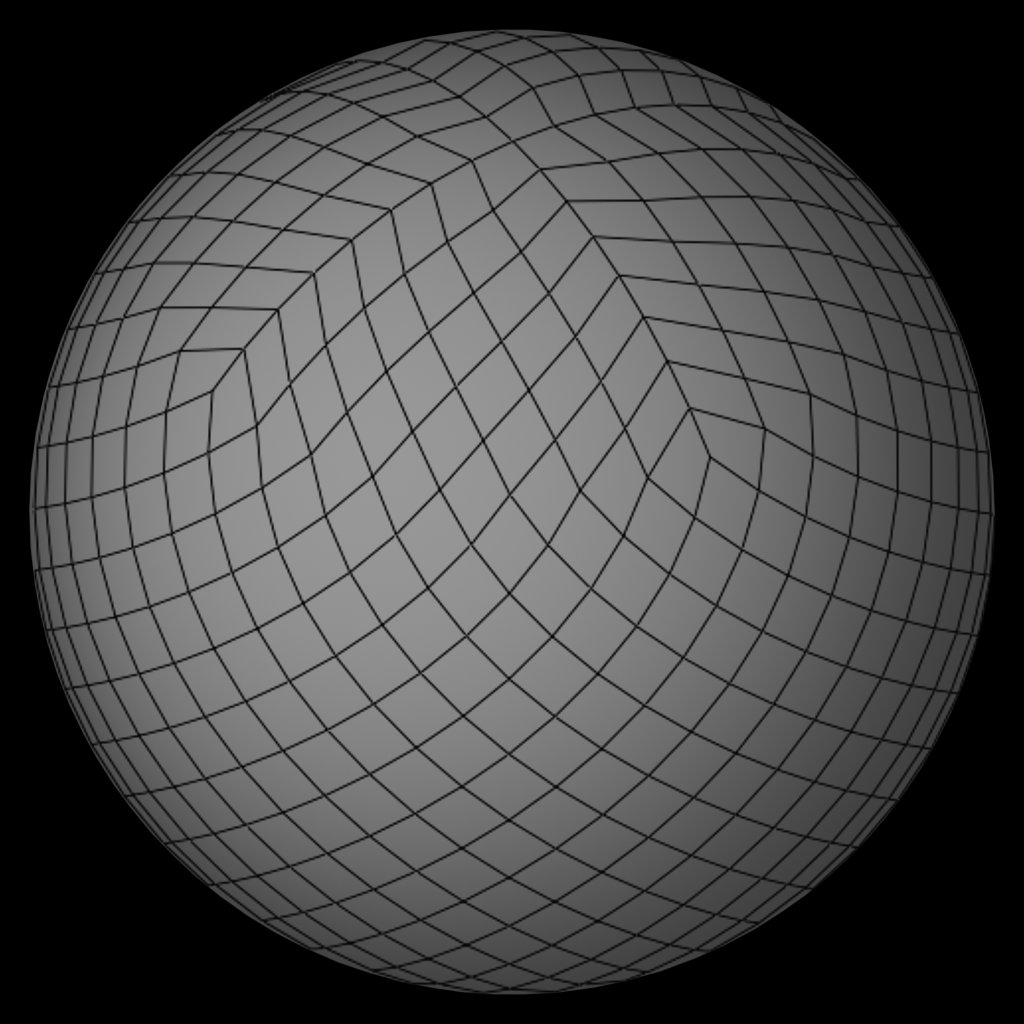
One of the key challenges in cosmology is working with spherical data. To address this, Jamshidi utilizes HEALPix (Hierarchical Equal Area isoLatitude Pixelation), a special method of pixelating a sphere where each pixel has the same area. "This pixelation is great for storing the data, and doing spherical math with it is very efficient," he explains. The researcher has created tutorials for implementing HEALPix spheres in Blender, making these techniques accessible to other scientists.
The applications of this approach extend beyond simple visualization. Jamshidi has developed methods for pixel-preserving map rotation, Doppler effect simulation, gravitational lensing visualization, and even real-time computation of spherical harmonics—mathematical functions used to analyze spherical data. "In cosmology, it is very common to describe a spherical map/image using spherical harmonic functions," he notes. "They help us to separate large and small features of spherical maps to investigate their physical origins."
Perhaps most remarkably, Jamshidi has addressed one of the limitations of Blender's Geometry Nodes—its use of float32 precision rather than the float64 required for high-precision cosmological calculations. "It is possible to emulate float64 numbers and their operations with two float32 numbers," he explains. "The only change that should be made in our process for Geometry Nodes is to store the 64-bit number in two float channels."
The open-source nature of Blender makes these techniques particularly valuable for the scientific community. Unlike specialized scientific visualization software that can be expensive and proprietary, Blender provides a free platform with powerful visualization capabilities. "Although other tools, such as CUDA or Compute shaders might be faster, Geo Nodes provides also a free debugger and visualizer," Jamshidi observes. "It is especially perfect for small-scale projects; we can calculate and visualize instantly, and in most cases, we can reach the final numerical result in real-time."
For researchers interested in exploring these techniques, Blender's Geometry Nodes documentation provides a comprehensive introduction to the system's capabilities.
Jamshidi's work suggests broader applications beyond cosmology. "From the first time I saw the nice works of Seanterelle on YouTube, to when I was developing the above techniques, and so far, I have been thinking about 'what other areas of physics can make use of Geometry Nodes?'" he reflects. Potential applications include simulating crystals, spin systems, astrophysical systems, liquids, protein folding, and many-body systems.
The researcher has made all his files available on a GitHub repository, allowing other scientists to build upon his work. This open approach to scientific computing represents a growing trend of leveraging creative tools for scientific research, potentially accelerating discovery through unexpected intersections of disciplines.
As computational needs in scientific research continue to grow, innovative approaches like Jamshidi's demonstrate how tools developed for one purpose can find valuable applications in entirely different fields. The marriage of creative software and scientific computing may open new pathways for visualization and analysis in cosmology and beyond.
Comments
Please log in or register to join the discussion