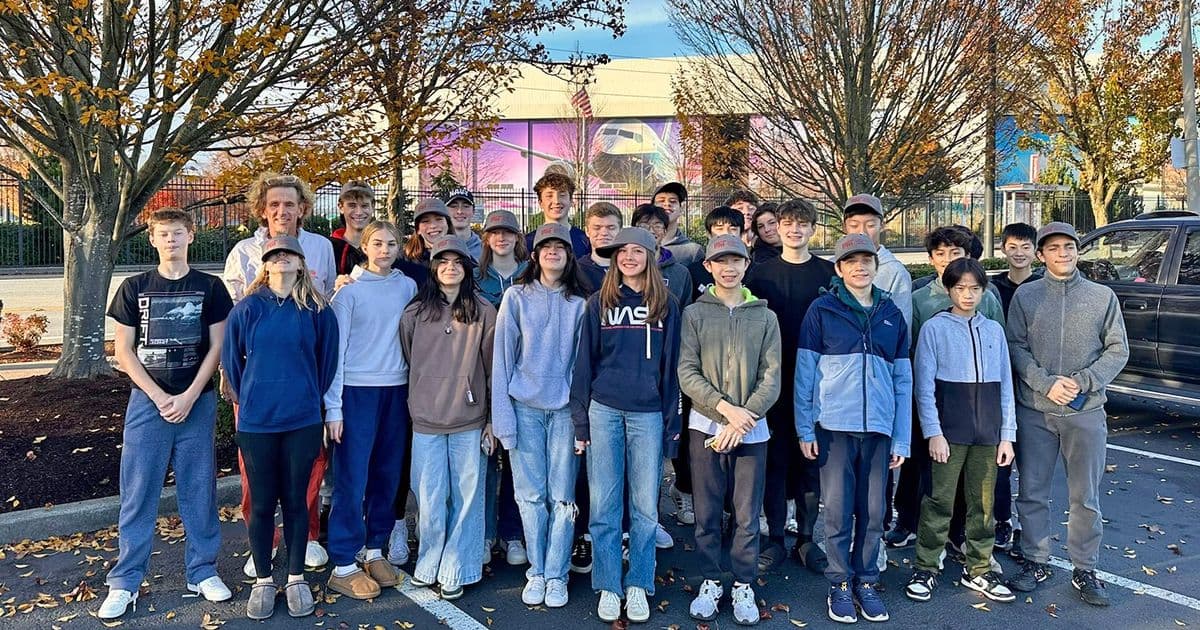
High school students from Mercer Island, Washington, toured Boeing's 737 factory through a collaboration between MIT's Leaders for Global Operations program, Boeing, and Engineering Tomorrow, gaining firsthand exposure to aerospace manufacturing and diverse engineering career paths.
A collaboration between MIT's Leaders for Global Operations program, Boeing, and the nonprofit Engineering Tomorrow is transforming how high school students envision careers in engineering by bringing them directly to the factory floor where commercial airplanes are built.
This initiative addresses a critical challenge in American manufacturing and engineering: the growing shortage of skilled workers across all levels, from degreed engineers to trained operators and technicians. Engineering Tomorrow frames this shortage not just as an economic issue but as a matter of national security, noting that the demand for engineers continues to rise dramatically as the United States seeks to remain competitive globally.
Bridging the Gap Between Classroom and Career
The collaboration grew organically through the robust MIT LGO alumni network. Kristine Budill SM '93, an LGO alumna serving on Engineering Tomorrow's board, recognized the potential for connection between the organization's mission and the substantial Boeing LGO community. She connected Engineering Tomorrow with Cameron Hoffman MBA '24, SM '24, a Boeing manufacturing strategy manager and fellow LGO graduate who helped translate this shared vision into reality.
For 30 ninth graders from Mercer Island High School's engineering design class, the result was a November 2025 visit to Boeing's Renton, Washington facility that went far beyond a typical field trip. The experience was carefully structured to prepare students before they ever set foot in the factory.
Engineering Tomorrow's program coordinator, Alex Dickson, explains that the organization first introduced aerospace concepts and a related lab challenge to the class via Zoom. A liaison then returned in person to guide students through a hands-on airplane design lab, helping them translate theoretical knowledge into practical application while answering questions about engineering pathways.
More Than Just a Tour
When students arrived at Boeing's production facility, they weren't passive observers. They engaged in conversations with engineers from multiple disciplines—aerospace, mechanical, electrical, and beyond—learning that engineering careers don't follow a single set pathway. The students toured the factory floor where they witnessed the assembly of 737 aircraft and saw testing of various components.
"It's awe-inspiring: Dozens of unfinished airplanes are under one site, and you see all of the real-world production engineering that goes into something that oftentimes we take for granted when we step onto an airplane," Dickson says.
The experience included engaging presentations about the plant's history, complete with high school-friendly facts such as the statistic that a 737 takes off or lands every two seconds somewhere in the world. Students learned about diverse career pathways, from design engineering to production management to technical specialization.
Personal Impact and Career Inspiration
For Hoffman, who has been with Boeing for a decade, the experience was deeply personal. He started at Boeing in 2015 as a recent college graduate and encountered several LGO alumni who recommended the program. His journey from manufacturing enthusiast to LGO graduate to Boeing leader shaped his understanding of how such experiences can influence young people's career trajectories.
"As a kid, the only engineering class that was available to me was architectural drafting. If this opportunity was offered to me when I was in high school, I would've jumped out of my shoes at the chance. You get to see products that are just so complex; you really can't believe it until you see it," Hoffman reflects.
The Mercer Island engineering design teacher, Michael Ketchum, found the experience transformative for his students. He estimates that roughly 80 percent of his students aspire to be engineers, and the field trip reinforced their ambitions while broadening their understanding of the field. The collaboration allowed him to expand his previously CAD-focused class to include 3D printing, electronics, and aerospace applications.
Measuring Success and Future Expansion
A post-trip survey revealed that 100 percent of students found seeing the production facility to be one of the coolest parts of the program, and all reported being more inclined to pursue engineering careers after the experience. Students specifically noted that conversations with Boeing engineers were inspiring and helped them understand the diverse pathways into the field.
Looking ahead, the LGO network hopes to expand this model to partner with additional companies across various industries, from healthcare to biotechnology. The goal remains consistent: creating exposure to real-world engineering and manufacturing environments that can inspire the next generation of problem-solvers.
This collaboration exemplifies how industry-academia partnerships can address workforce development challenges while providing meaningful experiences for young people exploring their career options. By connecting students with professionals who share their backgrounds and interests, programs like this help demystify engineering careers and show that there are many routes to success in these fields—whether through traditional four-year degrees, technical training, or other pathways.
The Boeing-LGO-Engineering Tomorrow partnership demonstrates that inspiring future engineers requires more than classroom instruction; it demands real-world exposure, mentorship, and the opportunity to see complex engineering systems in action. For the Mercer Island students who toured the Renton facility, that experience may well have set them on paths toward engineering careers they hadn't previously imagined possible.
Comments
Please log in or register to join the discussion