
In just five years, Brazil’s Pix instant payment system has overtaken Visa and Mastercard to become the country’s dominant transaction method, drawing U.S. trade scrutiny and sparking a debate over financial sovereignty.

In less than six years, Brazil’s Pix instant payment system has reshaped the country’s financial transaction habits, overtaking decades of dominance by Visa and Mastercard to become the primary way Brazilians move money. That rapid rise has now drawn formal pushback from the U.S. government, backed by the two credit card giants, in a dispute that blends trade policy, financial sovereignty, and the future of low-cost digital payments.
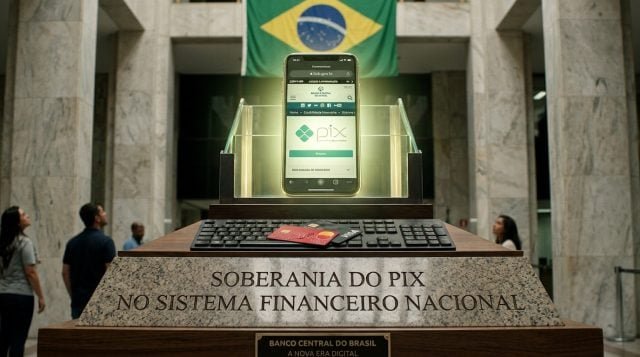
Pix is the instant payment system developed and managed by the Central Bank of Brazil (BCB), first announced in February 2019 and fully operational by November 2020. The name blends “Pi” (from Pagamentos Instantâneos, Portuguese for instant payments) and “Tix” (from Transações instantâneas X, instant X transactions), a nod to its core focus on speed and accessibility. More details are available on the official Pix portal.
Unlike private payment networks, Pix operates as a public utility: it is a real-time settlement layer that connects all financial institutions in Brazil, allowing instant transfers between any participating bank or fintech account 24 hours a day, 365 days a year. The system relies on “Pix keys,” user-defined identifiers that link to a bank account. These can be a phone number, email address, national ID number (CPF for individuals, CNPJ for businesses), or a randomly generated string. To make a payment, users open their bank’s app, select Pix, enter the recipient’s key or scan a QR code, confirm with biometrics or a PIN, and the transfer settles in seconds. Both parties receive immediate confirmation. For individual users, the service is free; businesses pay a fee of roughly 0.33% per transaction, far below the 2% to 5% average charged by credit card networks.
The adoption numbers are staggering. In 2025 alone, Pix processed 80 billion transactions worth R$35.3 trillion (approximately $6.7 trillion), a 33.7% increase from the R$26.5 trillion moved in 2024. Cumulative transactions since launch through September 2025 reached 196.2 billion, moving $16 trillion, an amount more than seven times Brazil’s 2024 annual GDP. As of early 2026, Pix has 180 million registered users, 162.8 million of whom are individuals, representing 93% of Brazil’s adult population. There are 617 million registered Pix accounts and 920 million active Pix keys, with 930 financial institutions participating in the system.
Daily transaction volume tells the clearest story of Pix’s dominance. The single-day record was set on June 6, 2025, with 276 million transactions, surpassing the combined daily volume of Visa and Mastercard in Brazil. By early 2025, Pix was processing an average of 224 million daily transactions, more than double the combined daily volume of the two U.S. card networks. This shift has upended Brazil’s payment market: in 2025, Pix accounted for 49% of all financial transactions in the country, while debit and credit cards each held 14%, and cash use dropped to 6% from 83% in 2021.
The growth has come at a direct cost to Visa and Mastercard. Estimates suggest Pix cost the two companies a combined R$12 billion (approximately $2.3 billion) between 2021 and 2024, with Visa losing R$6.5 billion and Mastercard R$5.3 billion. The lower fee structure is the primary driver: card networks charge merchants an average of 2.3% per transaction, while Pix’s 0.33% fee eats into the high-margin revenue the companies have relied on for decades.
Visa and Mastercard have lobbied against Pix since its early growth phase. In 2022, Mastercard Brazil CEO Marcelo Tangioni publicly criticized the system’s regulatory structure, arguing that the Central Bank cannot act as both regulator and operator. “Pix is great, beneficial for the industry. What’s not great is that it falls under the Central Bank. It can’t regulate and compete at the same time,” he said at the time. The companies have pushed the U.S. government to intervene, arguing that Pix’s state backing creates an unfair competitive advantage that violates international trade agreements.
In September 2025, those lobbying efforts paid off: the U.S. Trade Representative (USTR) launched a formal investigation into Pix, alleging the system imposes discriminatory rules on U.S. payment firms and creates an unfair competitive disadvantage. A White House report issued in April 2026 doubled down, labeling Pix a “detrimental system for global credit card companies” and signaling potential retaliatory trade measures if Brazil does not adjust the system’s rules.
The Brazilian government has responded with a firm, nationalist stance. President Luiz Inácio Lula da Silva has repeatedly defended the system, stating publicly that “no one will make us change Pix” and launching a social media campaign with the slogan “Pix is ours, my friend” to rally public support. The Brazilian Federation of Banks has also backed the system, noting that Pix uses an open model available to all financial institutions, and that its non-commercial status promotes competition rather than stifling it. “Pix is not a product sold by the Central Bank, it is a public infrastructure that lowers barriers to entry for smaller financial firms,” the federation said in a statement.
Even as the trade dispute escalates, the Central Bank of Brazil continues to expand Pix’s functionality to compete more directly with traditional payment products. Recent additions include:
- Automatic Pix: For recurring payments such as subscriptions and utility bills, which saw a 41% monthly increase in transaction volume and 34% growth in subscription count in its first year of operation.
- Proximity Pix: Enables contactless payments without an internet connection using NFC technology, targeting informal merchants and areas with poor connectivity.
- International Pix: Allows Brazilian travelers to make real-time payments abroad with automatic currency conversion, a direct competitor to credit card foreign transaction fees.
- Installment Pix: Lets users split payments into multiple installments, a feature that directly challenges credit card installment plans, which have long been a major revenue driver for Visa and Mastercard in Brazil.
The Central Bank has also strengthened fraud protections with the MED 2.0 (Special Refund Mechanism) update, which took effect in February 2026. The system allows users to track transferred funds and request refunds in cases of fraud, with mandatory participation from all financial institutions.
The dispute has implications far beyond Brazil. Pix is widely cited as a model for other developing economies looking to reduce reliance on foreign payment networks and lower transaction costs for merchants and consumers. More than 20 countries, including India, Mexico, and South Africa, have sent delegations to Brazil to study the system’s implementation. For Visa and Mastercard, which derive a significant portion of their global revenue from emerging markets, the spread of similar state-backed systems poses an existential threat to their business model.
As of April 2026, the USTR investigation remains ongoing, with no formal trade measures announced yet. Brazilian officials have offered to hold technical talks with U.S. counterparts to address regulatory concerns, but have refused to cede control of the system or raise fees for businesses. For now, Pix continues to grow: daily transaction volume in early 2026 is up 12% from the same period in 2025, and the Central Bank plans to roll out cross-border Pix transfers for remittances by the end of the year.
Comments
Please log in or register to join the discussion