
Microsoft's Global Employee & Executive Communications community demonstrates how structured operating models, AI-enabled tools, and continuous learning can transform dispersed communications teams into a coordinated force for organizational alignment.

Global communications teams face a fundamental coordination problem: how do you maintain consistency, speed, and quality across dozens of regions, hundreds of messages, and thousands of employees when your team is distributed worldwide? Microsoft's Global Employee & Executive Communications (GEEC) community is tackling this challenge through a combination of structured operating cadence, AI-powered resources, and targeted skill development.
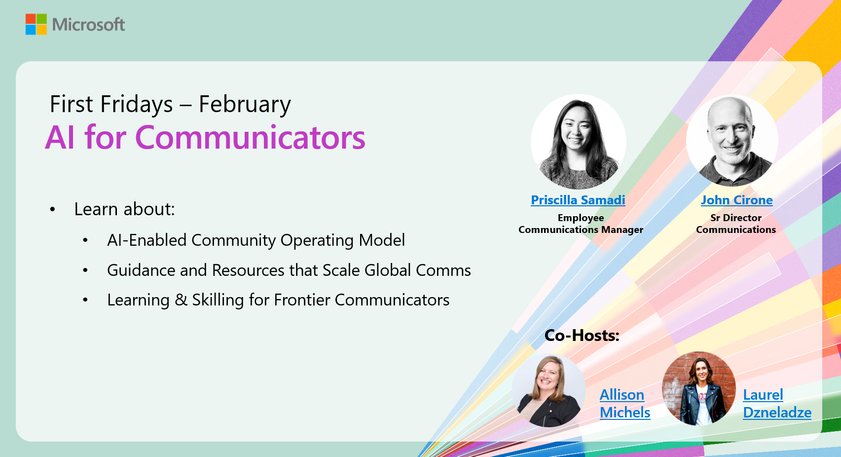
In their upcoming First Fridays session on February 6th, John Cirone (Sr Director Communications) and Priscilla Samadi (Communications Manager) will walk through how they've built this community into what they describe as a "force-multiplier" for alignment, learning, and execution. The approach centers on three core pillars that address the typical fragmentation of global communications work.
The Operating Model: Cadence as Coordination
The foundation of the GEEC community is a deliberate operating cadence. Rather than relying on ad-hoc collaboration or sporadic knowledge sharing, they've established regular touchpoints that keep the community aligned and moving together. This creates a predictable rhythm for sharing updates, surfacing challenges, and coordinating responses to emerging needs.
For communications teams, this structure solves a common problem: when you're managing regional communications across multiple time zones and business units, it's easy for teams to drift into silos. Each region develops its own processes, messaging approaches, and resource libraries. Over time, this creates inconsistency in brand voice, compliance risks from misaligned messaging, and duplicated effort as teams solve the same problems independently.
The cadence model addresses this by creating shared moments for alignment. When everyone knows there's a monthly or quarterly touchpoint for reviewing guidance, sharing learnings, and coordinating upcoming initiatives, it becomes easier to maintain consistency without heavy-handed central control.
AI-Enabled Guidance at Scale
The second pillar focuses on delivering timely, aligned guidance and resources through AI agents. This is where the model moves beyond traditional community management into something more powerful.
Traditional approaches to global communications guidance often involve static playbooks, email distributions, or portal repositories. The problem is that these resources quickly become outdated, or teams don't know they exist, or they can't find the right guidance for their specific situation.
By deploying AI agents that can deliver contextual guidance, the GEEC community can provide:
- Just-in-time recommendations based on the type of communication (employee announcement, executive briefing, crisis response)
- Region-specific adaptations that account for local regulations, cultural considerations, or business context
- Consistency checks that ensure messaging aligns with broader organizational strategy
- Speed that allows communicators to get answers without waiting for manual review cycles
The key insight here is that AI isn't replacing human judgment—it's amplifying the community's collective knowledge. When a communicator in Singapore needs guidance on a layoff announcement, the AI can draw on lessons from similar situations in other regions, adapted for local context, while ensuring alignment with global messaging standards.
Learning and Skilling for Frontier Readiness
The third pillar addresses the evolving skill requirements of modern communications professionals. The term "frontier-ready" suggests communicators need capabilities beyond traditional writing and editing—they need to work with AI tools, understand data analytics, manage digital channels, and adapt to rapidly changing information environments.
The GEEC community's approach to learning includes:
Ongoing Development: Rather than one-off training sessions, they've built continuous learning into the community fabric. This might include regular skill-building workshops, certification programs, or peer-led learning circles.
Peer Sharing: The community model allows communicators to learn from each other's successes and failures. When one region experiments with a new AI tool or communication channel, those lessons can be quickly shared and adapted by others.
AI-Powered Tools: Beyond guidance delivery, the community invests in tools that help communicators work smarter. This could include content generation assistants, sentiment analysis for employee feedback, or automated translation and localization support.
The Business Impact: From Coordination to Force Multiplier
What makes this model compelling is how it transforms the economics of global communications. In a traditional model, scaling communications across regions means linear growth in headcount and coordination overhead. Each new region or business unit requires dedicated communications support, and consistency becomes harder to maintain.
The GEEC model aims for something different: a force multiplier effect where the community's collective intelligence and tools allow each communicator to be more effective, and where coordination happens through structure rather than bureaucracy.
For organizations considering similar approaches, the key lessons are:
- Structure enables freedom: Regular cadence and shared guidance don't constrain teams—they free them to focus on execution rather than reinventing processes
- AI augments community knowledge: The technology works best when it's delivering the community's collective wisdom in contextual, actionable ways
- Skills development must be continuous: As communication channels and employee expectations evolve, the community must be a vehicle for ongoing learning
Practical Takeaways for Communications Leaders
The First Fridays session promises to share specific resources and approaches that other organizations can adapt. Based on the GEEC model, communications leaders should consider:
- Mapping your communication ecosystem: Identify where fragmentation is creating inefficiency or inconsistency
- Establishing alignment mechanisms: Create regular touchpoints that coordinate without controlling
- Investing in AI-enabled resources: Start with high-volume, high-variability tasks where AI can deliver community knowledge at scale
- Building learning into the workflow: Make skill development part of regular community interaction, not a separate activity
The February 6th session will likely dive into the specifics of how Microsoft has implemented these elements, what tools they're using, and what results they're seeing. For global communications teams struggling with coordination, consistency, or speed, this represents a practical blueprint for turning a distributed team into a strategic asset.
The broader implication is that the future of enterprise communications isn't about centralizing everything or letting regions operate independently—it's about creating intelligent coordination systems that combine human expertise, community learning, and AI amplification.
Register for the First Fridays session on February 6th at 8 am PT: aka.ms/FirstFridaysFeb
Comments
Please log in or register to join the discussion