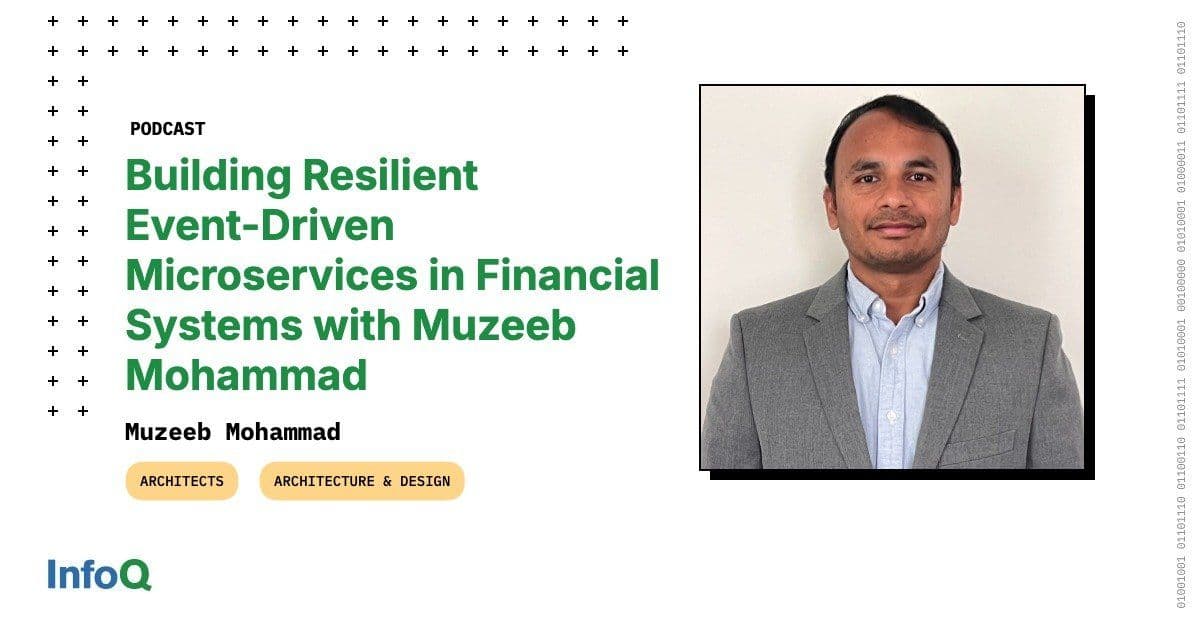
Muzeeb Mohammad discusses how JP Morgan Chase is modernizing legacy financial systems through event-driven microservices, sharing practical insights on migration strategies, observability, and security in highly regulated environments.
In this episode of the InfoQ Podcast, Thomas Betts speaks with Muzeeb Mohammad, Senior Manager of Software Engineering at JP Morgan Chase, about building event-driven microservices for financial systems. The conversation explores core principles of event-driven architectures, migration patterns from legacy mainframes, and the challenges of implementing these systems in highly regulated industries.
The Evolution from Monolithic to Event-Driven Systems
Financial services have traditionally relied on monolithic architectures built with RESTful APIs and SOAP-based web services. However, these approaches presented challenges with time-to-market and scalability. Mohammad's team at SEI (a previous employer) successfully implemented event-driven solutions using Kafka to address these limitations.
A practical example involved the customer checking account opening process. Previously, this monolithic workflow would process sequentially, failing if any single step encountered issues. The team decoupled this process by introducing Kafka topics for each downstream application - fraud checking, credit scoring, and account creation. Each service independently processed events, significantly improving performance and enabling faster deployments.
Key Benefits of Event-Driven Architecture
The transition to event-driven systems delivered multiple advantages:
- Improved scalability: Services could scale independently based on demand
- Faster time-to-market: Teams could deploy changes more frequently without impacting other services
- Enhanced reliability: Asynchronous processing reduced single points of failure
- Better observability: Implementation of TraceID patterns enabled end-to-end transaction visibility
The team leveraged observability tools like Splunk, Dynatrace, and AppDynamics to monitor system health and quickly identify issues across the distributed architecture.
Bridging Legacy Mainframes with Modern Architecture
Many financial institutions still rely heavily on mainframes for core processing. Mohammad describes a hybrid approach where COBOL programs on mainframes emit events through MQ layers. These events are then consumed by distributed microservices running in public cloud environments.
This pattern allows organizations to gradually modernize their systems while maintaining the reliability of existing mainframe infrastructure. The team implemented change data capture (CDC) tools to ensure data consistency between mainframe databases and distributed systems, running reconciliation processes throughout the day to verify accuracy.
Security and Compliance in Financial Systems
Security remains paramount in financial services. The team implemented OAuth-based mechanisms for API governance and developed environment-as-code using Terraform to embed security policies at the platform level. This approach ensures that security considerations are integrated throughout the development lifecycle rather than treated as an afterthought.
The Role of AI in Financial Systems
Mohammad discusses how AI is being explored for anomaly detection in system observability. By feeding logs, traces, and other metrics into AI models, the team can identify issues across complex microservice architectures more efficiently than manual analysis. This approach is particularly valuable when dealing with systems involving 50+ microservices.
Looking Ahead: The Future of Financial Systems
Over the next decade, Mohammad predicts significant changes in financial software engineering:
- Accelerated development cycles using AI tools
- Implementation of business-driven use cases powered by AI
- Enhanced customer visibility into transaction processing
- Continued migration from legacy systems to distributed architectures
The shift represents a fundamental change in how financial institutions approach software development, moving from isolated solutions to comprehensive platform strategies that encompass security, infrastructure, and business logic.
Key Takeaways
- Event-driven architectures enable better scalability and faster deployment cycles in financial systems
- Hybrid approaches can bridge legacy mainframes with modern microservices
- Observability and traceability are essential for managing complex distributed systems
- Security must be embedded throughout the development process, not added as an afterthought
- AI is increasingly being used for both operational efficiency and customer-facing applications
The conversation provides valuable insights for organizations considering similar modernization efforts, particularly those in highly regulated industries where reliability and security are paramount.
About the Author
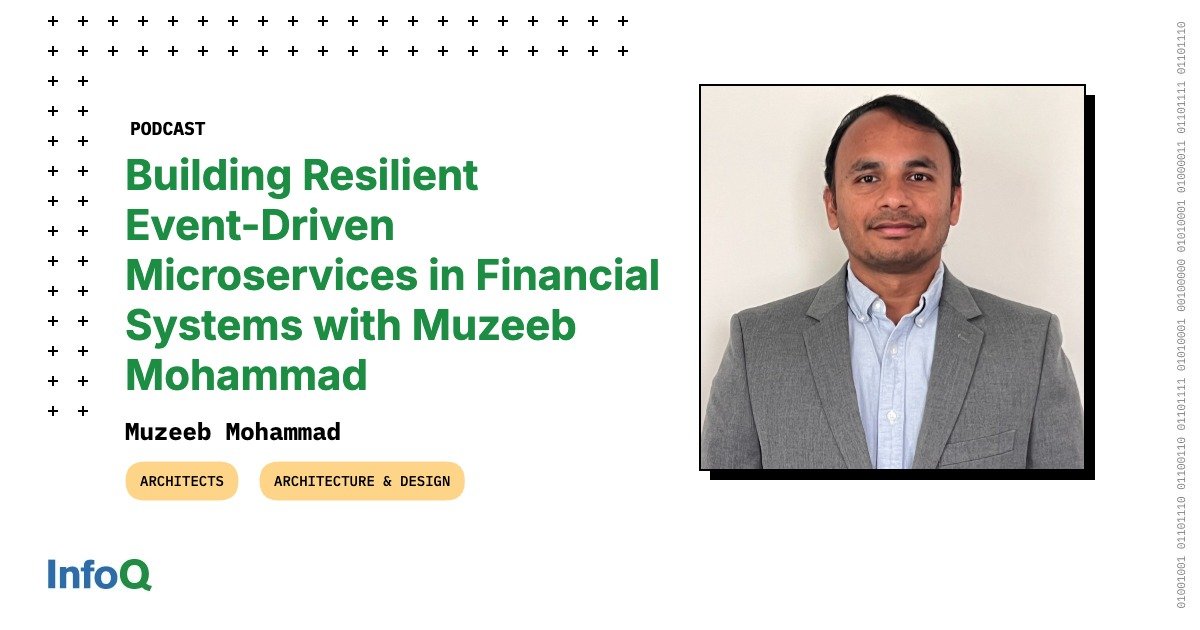
Muzeeb Mohammad is a Senior Manager of Software Engineering at JP Morgan Chase and a Senior Member of IEEE. He specializes in designing secure, resilient, and high-performance distributed microservices for large-scale financial platforms.
Listen to the full podcast on Apple Podcasts, YouTube, Soundcloud, Spotify, or Overcast.
Related Topics:
- Architecture & Design
- Observability
- Monitoring
- Resilience
- Microservices
- Event Driven Architecture
- Application Performance Management
Related Content:
- Scaling API Independence: Mocking, Contract Testing & Observability in Large Microservices Environments
- Understanding and Mitigating High Energy Consumption in Microservices
- Monzo's Real-Time Fraud Detection Architecture with BigQuery and Microservices
- Using Traffic Mirroring to Debug and Test Microservices in Production-Like Environments
** Join a community of over 250,000 senior developers.
Comments
Please log in or register to join the discussion