
BunsenLabs Linux has released Carbon, its Debian 13-based lightweight distro that modernizes while maintaining its CrunchBang heritage.
BunsenLabs Linux has released Carbon, its latest version based on Debian 13 "Trixie," marking seven months since Debian's latest stable release became available. The new version represents a careful evolution of the lightweight, Debian-based distribution that began as a community continuation of CrunchBang Linux.
A brief history of BunsenLabs
BunsenLabs was announced in February 2015, just days after CrunchBang called it quits. The project emerged as one of two main continuations of CrunchBang, with the other being CrunchBang++ (CB++), a mainly one-man project by Ben "Computermouth" Young. While CB++ tends to release sooner and sticks very close to the original CrunchBang model, BunsenLabs has positioned itself as the more experimental and innovative sibling.
Both projects share the same heritage but have evolved in different directions. CB++ remains technologically conservative, using the X11-based Openbox window manager and tint2 panel, while BunsenLabs has been more willing to experiment with new approaches.
What's new in Carbon
The Debian 13-based BunsenLabs Carbon moves slightly further from its CrunchBang roots while maintaining the familiar aesthetic. The most notable changes involve replacing multiple core components with alternatives that can work on both X11 and the Wayland-based labwc compositor.
Desktop environment changes
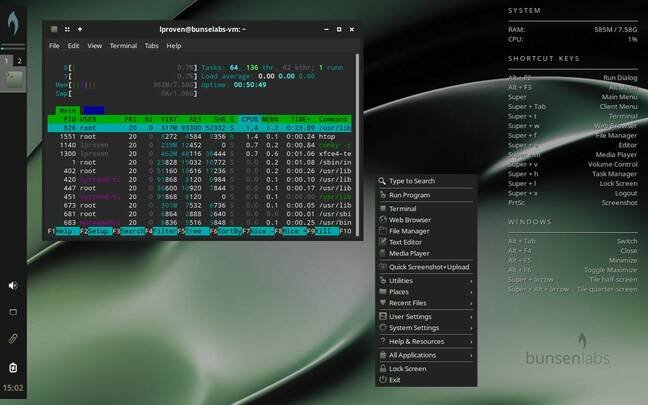
The tint2 panel has been replaced by xfce4-panel from the Xfce desktop, and LXDE's lxterminal has given way to xfce4-terminal. These changes bring several advantages:
- The Xfce panel includes a built-in GUI for adjusting settings, eliminating the need to edit configuration files manually
- The panel shows icons for apps using the stock Xfce window-buttons component, set to hide labels
- A virtual desktop indicator now displays two numbers, though users must switch between sections to see what's running on each desktop
The window manager remains Openbox, and the overall desktop appearance stays familiar with a vertical floating panel on the left, no desktop icons, and a Conky system monitor displaying hotkeys for launching applications using the Super (Windows) key.
Menu system evolution
The classic CrunchBang-style app menu, now called bl-menu, launches when clicking the menu button at the top. Unlike Xfce's start-menu analogs, this maintains the traditional BunsenLabs approach while benefiting from the underlying Xfce infrastructure.
Technical improvements and Wayland readiness
While Carbon still defaults to Openbox on X.org, the maintainers have laid groundwork for a potential transition to Wayland. The new components can work with both X11 and the Wayland-based labwc compositor, making future migration possible without a complete desktop overhaul.
Performance characteristics
Despite being Debian underneath with systemd, BunsenLabs Carbon remains quite lightweight:
- Approximately 550 MB of RAM in use when idle
- Takes about 4.4 GB of disk space
- Uses less RAM and disk space than CB++ 13 on comparable hardware
The distribution's efficiency makes it suitable for older hardware while still providing a modern computing experience.
Comparison with CrunchBang++
When comparing the two Debian 13 releases, several differences emerge:
- CB++ 13 was released in August 2025, soon after Debian 13 itself
- CB++ sticks close to its tried-and-tested design with X11-based Openbox and tint2 panel
- BunsenLabs Carbon is slightly lighter and, according to the article, "rather prettier"
- CB++ maintainer is investigating an Alpine Linux-based variant, which would be an interesting development
Installation and availability
The BunsenLabs Carbon release is available now for users who want a lightweight, customizable Linux distribution with Debian's stability and extensive package repositories. The distribution maintains the balance between modern functionality and system efficiency that has made BunsenLabs popular among users who prefer a more hands-on approach to their desktop environment.
For users coming from CrunchBang or those who appreciate minimalist, keyboard-friendly interfaces, BunsenLabs Carbon offers a familiar yet updated experience that respects its heritage while embracing necessary improvements.

Comments
Please log in or register to join the discussion