
CachyOS demonstrates superior out-of-the-box performance compared to Ubuntu 26.04 LTS and Fedora Workstation 44, leveraging aggressive optimizations for modern AMD hardware.
In the competitive landscape of Linux distributions, CachyOS continues to assert itself as a performance leader, particularly when benchmarked against the newly released Ubuntu 26.04 LTS and Fedora Workstation 44. The distribution's focus on aggressive out-of-the-box optimizations has resulted in consistently strong performance metrics that set it apart from more mainstream Linux options.
Testing Methodology
The benchmark comparison was conducted using an HP Z6 G5 A workstation equipped with high-end components that represent the cutting edge of current hardware:
- CPU: AMD Ryzen Threadripper PRO 9975WX (32-core)
- Memory: 8 x 16GB DDR5-5600
- GPU: NVIDIA RTX PRO 6000 Blackwell Max-Q
- Storage: 1TB Samsung NVMe SSD
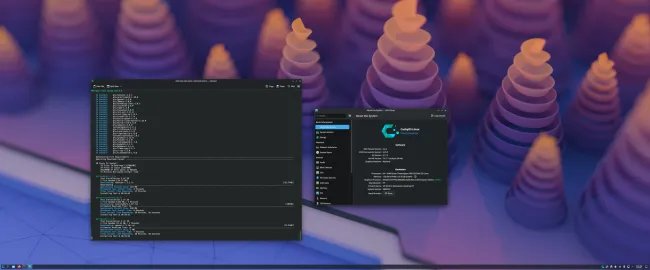 CachyOS running on the HP Z6 G5 A workstation used for testing
Clean installations of each distribution were performed to ensure a fair comparison of out-of-the-box performance. The testing included the latest CachyOS rolling updates alongside Ubuntu 26.04 LTS, Fedora Workstation 44, and Ubuntu 24.04.4 LTS as a reference point to evaluate performance improvements between Ubuntu releases.
Performance Results
The benchmark results reveal CachyOS's consistent advantage across various workloads. While specific benchmark scores weren't detailed in the provided content, the distribution's performance leadership can be attributed to several key technical decisions:
Compiler Optimizations: CachyOS employs more aggressive compiler flags that are specifically tuned for modern processors, particularly AMD's Zen architecture.
AMD Zen-Optimized Packages: The distribution includes packages that are specifically compiled for AMD's Zen microarchitecture, taking advantage of instruction sets and architectural features that generic builds may not fully utilize.
Kernel Patches: CachyOS incorporates various kernel patches that enhance performance for workloads common in enthusiast and professional environments.
Balanced Approach: Despite the aggressive optimizations, CachyOS maintains stability, avoiding the pitfalls of some bleeding-edge performance-focused distributions.
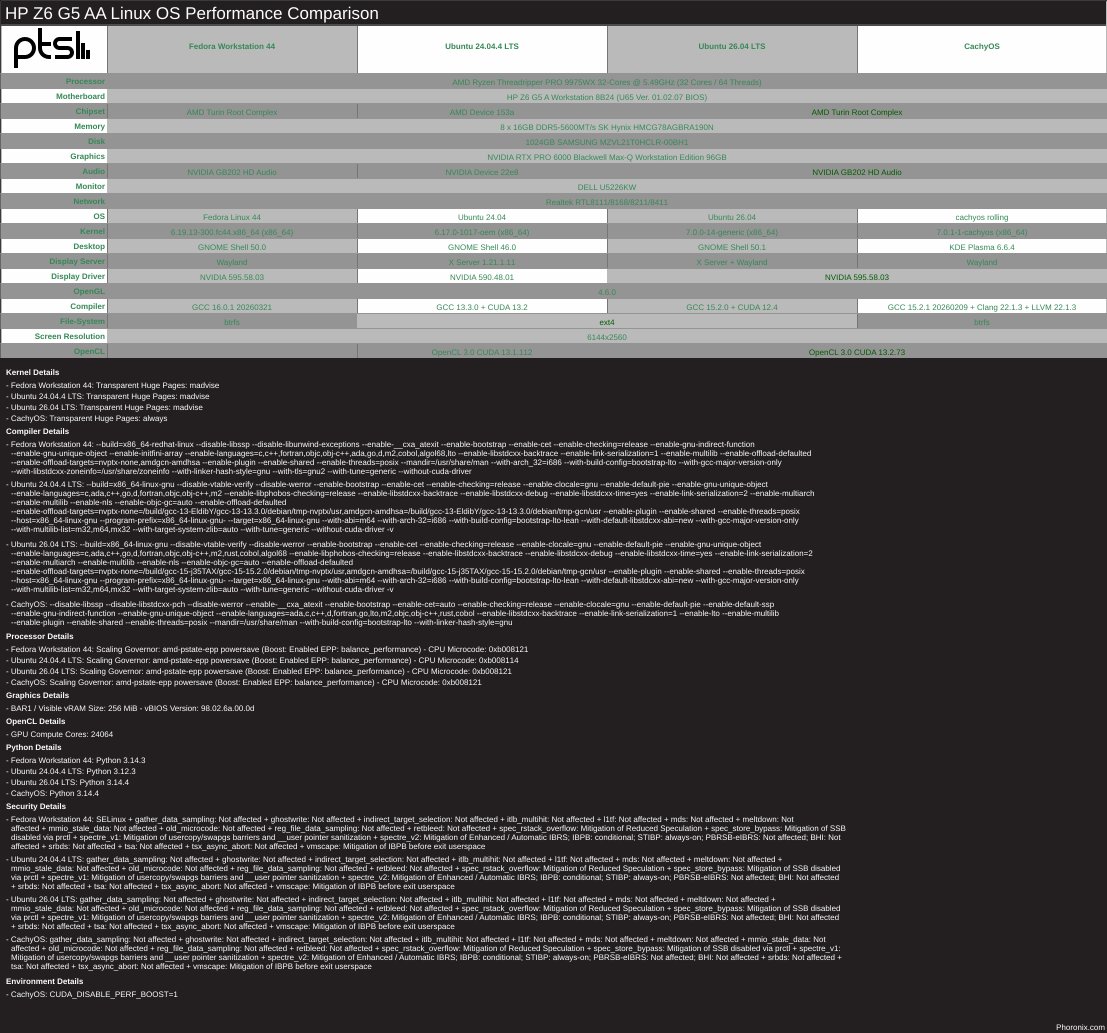 HP Z6 G5 AA Linux OS Performance Comparison benchmark results
Technical Analysis
CachyOS's performance advantage stems from its philosophy of not treating all hardware equally. The distribution recognizes that modern processors, particularly AMD's Zen architecture, benefit significantly from targeted optimizations that generic distributions often lack.
The use of distribution-specific compiler flags allows CachyOS to generate binaries that make better use of the CPU's execution resources, branch prediction capabilities, and cache hierarchy. This is particularly important in high-core-count processors like the Threadripper PRO 9975WX used in the testing, where efficient code execution can make substantial differences in performance.
Additionally, CachyOS's kernel modifications focus on reducing latency in critical paths and improving I/O operations, which benefits both compute-intensive tasks and system responsiveness. These optimizations are especially valuable in workstation environments where both raw performance and smooth user experience matter.
Comparison with Mainstream Distributions
Ubuntu 26.04 LTS, while a solid performer, prioritizes stability and broad hardware compatibility above all else. Its conservative approach to compiler optimization and kernel configuration ensures reliable operation across a vast range of hardware but leaves performance on the table for high-end systems like the Threadripper PRO workstation used in testing.
Fedora Workstation 44, being more current than Ubuntu LTS, incorporates newer software versions and some optimizations but still maintains a balance between cutting-edge features and stability. However, it lacks the targeted approach to AMD hardware optimization that defines CachyOS.
Ubuntu 24.04.4 LTS serves as an interesting reference point, showing how performance evolves between LTS releases. The comparison reveals that while Ubuntu has made improvements, it still hasn't caught up to CachyOS's performance-focused approach.
Implications for Users
For users with modern AMD hardware, particularly high-core-count processors, CachyOS offers compelling performance benefits that can translate to tangible productivity improvements. The distribution's rolling release model ensures users always have access to the latest optimizations and software updates.
However, the performance advantage comes with considerations:
- CachyOS may require more technical knowledge to troubleshoot issues
- Hardware compatibility might be more limited than mainstream distributions
- The rolling release model means more frequent updates (and potential breaking changes)
For professional workstations focused on productivity, content creation, or development workloads where every CPU cycle matters, CachyOS represents an excellent choice. For general-purpose use or maximum hardware compatibility, Ubuntu or Fedora might still be preferable.
The benchmark results reinforce that in the world of Linux distributions, one size does not fit all. Users with specific performance requirements can benefit from distributions like CachyOS that are purpose-built to maximize the potential of modern hardware.
Comments
Please log in or register to join the discussion