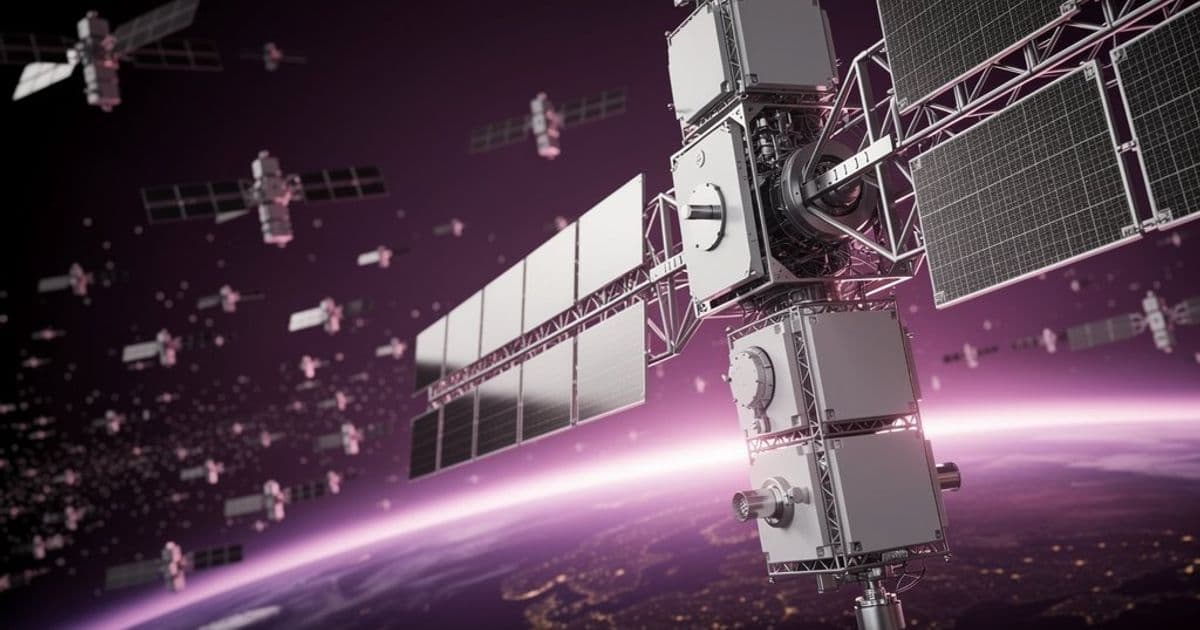
Chinese firms have filed applications with the International Telecommunication Union to launch over 200,000 internet satellites, a dramatic escalation in the global space race that comes just weeks after Beijing criticized SpaceX's Starlink constellation as a collision risk.

Chinese firms have submitted applications to the International Telecommunication Union (ITU) for more than 200,000 internet satellites, representing a massive expansion of China's orbital ambitions. The filings were made at the end of December 2025, shortly after Chinese officials raised concerns about SpaceX's Starlink constellation creating collision risks in shared orbital resources.
The two largest projects, designated CTC-1 and CTC-2, each propose 96,714 satellites. Both were filed by the Institute of Radio Spectrum Utilisation and Technological Innovation, an organization that according to the Radio Association of China was only registered in Hebei province on December 30, 2025—the day after these ITU submissions were made. This timing suggests the entity was created specifically to handle these satellite filings.
What's Actually New Here
The sheer scale of these applications is unprecedented. For context, SpaceX's current Starlink constellation operates approximately 6,000 satellites, with FCC approval for up to 12,000 in its first generation and pending approval for an additional 30,000 second-generation satellites. The Chinese filings alone would represent more than triple the total approved Starlink capacity.
However, ITU filings represent intentions, not commitments. The ITU requires satellite operators to file frequency coordination requests and technical specifications, but these applications must still undergo years of technical review, frequency coordination with other nations, and national regulatory approval before any launches occur.
The Collision Risk Context
The timing is notable. In late 2025, Chinese space officials publicly criticized SpaceX's Starlink satellites for creating near-miss scenarios. Chinese state media reported that Starlink satellites had made "dangerous approaches" to China's space station modules in 2021 and 2022, forcing evasive maneuvers.
SpaceX has consistently maintained that its satellites have autonomous collision avoidance systems and that the risk of orbital collisions remains extremely low. The company tracks objects through its own systems and coordinates with the US Space Force's 18th Space Defense Squadron.

Technical and Regulatory Hurdles
These Chinese applications face significant obstacles:
Frequency Coordination: The ITU requires satellite operators to coordinate frequencies to prevent interference. With 200,000 satellites potentially sharing spectrum, this becomes a complex international negotiation that could take years.
Orbital Debris: Each satellite adds to the space debris problem. Even with deorbiting plans, the sheer number creates risk. The European Space Agency estimates over 1 million objects larger than 1 cm currently orbit Earth.
Launch Capacity: China currently lacks the launch capacity to deploy such a massive constellation quickly. The country's largest rocket, the Long March 5B, can lift approximately 25 tons to low Earth orbit. Deploying 200,000 satellites would require thousands of launches.
Satellite Miniaturization: Most proposed satellites would need to be small, likely under 200 kg each, to make the economics work. This requires advances in satellite technology that may not yet be mature.
The Broader Pattern
This filing represents a strategic shift in China's space policy. Historically, China has focused on government-led space station programs and lunar missions rather than commercial satellite constellations. The emergence of multiple private Chinese satellite companies filing through a newly created entity suggests Beijing is now encouraging a competitive commercial approach.
The filings also reflect a growing recognition that low Earth orbit is becoming a contested resource. The US, China, Russia, and European nations all see satellite constellations as critical infrastructure for global communications and internet access.
What Happens Next
The ITU review process will likely take 3-5 years for these applications. During that time, the Chinese firms must demonstrate technical capability, secure launch licenses from Chinese regulators, and complete frequency coordination with other satellite operators.
If approved, the actual deployment would likely be phased over a decade or more. The first priority would be establishing a working constellation of a few hundred satellites to prove the technology and business model before scaling to the full proposed numbers.
The real significance may be political rather than technical. These filings signal China's intent to compete in the global satellite internet market and challenge SpaceX's current dominance. Whether 200,000 satellites actually reach orbit remains uncertain, but the message is clear: the space race for orbital internet dominance is accelerating.
For SpaceX, this represents potential competition in a market it has largely dominated. However, the company benefits from years of operational experience, established launch infrastructure, and a growing customer base. The Chinese filings, while ambitious, still face substantial technical and regulatory barriers before they become operational reality.
Comments
Please log in or register to join the discussion