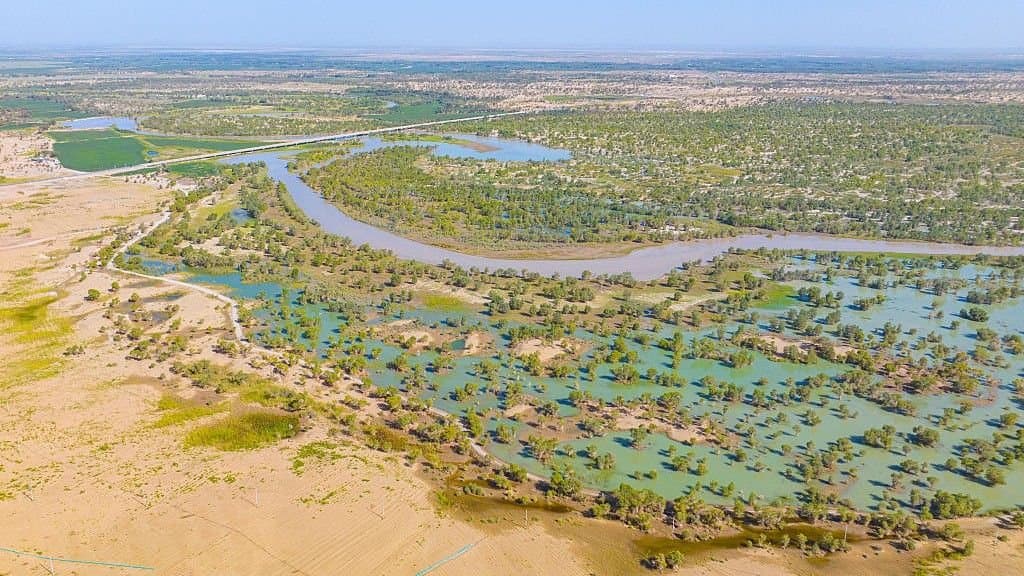
China's massive tree-planting initiative around the Taklamakan Desert has transformed this arid region into a carbon-absorbing ecosystem, offering a model for combating desertification and climate change.
Vegetation grows on the banks of the Tarim River along the Taklamakan Desert's northern edge. (Image credit: CFOTO/Future Publishing via Getty Images)
China's ambitious tree-planting campaign around the Taklamakan Desert has achieved something remarkable: transforming one of the world's largest and driest deserts into a carbon sink that absorbs more carbon dioxide from the atmosphere than it releases.
The Taklamakan Desert, spanning approximately 130,000 square miles (337,000 square kilometers) in northwestern China, has long been considered a "biological void" due to its extreme aridity. Encircled by high mountains that block moist air for most of the year, the desert's harsh conditions made it inhospitable for most plant life.
However, over the past several decades, China has implemented an extensive afforestation program around the desert's periphery. A new study published in the Proceedings of the National Academy of Sciences reveals that this human-led intervention is beginning to yield significant environmental benefits.
"We found, for the first time, that human-led intervention can effectively enhance carbon sequestration in even the most extreme arid landscapes, demonstrating the potential to transform a desert into a carbon sink and halt desertification," said Yuk Yung, professor of planetary science at Caltech and senior research scientist at NASA's Jet Propulsion Laboratory.
The Great Green Wall Initiative
The transformation stems from China's Three-North Shelterbelt Program, also known as the "Great Green Wall," launched in 1978. This massive ecological engineering project aimed to plant billions of trees around the margins of the Taklamakan and Gobi deserts by 2050 to combat desertification.
To date, more than 66 billion trees have been planted in northern China. The program has dramatically increased forest cover in the country from 10% of its area in 1949 to more than 25% today. China completed encircling the Taklamakan Desert with vegetation in 2024.
Heavy machinery is used to level sand dunes where China wants to plant trees and shrubs along the edges of the Taklamakan Desert. (Image credit: CFOTO/Future Publishing via Getty Images)
Scientific Evidence of Carbon Sequestration
The research team analyzed 25 years of satellite data, ground observations, and atmospheric measurements to assess the desert's carbon dynamics. Their findings show a clear correlation between vegetation expansion and increased carbon dioxide uptake.
During the Taklamakan's wet season from July to September, precipitation averages about 0.6 inches (16 millimeters) per month—2.5 times higher than the dry season. This precipitation enhances vegetation cover, greenness, and photosynthesis along the desert's margins, lowering CO2 levels from 416 parts per million in the dry season to 413 ppm in the wet season.
Vegetation cover around the Taklamakan Desert has grown, boosting photosynthesis and CO2 sequestration. (Image credit: CFOTO/Future Publishing via Getty Images)
Implications for Desert Management
The study demonstrates that the Taklamakan Desert, at least along its rim, represents "the first successful model demonstrating the possibility of transforming a desert into a carbon sink," according to Yung. This finding challenges previous assumptions about the limitations of afforestation in extreme arid environments.
While experts continue to debate whether the Great Green Wall has significantly reduced sandstorms, its role as a carbon sink may serve as a valuable model for other desert regions facing similar challenges of desertification and climate change.
The research also contrasts with earlier studies that focused on CO2 absorption by desert sand itself, which suggested that sand is not a stable carbon sink under climate change due to temperature-related CO2 release.
Broader Context
China's approach offers important lessons for global efforts to combat desertification and climate change. The country's forest cover has increased dramatically since 1949, demonstrating the potential for large-scale ecological restoration projects to deliver multiple environmental benefits.
As climate change intensifies and desertification threatens more regions worldwide, the Taklamakan experiment provides evidence that even the most extreme arid landscapes can be transformed through sustained human intervention and ecological engineering.
The success of this initiative suggests that strategic afforestation could play a significant role in global carbon management strategies, particularly in regions where traditional approaches to carbon sequestration may be less effective.
Comments
Please log in or register to join the discussion