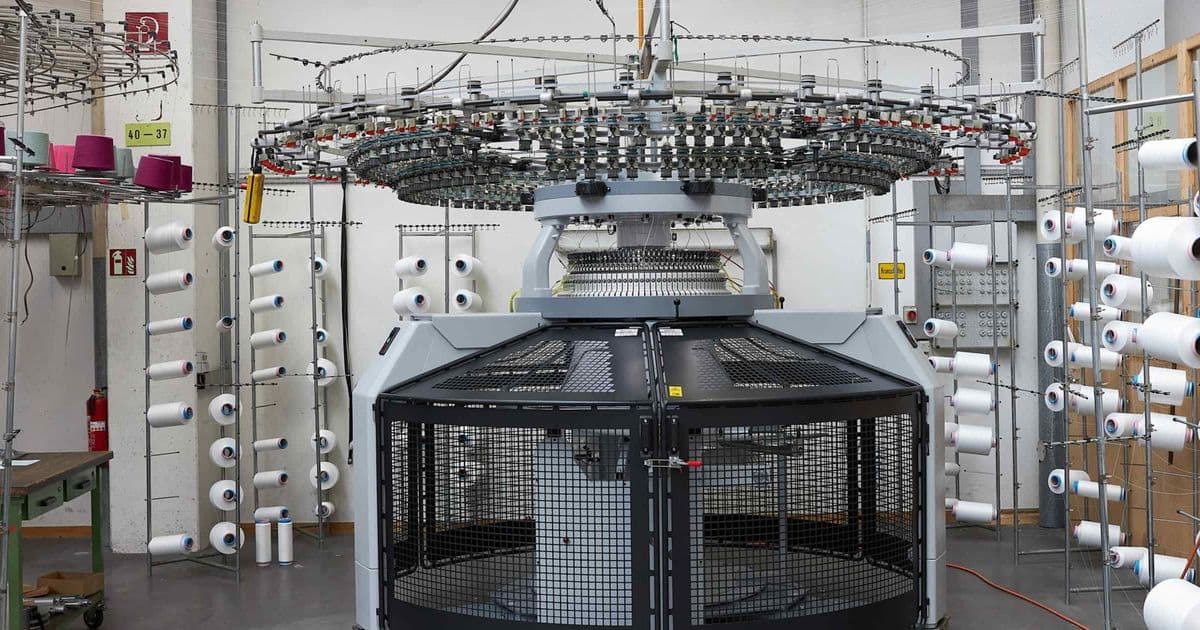
Chinese investor Huixing acquires 120-year-old Mayer & Cie, providing new capital and market access to a German textile machinery giant facing increasing competition from Chinese manufacturers.
In a significant cross-border industrial transaction, Chinese investment firm Huixing has acquired a controlling stake in Mayer & Cie, the 120-year-old German manufacturer of circular knitting machines. The deal injects new capital into the family-owned business while potentially reshaping the competitive dynamics of global textile manufacturing equipment.
Founded in 1906, Mayer & Cie has established itself as a cornerstone of the German textile industry, with over 80,000 of its circular knitting machines operating worldwide. These specialized machines produce components for clothing items including hats, socks, collars, and other garments that end up in collections from global fashion retailers such as H&M, Uniqlo, and Decathlon. The acquisition comes at a critical time for the company as it faces mounting pressure from lower-cost Chinese competitors in the textile machinery sector.
The financial terms of the deal were not disclosed, but the strategic implications extend far beyond the balance sheet of Mayer & Cie. The company has struggled with pricing pressures and market share erosion as Chinese manufacturers have developed increasingly sophisticated textile machinery capabilities. By bringing in a Chinese investor, Mayer & Cie gains access to potentially lower-cost manufacturing components and distribution channels throughout Asia, while maintaining its German engineering and quality standards.
For Huixing, the acquisition represents a strategic foothold in the high-value segment of textile manufacturing equipment. While China dominates the lower and mid-range textile machinery market, premium European brands like Mayer & Cie have maintained strong positions in the high-precision, high-speed segments where reliability and technical sophistication command premium prices. This acquisition may signal a broader strategy by Chinese investors to acquire established Western brands to gain technological capabilities and market credibility.
The global textile machinery market was valued at approximately $4.2 billion in 2025, with Asia-Pacific accounting for nearly 45% of consumption. Europe represents about 30% of the market, with Germany being a particularly significant player due to its precision engineering capabilities. The sector has seen consolidation in recent years, with several Italian and German manufacturers either merging or being acquired by larger industrial groups.
Mayer & Cie's circular knitting machines represent a specialized segment of textile manufacturing. Unlike conventional sewing machines that join flat pieces of fabric, circular knitting machines create seamless tubes of fabric in a single process. This technology reduces material waste and production time while enabling more complex fabric structures. The company's machines can cost anywhere from €50,000 to over €500,000 depending on the model and capabilities, reflecting their position in the premium segment of the market.
The acquisition raises questions about the future of Mayer & Cie's production facilities in Germany and Switzerland. While the company has maintained manufacturing operations in Europe, cost pressures may eventually lead to some production shifting to Asia. However, the company's reputation for quality and innovation suggests that core engineering and R&D functions will likely remain in Europe.
Industry analysts view this transaction as part of a broader trend of Chinese investment in European manufacturing assets. In 2025 alone, Chinese companies invested approximately €8.5 billion in European industrial assets, with a particular focus on machinery, automotive components, and renewable energy equipment. This represents a 12% increase from 2024 levels, indicating sustained Chinese interest in acquiring established Western brands and technologies.
For Mayer & Cie, the Huixing investment provides a "new lease of life" as the company navigates an increasingly competitive landscape. The infusion of capital will likely support product development initiatives while maintaining the quality standards that have made the brand trusted by premium fashion manufacturers. The partnership may also enable Mayer & Cie to develop more cost-effective models to compete with Chinese manufacturers in mid-range markets while preserving its premium positioning.
The deal also reflects the evolving nature of global textile supply chains. As fashion brands increasingly seek to diversify their manufacturing bases beyond traditional low-cost countries like Bangladesh and Vietnam, there is growing demand for flexible, high-quality production equipment that can enable shorter production runs and faster response times. This trend benefits specialized manufacturers like Mayer & Cie that offer technologically advanced solutions.
Looking ahead, the success of this acquisition will likely depend on how effectively Huixing and Mayer & Cie's management can integrate their respective strengths. The German company brings decades of engineering expertise and established relationships with global fashion brands, while the Chinese investor provides capital, market access, and potentially manufacturing efficiencies. If managed well, this combination could create a more competitive global player in the textile machinery sector.
The transaction also highlights the strategic importance of specialized manufacturing technologies in an era of increasing protectionism and supply chain uncertainty. As countries seek to rebuild domestic manufacturing capabilities, the companies that control key production technologies will hold significant influence over global manufacturing networks.
For the textile industry at large, Mayer & Cie's acquisition by a Chinese investor signals a maturation of the competitive landscape. Chinese manufacturers have moved beyond competing solely on price to developing increasingly sophisticated capabilities. The acquisition of established European brands represents a next phase in this evolution, combining Chinese market advantages with Western technological expertise.
As global fashion brands continue to face pressure to improve sustainability and efficiency in their supply chains, the companies that can provide innovative manufacturing solutions will be well-positioned for growth. Mayer & Cie, with its enhanced resources through the Huixing investment, may be better positioned to develop technologies that address these industry challenges.
The transaction between Huixing and Mayer & Cie represents more than just a change of ownership in a century-old German company. It reflects the ongoing reshaping of global manufacturing competitiveness, the increasing sophistication of Chinese industrial capabilities, and the strategic importance of specialized manufacturing technologies in the 21st century economy.
Comments
Please log in or register to join the discussion