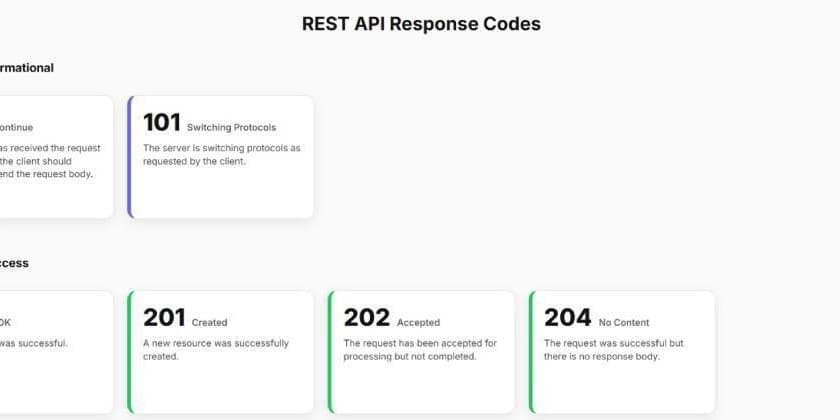
HTTP status codes seem simple until you see them misused daily. This guide breaks down the most common REST API status code confusions and explains when to use each one correctly.
HTTP status codes seem simple until you see them misused daily. This guide breaks down the most common REST API status code confusions and explains when to use each one correctly.
The Problem with Status Code Consistency
Choosing the correct HTTP status code in REST APIs sounds simple — until you work on real projects. In practice, I kept seeing the same issues repeatedly:
- 200 OK returned for validation errors
- Confusion between 400 and 422
- 401 and 403 used interchangeably
- Business rule failures mapped to random 4xx codes
These small inconsistencies slowly break API contracts and make frontend–backend collaboration harder.
Common Status Code Confusions (with Examples)
400 vs 422
400 Bad Request The request is malformed or structurally invalid.
422 Unprocessable Entity The request is valid, but business validation failed. Use 422 when the payload is correct but domain rules are violated.
401 vs 403
401 Unauthorized Authentication is missing or invalid.
403 Forbidden The user is authenticated but does not have permission.
This distinction becomes very important when building secure APIs.
409 Conflict
Often underused, but very useful. Use 409 Conflict when a request conflicts with the current state of the resource:
- duplicate data
- version conflicts
- business rule violations
Why I Built a Small Helper
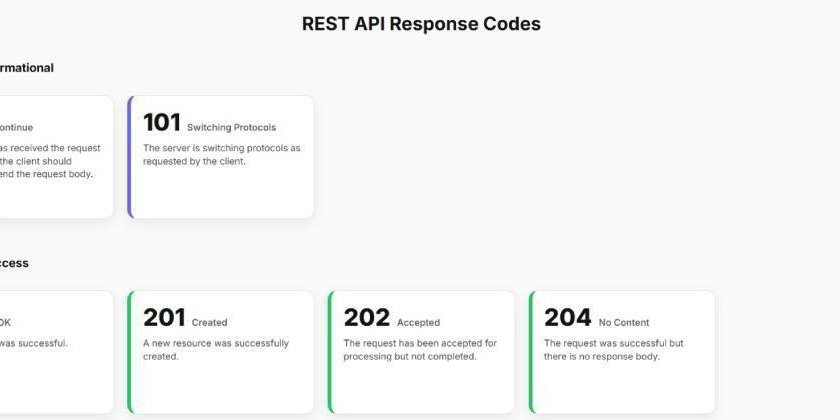
After repeatedly explaining these choices in code reviews and discussions, I built a small visual helper that maps common REST API scenarios to appropriate HTTP status codes. The goal was:
- Simplicity over completeness
- REST-focused usage (not browser behavior)
- Clear "when to use" guidance
- Real-world API scenarios
You can explore the live demo at https://ramkumar-kollimalayan.github.io/rest-api-response-code-helper/ and find the source code on GitHub.
A Small Reflection
What surprised me most was how often developers treated this as a reference rather than a one-time read. It reinforced the idea that small, focused tools solving everyday confusion can be more useful than large, exhaustive documentation.
Feedback Welcome
This helper is intentionally opinionated and scoped. If you design or review APIs regularly, I'd love to hear:
- Which HTTP status codes you see misused most
- Any scenarios where you would choose differently
Thanks for reading!

Comments
Please log in or register to join the discussion