Cloudflare launches Custom Regions, allowing customers to define arbitrary geographic groupings for data processing boundaries, expanding beyond its 35 pre-defined regions to meet specific compliance and sovereignty requirements.
Cloudflare has introduced Custom Regions, a new feature that expands its Regional Services offering by allowing customers to precisely define where their data is processed across its global edge network. The announcement marks a significant evolution in Cloudflare's approach to data residency, moving beyond pre-defined geographic regions to support arbitrary combinations of countries and territories.
From Fixed Regions to Custom Boundaries
The new Custom Regions capability addresses a long-standing customer request for more granular control over data processing locations. While Cloudflare previously offered 35 pre-defined regions, customers often needed specific combinations that didn't fit neatly into these categories. The feature allows organizations to create custom geographic groupings based on their unique compliance, regulatory, or business requirements.
Andrew Berglund, systems engineer at Cloudflare, and Erik Engstrom, product leader at Cloudflare, explained the motivation behind the feature: "While our 35 pre-defined regions serve many of our customers' needs, the digital world isn't one-size-fits-all. We've heard you loud and clear: you've asked for a specific country, unique combinations of countries, and the ability to exclude a set of countries from a region."
How Custom Regions Work
Custom Regions operates on three fundamental building blocks that customers must configure:
- Defining region membership - Customers specify which data centers belong to their custom region using expressions based on ISO country codes
- Selecting an in-region destination - Cloudflare determines the optimal processing location within the defined boundaries
- Enforcing boundaries at the edge - The system ensures all processing stays within the specified geographic limits
Region membership can be defined using inclusion rules like country_code == "TR" or country_code in ["DE", "FR", "NL"], or exclusion rules such as !(country_code in ["US", "CA", "MX"]). The system evaluates these expressions against metadata from each data center to determine region boundaries.
For destination selection, Cloudflare uses a sophisticated algorithm that intersects allowed data centers with a performance-ranked list based on real-time network quality, capacity, and health metrics. This ensures both compliance with geographic boundaries and optimal performance for end users.
A Different Approach to Regional Processing
Cloudflare's approach differs fundamentally from traditional cloud providers like Azure or AWS. Rather than defining fixed geographic regions with resources deployed in specific data center subsets, Cloudflare operates a global edge network where workloads run across its entire infrastructure.
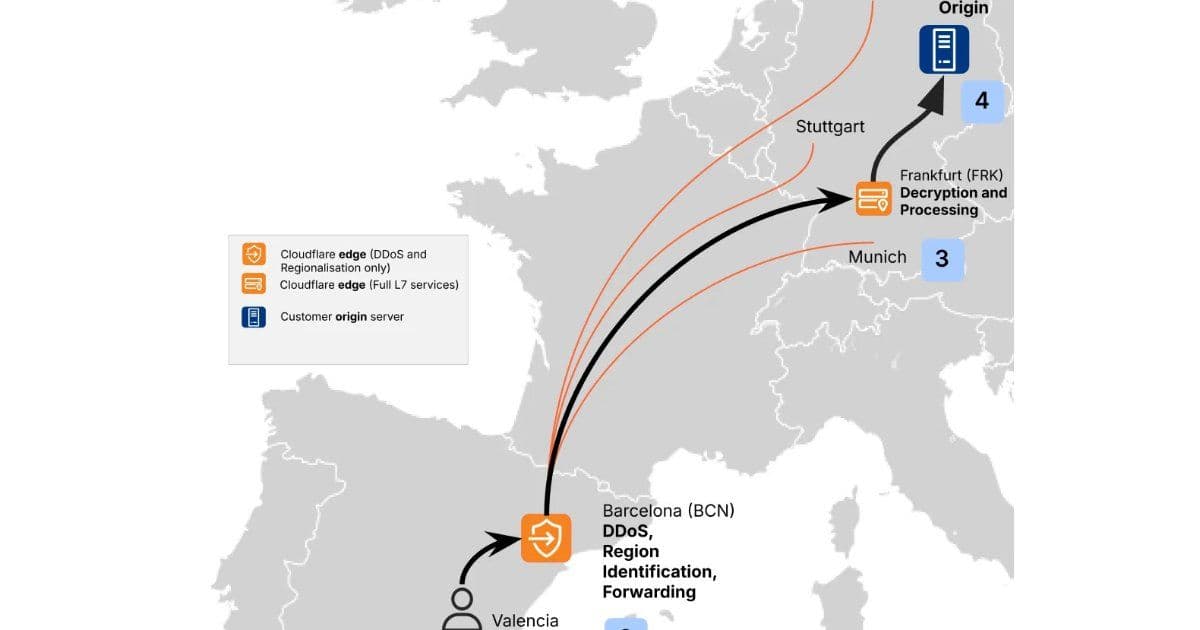
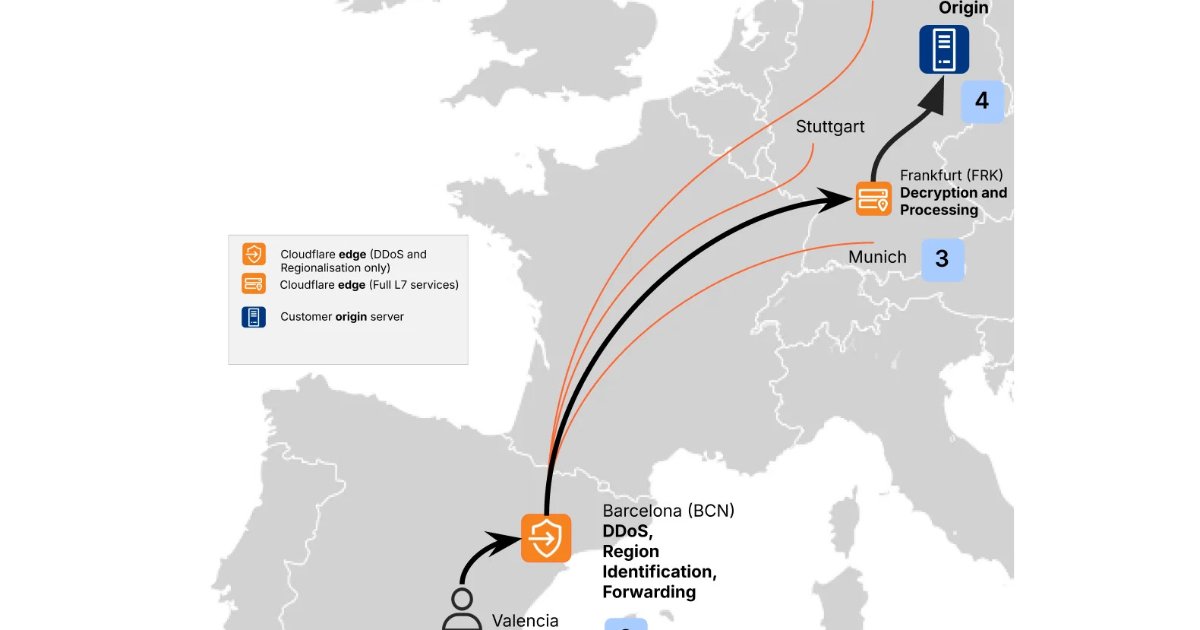
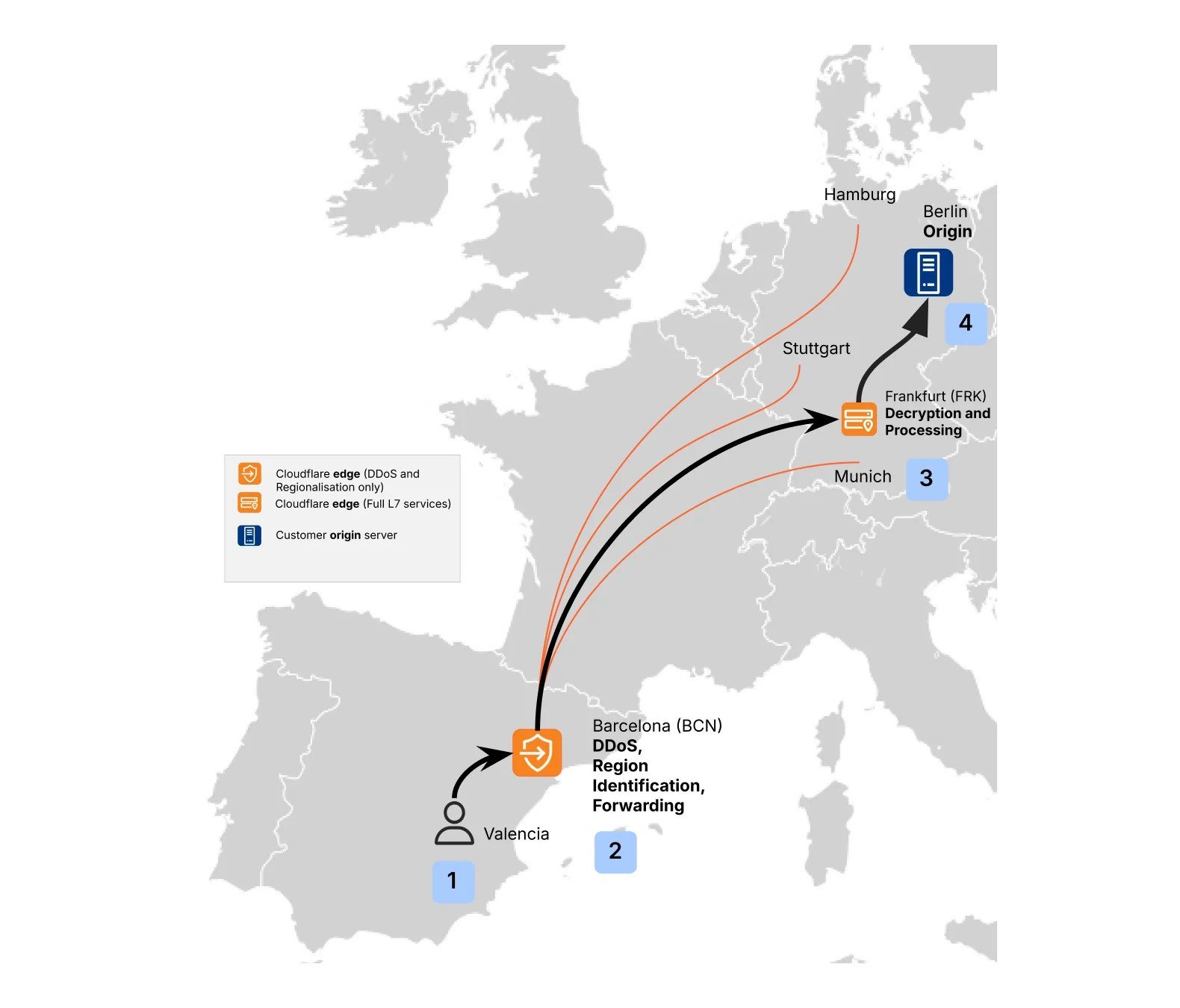
This "edge-first" architecture means that regional processing isn't about deploying resources in a specific area, but rather about controlling where traffic flows and where processing occurs. The system initially receives and protects traffic at the nearest data center for global ingestion and L3/L4 DDoS defense, then checks whether the request belongs to the configured region. Requests are either processed locally or forwarded to the appropriate in-region data center for TLS termination and Layer 7 processing.
Real-World Use Cases
The flexibility of Custom Regions enables numerous practical scenarios. Organizations can create regions that include North America (Canada, United States, and Mexico), or exclude those three countries to create a "rest of world" region. More creative combinations are also possible, such as defining a region based on countries that use Fahrenheit (United States, Bahamas, Cayman Islands, Marshall Islands, and Liberia).
This granularity is particularly valuable for organizations with complex compliance requirements, multinational operations, or specific data sovereignty needs that don't align with traditional geographic boundaries.
Industry Context and Compliance
On LinkedIn, R5 Inteligência Digital noted that "Fine-grained regional boundaries are becoming a board-level requirement where compliance and latency both matter. Custom Regions should help teams move from policy intent to enforceable operating controls."
This observation highlights the growing importance of data residency controls in enterprise environments. As regulations like GDPR, Schrems II, and various national data protection laws evolve, organizations need more sophisticated tools to demonstrate compliance and maintain control over their data processing locations.
Current Availability and Implementation
At launch, Custom Regions is not available as a self-service feature. Customers must contact their Cloudflare account team to implement custom region configurations. This approach allows Cloudflare to work closely with customers to understand their specific requirements and ensure proper implementation.
The feature builds on Cloudflare's existing Regional Services foundation, which already enforces the core principle that "TLS termination and Layer 7 processing only happen inside your chosen region." Custom Regions simply expands the flexibility of defining what those chosen regions can be.
Technical Architecture and Enforcement
The enforcement mechanism is critical to Custom Regions' effectiveness. When traffic enters Cloudflare's network, the system performs several checks:
- Initial global ingestion and DDoS protection at the nearest data center
- Region membership verification based on the configured custom region
- Routing decisions to either process locally or forward to an appropriate in-region data center
- Strict enforcement that all Layer 7 processing occurs within the defined boundaries
This multi-step process ensures that even with the increased flexibility of custom regions, the fundamental compliance guarantees remain intact.
Looking Forward
Custom Regions represents Cloudflare's response to the growing demand for flexible, fine-grained data residency controls in a global edge computing environment. As organizations navigate increasingly complex regulatory landscapes and seek to balance global performance with regional compliance, features like Custom Regions become essential tools in their cloud architecture toolkit.
The introduction also signals Cloudflare's continued evolution from a simple CDN and security provider to a comprehensive edge computing platform that can meet sophisticated enterprise requirements for data sovereignty and compliance.
For developers and architects, Custom Regions offers a new dimension of control over application deployment and data processing, enabling more nuanced approaches to global application design while maintaining compliance with regional requirements.
Comments
Please log in or register to join the discussion