A deep dive into the practical challenge of retrofitting gigabit networking in UK homes, where phone sockets outnumber Ethernet ports by a vast margin. The author documents the discovery and deployment of Gigacopper's G4201TM, a device that leverages existing telephone wiring to deliver full gigabit speeds, and explores the technical and logistical hurdles involved.
The Problem: UK Homes Are Wired for the Past
British housing stock presents a unique networking challenge. Walk into a modern apartment or a decades-old terrace, and you'll find a proliferation of phone sockets—often two per room, sometimes more. Yet, Ethernet ports are virtually nonexistent. There's no building code requiring data wiring, so even new constructions rely on the legacy telephone infrastructure. This creates a frustrating gap: gigabit internet service is available, but distributing that bandwidth within the home is a nightmare.
For years, the author lived with powerline adapters, which use the home's electrical wiring to transmit data. Performance was inconsistent. Early models delivered a stable but meager 30 Mbps. Later, a G.hn 2400 standard adapter managed 180 Mbps to the office (with high variance) and only 80 Mbps to the top floor. The latency was acceptable for gaming, but the bandwidth was insufficient for large downloads, like the 50 GB updates for Helldivers 2 that plague modern gaming.
The core issue is that electrical wiring is noisy. It's designed for 50/60 Hz AC power, not for high-frequency data signals. Every switch, appliance, and dimmer introduces interference. Phone lines, in contrast, are dedicated to carrying signals. They should, in theory, be a far superior medium for data transmission.
The Solution: Gigacopper and G.hn over Copper
The technology to run Ethernet over telephone lines isn't new. The G.hn standard, developed by the ITU-T, is designed to work over any copper wiring—power lines, coaxial cables, and phone lines. It's mature and proven. The problem isn't the standard; it's the product ecosystem. Manufacturers have focused almost exclusively on powerline adapters, neglecting the potentially superior phone line market.
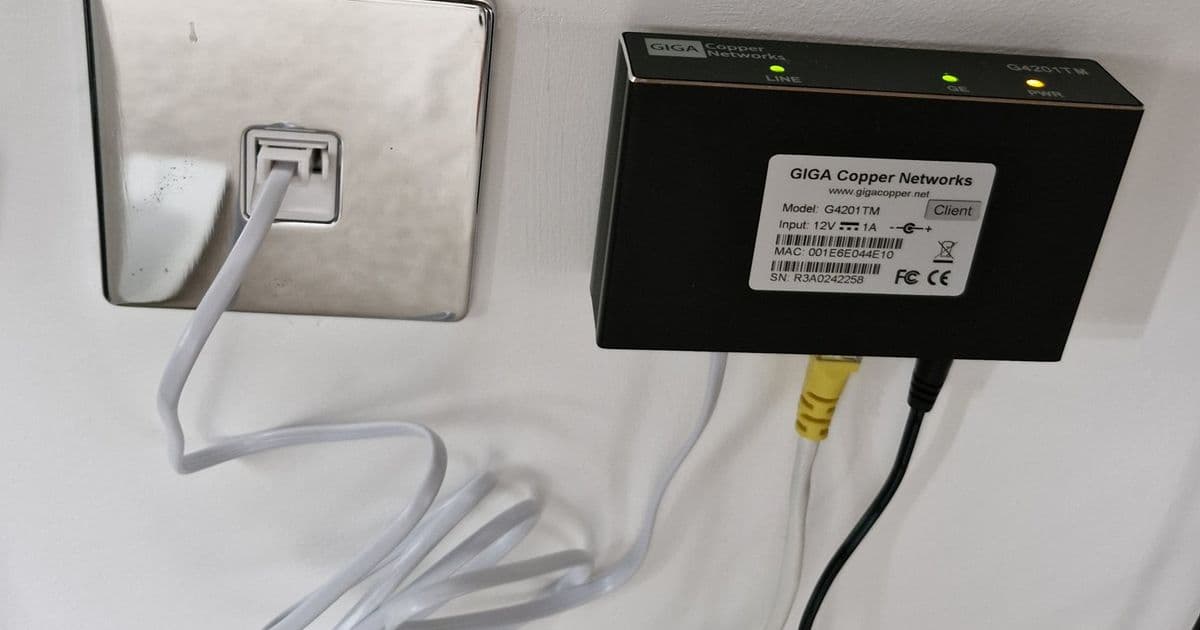
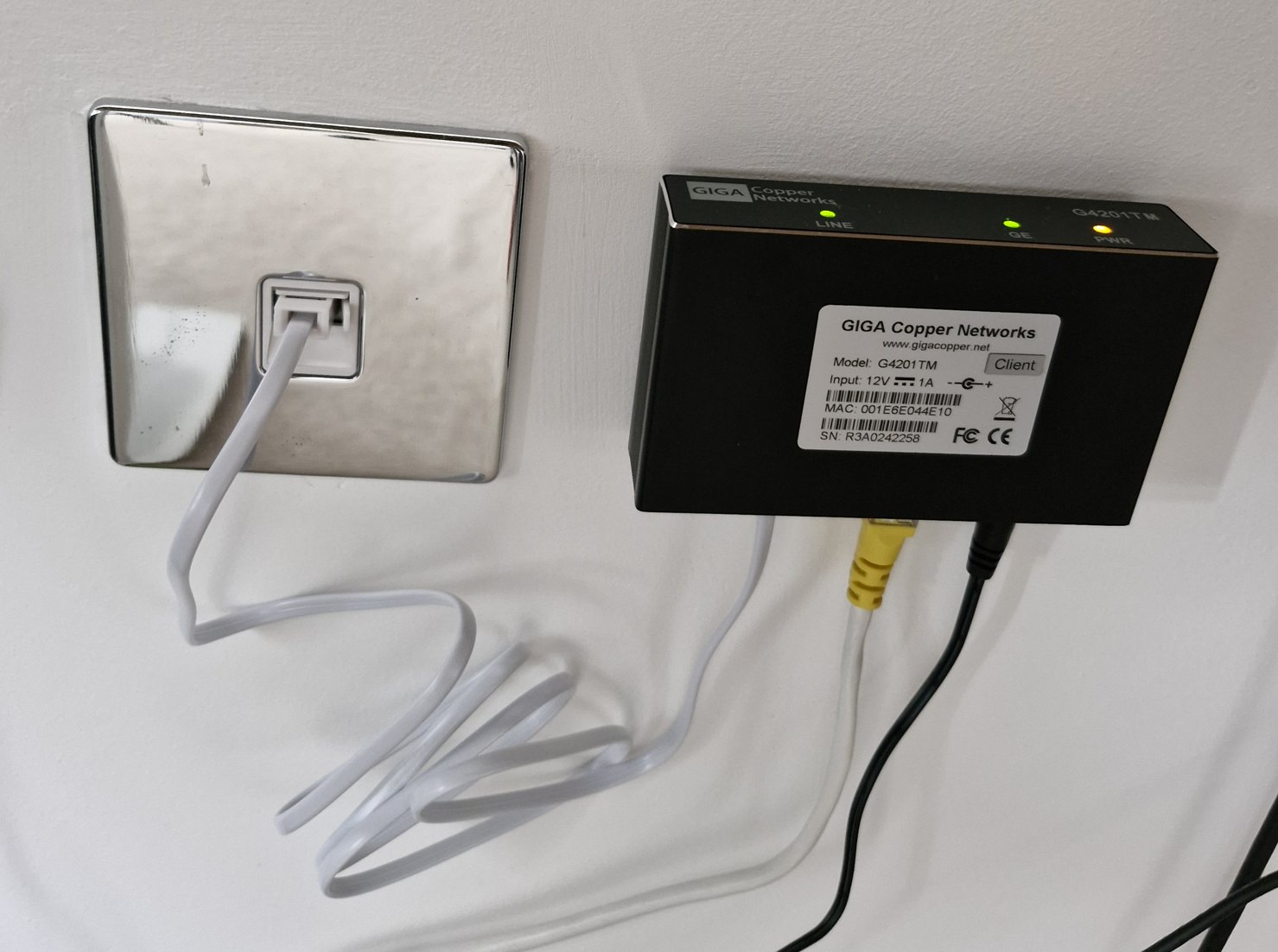
After extensive searching, the author found a German company, Gigacopper, that manufactures exactly what was needed. Their G4201TM device is a simple bridge: it connects to a standard RJ11 phone socket on one end and provides a gigabit Ethernet (RJ45) port on the other. It's powered by a simple adapter.
The product is niche, which means it's not available on mainstream UK retailers. The author ordered via eBay Germany, a process that required navigating international shipping and Brexit-era customs procedures. The package, shipped via DHL to Royal Mail, was held at the border until import fees (20% VAT plus handling) were paid online—a cumbersome but standard process for EU-to-UK shipments since 2020.
Deployment and Testing: From Theory to Full Gigabit
Upon arrival, the hardware was straightforward: a pair of G4201TM units, a German-to-UK power adapter (included), and an RJ11 cable. The author supplemented this with standard UK phone cables (BT631A to RJ11) and existing Ethernet cables.
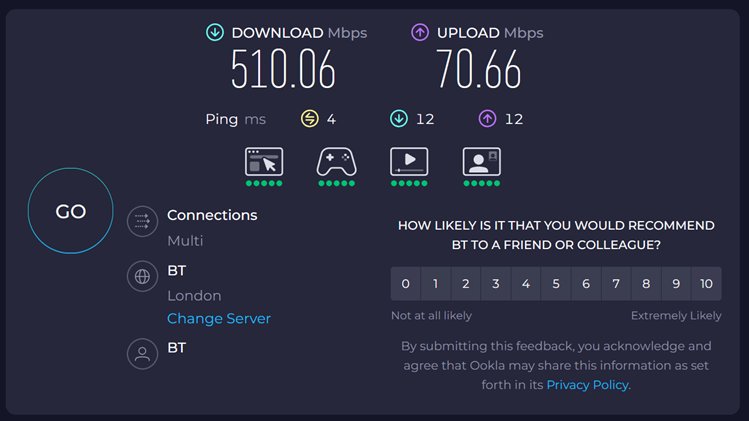
Plugging the devices into phone sockets in different rooms yielded an immediate success: the full 500 Mbps internet connection was delivered to the remote room. The web interface reported a physical layer speed of 1713 Mbps, and a debugging tool showed a connected link at 1385 Mbps over a 200 MHz phone line (SISO mode).
A critical discovery followed: the author had inadvertently purchased the "Client/Server" variant, which is pre-configured as a dedicated pair with asymmetric bandwidth (70/30 split) and slightly higher latency. The intended product was the "InHome" variant, which supports up to 16 devices in a peer-to-peer mesh with sub-millisecond latency. Gigacopper's support was responsive, providing the necessary firmware and tools to reflash the devices to the correct mode.
Verifying a true gigabit link required a more rigorous test. The author's initial plan—using a laptop with a built-in Ethernet port—failed due to a dead CPU fan. This underscored a key point: for most homes, a 1 Gbps link is more than sufficient. The real value of the Gigacopper device is its ability to create a shared 1.7 Gbps physical layer link across multiple rooms, far exceeding the needs of any single device.
To finally confirm the capability, an USB-C to Ethernet adapter was used. Running iperf3 between a phone (via Wi-Fi, as a source) and a computer (via the Gigacopper link) confirmed the full gigabit throughput. The system works as advertised.
The Wiring Labyrinth: Why This Is a Miracle
The author's investigation into the home's actual wiring revealed why retrofitting Ethernet is nearly impossible. British phone sockets are daisy-chained in an "incomprehensible maze." A single Cat5 cable (8 wires) might be used for a phone line, with only 2 or 4 wires actually connected.
Opening a socket in the office revealed two Cat5 cables daisy-chained, with only three wires in use. The master socket in the technical room—a critical junction where internal wiring meets the external line—was even more puzzling: a single Cat5 cable with only four wires connected. This was not the true master socket. The real external line and the cables from other floors were likely hidden behind a blank plate, with a tangled mess of mismatched, crimped wires.
This chaotic, undocumented wiring makes it virtually impossible to reconfigure the home for standard Ethernet. You cannot simply replace phone sockets with RJ45 jacks when the underlying cabling is a daisy-chained, two-wire setup. Installing switches to break the daisy chain would be impractical and costly.
This is where the Gigacopper device becomes a "miracle." It doesn't care about the wiring topology. It works over whatever pair of wires are available, whether they're daisy-chained or not. It bypasses the need for structured cabling entirely.
The Untapped Market and Final Verdict
The experience highlights a significant gap in the UK market. While powerline adapters are ubiquitous, products designed for phone line networking are rare, despite the technology being mature and the physical infrastructure being perfectly suited. For millions of UK residents living in homes with dozens of phone sockets and zero Ethernet ports, this is the only practical way to achieve wired gigabit speeds without invasive and expensive renovations.
The Gigacopper G4201TM, while niche and requiring an international purchase, delivers on its promise. It transforms the legacy telephone network into a high-speed data backbone, offering stable, low-latency gigabit connectivity. For anyone struggling with Wi-Fi dead zones or the limitations of powerline adapters in a UK home, this solution is worth the effort of sourcing from Germany.
The author's journey from a struggling 180 Mbps powerline link to a verified 1 Gbps connection over phone wires demonstrates that sometimes, the best solution isn't the newest or most advertised one—it's the one that intelligently repurposes what's already there.

Comments
Please log in or register to join the discussion