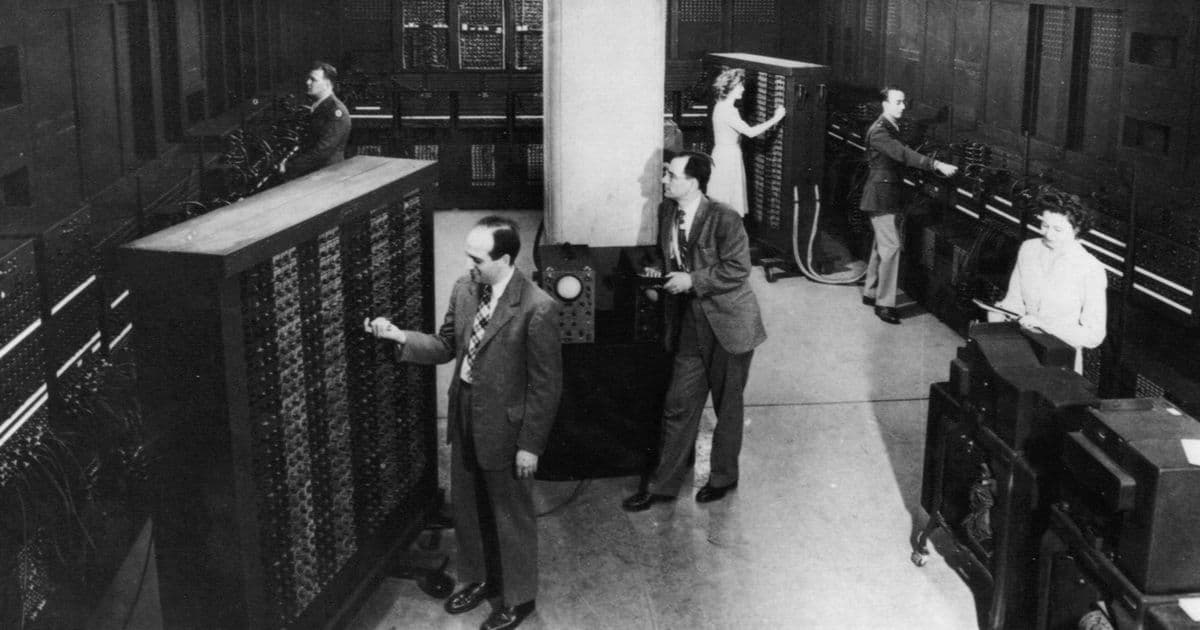
On February 15, 1946, the ENIAC became the world's first general-purpose electronic computer, marking the beginning of the digital revolution that would eventually lead to modern computing.
Today marks the 80th anniversary of a technological milestone that changed the course of human history: the public unveiling of the ENIAC (Electronic Numerical Integrator and Computer) on February 15, 1946. Constructed at the Moore School of Electrical Engineering at the University of Pennsylvania, this massive machine represented the dawn of the electronic computing era and laid the foundation for every digital device we use today.
A Colossus of Computing Power
When ENIAC was first demonstrated to the world, it was nothing short of revolutionary. At a time when complex calculations could take weeks to complete by hand, ENIAC could perform approximately 5,000 calculations per second. This made it roughly 1,000 times faster than its mechanical and electromechanical predecessors, bringing mathematical computation to electronic speeds for the first time.
The machine's capabilities were immediately recognized as transformative. "The ballistics calculation that previously took 12 hours on a hand calculator could be done in just 30 seconds," notes the Penn Engineering blog. This dramatic speedup had immediate practical applications, particularly for the U.S. military, which had funded the project.
ENIAC's computational prowess was applied to a wide range of critical tasks. Beyond calculating artillery trajectories, it was used for hydrogen bomb calculations, ballistic missile and rocket computations, and even early weather prediction experiments. These applications demonstrated the machine's versatility as a general-purpose computing device, distinguishing it from earlier specialized calculating machines.
Engineering Marvel of Its Time
To appreciate ENIAC's significance, it's worth examining its extraordinary construction. The machine contained 18,000 vacuum tubes, 70,000 resistors, 10,000 capacitors, and an astonishing 500,000 soldered joints. It consumed 150 kilowatts of power and occupied a 30 by 50-foot room, weighing approximately 30 tons.
ENIAC was composed of 40 panels arranged in a U-shape, each serving specific functions. The architecture included a Cycling Unit, Master Programmer Unit, Function Tables, Accumulators, and Digit Trays. Today, some of the original ENIAC panels remain on display in the Moore Building, where students can sit in the shadow of this computing behemoth that helped launch their field.
Programming ENIAC was a complex and time-consuming process that bears little resemblance to modern software development. Programmers used a combination of plugboard wiring and three portable function tables, each containing 1,200 ten-way switches. Mapping a problem to run on ENIAC typically required several weeks of work by highly trained teams, followed by extensive testing, verification, and debugging.
The Human Side of ENIAC
The story of ENIAC includes important but often overlooked contributions from women programmers. Jean Bartik and Frances Spence were among the six women who programmed the machine, and they were present at its public unveiling. Bartik even helped troubleshoot a switch issue the night before the demonstration. Despite their crucial roles in making ENIAC operational and demonstrating its capabilities, the contributions of these women programmers were nearly forgotten for decades.
(Image credit: University of Pennsylvania)
Reliability Challenges
ENIAC's reliance on vacuum tubes presented significant reliability challenges. Several tubes would burn out each day, rendering the machine nonfunctional about half the time, according to Wikipedia sources. However, as engineers gained experience with the machine's characteristics, reliability improved considerably. The maintenance requirements were substantial, but the computational benefits far outweighed the operational difficulties.
Legacy and Evolution
The ENIAC was officially retired on October 2, 1955, after nearly a decade of service. By that time, the computing landscape had already begun to evolve. Its successor, the EDVAC, implemented the stored-program architecture that would become standard in modern computers. The early 1950s saw the introduction of UNIVAC I and IBM's entry into the mass market with systems like FORTRAN programming.
From these early machines emerged the IBM PC era of the early 1980s, and ultimately the ubiquitous personal computing devices we use today. "All thanks to the ENIAC," Penn Engineering cheekily asserts, and while that might be an overstatement, there's no denying ENIAC's pivotal role in demonstrating that electronic digital computing was not just possible but practical and transformative.
A Humble Beginning for Modern Computing
Looking back from our current vantage point, where even the simplest microcontroller exceeds ENIAC's capabilities by orders of magnitude, it's easy to dismiss the machine as primitive. However, this perspective misses the point. ENIAC wasn't just a computer; it was the proof of concept that launched an entire industry and fundamentally altered the trajectory of human technological development.
The 80th anniversary of ENIAC's unveiling reminds us that revolutionary technologies often begin as cumbersome, power-hungry, and unreliable prototypes. What matters is not their initial perfection but their demonstration of possibility. ENIAC showed the world that electronic computing could work, and that single insight opened the door to everything that followed.
The machine that once filled a room and consumed enough power for a small town now fits in our pockets with capabilities that would have been unimaginable in 1946. Yet every smartphone, every laptop, every server owes a debt to that first general-purpose electronic computer that proved the concept and inspired generations of engineers to push the boundaries of what was possible.
As we celebrate ENIAC's 80th birthday, we're not just commemorating an old machine; we're honoring the moment when the digital age truly began.
Comments
Please log in or register to join the discussion