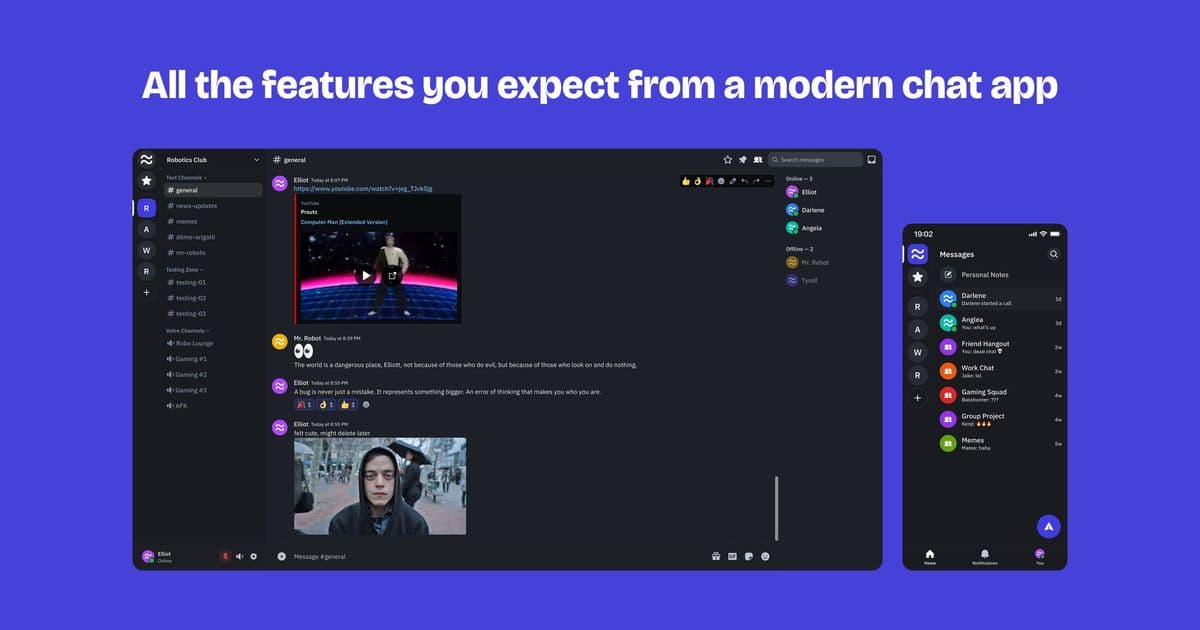
Hampus Kraft, a 22-year-old Swedish developer, has spent five years building Fluxer - an ambitious open source alternative to Discord that prioritizes user control, transparency, and European ownership over venture capital incentives.
In an era where digital communication platforms increasingly prioritize investor returns over user experience, a young Swedish developer has spent half a decade building what he believes could be the most credible open source alternative to Discord yet. Hampus Kraft, a 22-year-old computer engineering student at KTH Royal Institute of Technology, has quietly developed Fluxer - a feature-complete, self-hostable instant messaging and VoIP platform that mirrors Discord's familiar interface while offering fundamentally different incentives.
The Genesis of an Alternative
Kraft's journey began in 2017 when he first discovered Discord as a high school student. What started as casual use evolved into deep technical fascination during the pandemic lockdowns of 2020. While studying from home, Kraft found himself with abundant time to explore Discord's architecture, eventually joining their Testers program and earning bug hunting credentials.
"What I'm about to introduce is a brand new OSS community chat app I've worked on solo, on and off, for the past 5 years," Kraft explains. "I believe it's one of the closest public attempts at feature parity with platforms like Discord or Slack to date."
The timing feels prescient. Discord's rumored March 2026 IPO has intensified scrutiny of the platform's direction, with users increasingly concerned about data privacy, feature accessibility, and the inevitable pressure to monetize that comes with public markets.
Why Build Another Chat Platform?
Kraft is refreshingly honest about Fluxer's target audience. "If Discord does what you need, and you're fine relying on a proprietary, investor-driven platform and have no concerns about their upcoming IPO, then you probably don't need Fluxer."
Instead, Fluxer targets users who value:
- Free and open source software under AGPLv3 licensing
- Self-hosting capabilities without artificial restrictions
- European ownership and data residency options
- Transparent business models without venture capital pressure
- Familiar UX that doesn't require learning new patterns
"Discord's network effect is hard to beat head-on," Kraft acknowledges, "so I'm focusing where switching is already plausible: technical users and communities that value control and transparency, and want software they can run on their own terms."
The Technical Foundation
Fluxer's architecture represents years of iteration and learning. The current stack draws heavily from Discord's proven patterns while incorporating lessons from other large-scale messaging platforms like WhatsApp.
Backend Architecture
The backend splits across several components, though self-hosting requires only the core server:
- Fluxer Server (TypeScript): The main application with modules for HTTP API, workers, media proxy, and more
- Fluxer Gateway (Erlang): Handles real-time connections using Erlang/OTP's strengths for fault tolerance
- LiveKit: Optional dependency for voice and video capabilities
- Cloudflare Tunnels: For easy home hosting without port forwarding
Kraft chose Erlang/OTP specifically for its "soft real-time systems and hot code swapping" capabilities. "You can replace code while the application is running without losing live state or connections," he notes, paying homage to the language's creators: "Hello Mike. Hello Joe. Hello Robert."
The real-time system mirrors Discord's approach, using a session-based architecture where each user connection maintains state through GenServers. This allows for efficient presence tracking, message buffering, and seamless reconnection handling.
Database Strategy
Initially built on Cassandra for production use, Fluxer now supports SQLite as the default for self-hosted instances. Kraft's reasoning reveals deep architectural thinking:
"Cassandra makes it hard to be accidentally inefficient. You have to think upfront about how your data is modelled and queried, because inefficient queries are either impossible or very explicitly opt-in."
For write-heavy, event-driven applications like Fluxer, Cassandra's eventual consistency model proves advantageous. "When you send a message on Fluxer, you generally only hit the database with a single foreground read to validate your auth session," Kraft explains.
The Frontend Challenge
The web client represents perhaps the most complex aspect of Fluxer. Kraft built a custom Discord-compatible Markdown parser and renderer with extensive testing, plus an infinite scrolling message scroller that handles the myriad edge cases of real-time chat.
Currently using Electron for desktop deployment, Kraft acknowledges the criticism: "I know, I know. I'm not too happy about it either." He's evaluating Tauri but notes that "the desktop app is ultimately at the mercy of whatever runtime the OS happens to provide."
Business Model Without VC
Fluxer's sustainability strategy centers on multiple revenue streams that align with its open source principles:
- Hosted freemium instance with optional Plutonium subscription for higher limits
- Lifetime Visionary plans for early supporters
- Donations from self-hosting users
- GitHub Sponsors for ongoing development
- Paid support through Operator Passes
- Commercial licenses for companies wanting AGPLv3 exemptions
Crucially, Kraft emphasizes that "Fluxer is committed to not paywalling parts of the software or requiring licence key checks. It also won't force upgrades to unlock quotas on software you run yourself."
Privacy and Moderation
Fluxer takes a different approach to content moderation than typical platforms. Each instance is responsible for its own moderation, with Fluxer.app using Project Arachnid's Shield tool to detect known CSAM content.
The platform also addresses growing concerns about American technology dominance. While some dependencies are unavoidable, Fluxer uses European CDN provider Bunny.net and OVH hosting, with plans for EU-based instances as federation develops.
The Road Ahead
Currently in public beta, Fluxer has already achieved remarkable feature parity with Discord. The roadmap includes federation support, native mobile apps, and enhanced web integration.
Kraft's vision extends beyond just replicating Discord's features. He wants Fluxer to embrace the open web through RSS/Atom feeds for public forum channels, allowing content to be discoverable and archivable without AI intervention.
The Human Element
What makes Kraft's story compelling isn't just the technical achievement but the persistence behind it. Building a complex platform solo while completing a computer engineering degree represents extraordinary dedication.
"This is my work, and it's hard-earned," Kraft states. "If something seems too good to be true, it's because I've put real effort into making it good."
His use of AI tools reflects a pragmatic approach: "I treat the code it outputs like I would any external contribution. No LLM designed the system, wrote the specs, or made architectural decisions. That was all me."
The Broader Context
Fluxer arrives at a moment when users are increasingly questioning their dependence on centralized platforms. The project represents a bet that enough people value transparency, control, and European ownership to support an independent alternative.
"I want Fluxer to stay fully independent and bootstrapped," Kraft emphasizes. "That means relying heavily on donations, whether one-off or recurring."
Whether Fluxer can achieve escape velocity in a market dominated by network effects remains to be seen. But Kraft has already accomplished something remarkable: building a production-ready, feature-complete alternative to one of the most complex platforms in existence, all while maintaining his principles about open source, privacy, and user control.
As Kraft puts it: "With your help, Fluxer can become a serious FOSS alternative to Discord."
And perhaps, in an era of increasing platform consolidation and investor-driven decisions, that's exactly what the internet needs.
Comments
Please log in or register to join the discussion