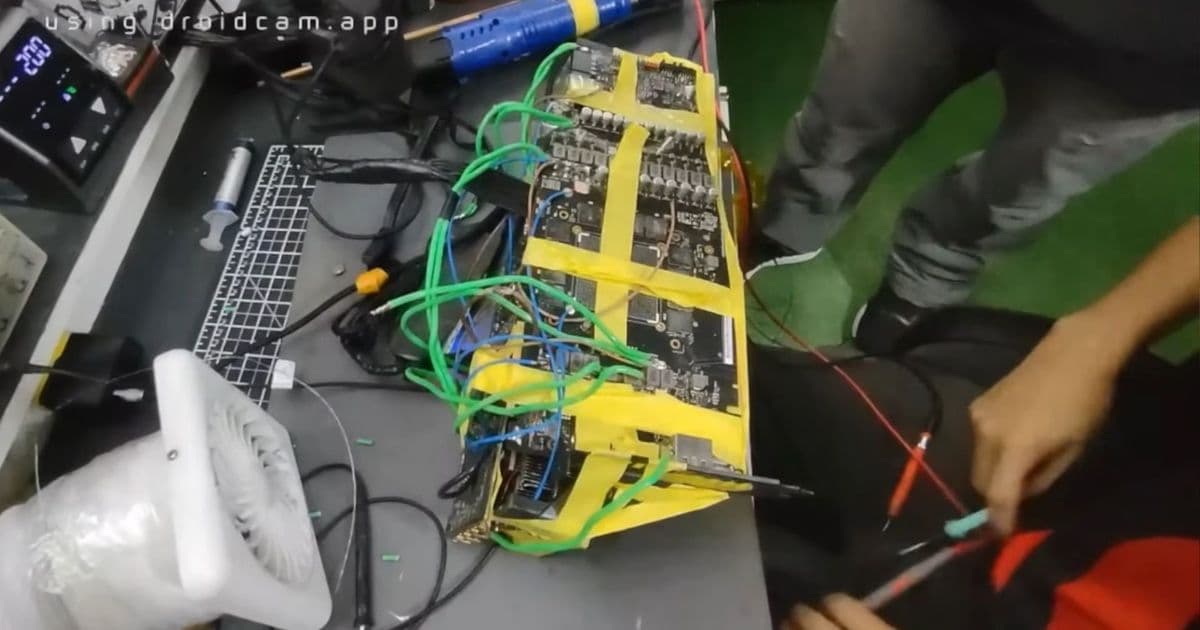
Brazilian modders resurrect a damaged RTX 5070 Ti by transplanting an RTX 2080 Ti PCB and AMD RX 580 VRMs, achieving record-breaking 3.23 GHz clock speeds and 11,150 Unigine Superposition score.
When a graphics card suffers catastrophic damage, most would consider it beyond repair. But Brazilian modder Paulo Gomes and his team saw opportunity where others saw scrap metal. What began as an attempt to resurrect a burned-out RTX 5070 Ti evolved into one of the most ambitious GPU modifications ever attempted, resulting in a hybrid card that now sits atop Unigine's benchmark leaderboard.
The Resurrection Begins
(Image credit: ET's LGA1155 via YouTube)
The journey started with a severely damaged RTX 5070 Ti that had suffered what appeared to be terminal failure. The card had a massive hole in its PCB, rendering it seemingly unusable. Rather than accepting defeat, Gomes and his team embarked on an engineering challenge that would push the boundaries of what's possible with consumer graphics hardware.
The initial hurdle was power delivery. The damaged card's VRMs (Voltage Regulator Modules) were compromised, making it impossible to supply adequate power to the GPU. The solution? Salvage working VRMs from an AMD Radeon RX 580. This cross-platform power solution was the first indication that this mod would break conventional rules.
Enter the RTX 2080 Ti Donor
Fresh from their initial success, Gomes teamed up with fellow YouTuber ET's LGA1155 to take the project to the next level. The team acquired an Asus RTX 2080 Ti, not for its GPU, but for its PCB. The plan was to transplant the working RTX 5070 Ti GPU onto the more robust RTX 2080 Ti PCB, creating a hybrid that would combine the best of both worlds.
The seven-hour transplant operation involved extensive soldering work. The team had to carefully wire up power and ground paths between the donor RTX 2080 Ti PCB and the original RTX 5070 Ti components. This wasn't simply a matter of plugging components together – it required precise electrical engineering to ensure proper signal routing and power delivery.
Technical Challenges and Solutions
Throughout the modification process, the team encountered numerous obstacles that would have stopped most enthusiasts in their tracks:
PCIe Lane Limitations: Initially, the benchmark system could only utilize the card over four PCIe 4.0 lanes, severely limiting bandwidth. The team later switched to a different benchmark PC that provided PCIe 3.0 over 16 lanes, effectively doubling the available bandwidth.
Voltage Issues: The card experienced a significant voltage drop of 400 mV under load during initial testing. Through careful adjustments and additional wiring, the team managed to reduce this to around 30 mV, a crucial improvement for stability and performance.
Thermal Management: Temperature spikes proved to be a major concern. The card experienced dramatic thermal events, including one instance where temperatures jumped from 50°C to 80°C in just one second. Additionally, 12V power wires reached nearly 100°C during benchmark testing, highlighting the extreme stress on the modified components.
Signal and Driver Conflicts: The team faced display signal issues at 1080p resolution and various driver conflicts that required extensive troubleshooting and firmware adjustments.
Performance Breakthrough
Despite the numerous challenges, the Frankenstein RTX 5070 Ti ultimately achieved remarkable results. The hybrid card reached an impressive 3.23 GHz clock speed, with memory bandwidth hitting 34 Gbps. These figures represent significant overclocking achievements, especially considering the card's damaged origins.
The true measure of success came through Unigine Superposition benchmarking. Throughout the modification process, the team used this tool to track progress and optimize performance. The final result was a high score of 11,150, placing this modified card at the top of Unigine's leaderboard for RTX 5070 Ti GPUs.
Engineering Marvel or Practical Achievement?
(Image credit: ET's LGA1155 via YouTube)
While the end result is undeniably impressive from a technical standpoint, it's important to note that this modification is far from practical for the average user. The copious amounts of electrical tape, solder joints, and makeshift wiring solutions make this a challenge that only serious electrical engineers with specialized equipment could hope to replicate.
The thermal management issues alone – with wires reaching near-100°C temperatures – demonstrate that this is more of a proof-of-concept than a viable consumer product. The card's stability under sustained load remains questionable, and the extensive modifications likely void any possibility of warranty coverage.
Significance in the Modding Community
This project represents a significant milestone in the PC hardware modding community. It demonstrates that with enough expertise, determination, and unconventional thinking, even severely damaged components can be given new life. The successful integration of parts from different GPU generations and even different manufacturers (AMD VRMs powering an Nvidia GPU) showcases the flexibility of modern graphics card architectures.
The achievement also highlights the importance of PCB design in graphics card performance. By transplanting the damaged RTX 5070 Ti onto a more robust RTX 2080 Ti PCB, the team was able to overcome limitations that would have otherwise prevented the card from reaching its full potential.
Looking Forward
While few enthusiasts will attempt to replicate this exact modification, the techniques and problem-solving approaches demonstrated by Gomes and his team provide valuable insights for the broader hardware modification community. The project serves as inspiration for those looking to push the boundaries of what's possible with existing hardware.
The Frankenstein RTX 5070 Ti stands as a testament to human ingenuity and the relentless pursuit of performance, even in the face of seemingly insurmountable technical challenges. It may not be practical, elegant, or safe for everyday use, but it undeniably represents a triumph of engineering creativity.
For those interested in following similar projects or learning more about extreme hardware modifications, Paulo Gomes documents his work on YouTube, where he continues to push the boundaries of what's possible with PC hardware.
Comments
Please log in or register to join the discussion