A solo developer's year-long journey transforming a personal Japanese learning tool into a crowdfunded physical product, navigating manufacturing, company formation, marketing challenges, and burnout before ultimately launching on Kickstarter.
In the summer of 2024, after finishing R. F. Kuang's "Babel" and finding myself with free time, I decided to return to learning Japanese. This seemingly simple decision would eventually lead me down a path that transformed a personal Anki deck into a Kickstarter project with a $55,000 funding goal.
The Initial Spark (August 2024)
Japanese presents unique challenges for Western learners, primarily due to Kanji. While Hiragana and Katakana consist of about 50 phonetic symbols each that can be learned in a week, there are approximately 2,136 Kanji required for fluency. Each character has multiple readings and meanings, making memorization a significant undertaking.
I've always been a proponent of spaced repetition systems, particularly Anki. Previous attempts at studying Kanji had left me frustrated with existing resources, especially their reliance on mnemonics that felt more like brute-force memorization than genuine understanding. I found these stories distracting and misleading compared to the etymological origins of characters, which provide deeper comprehension.
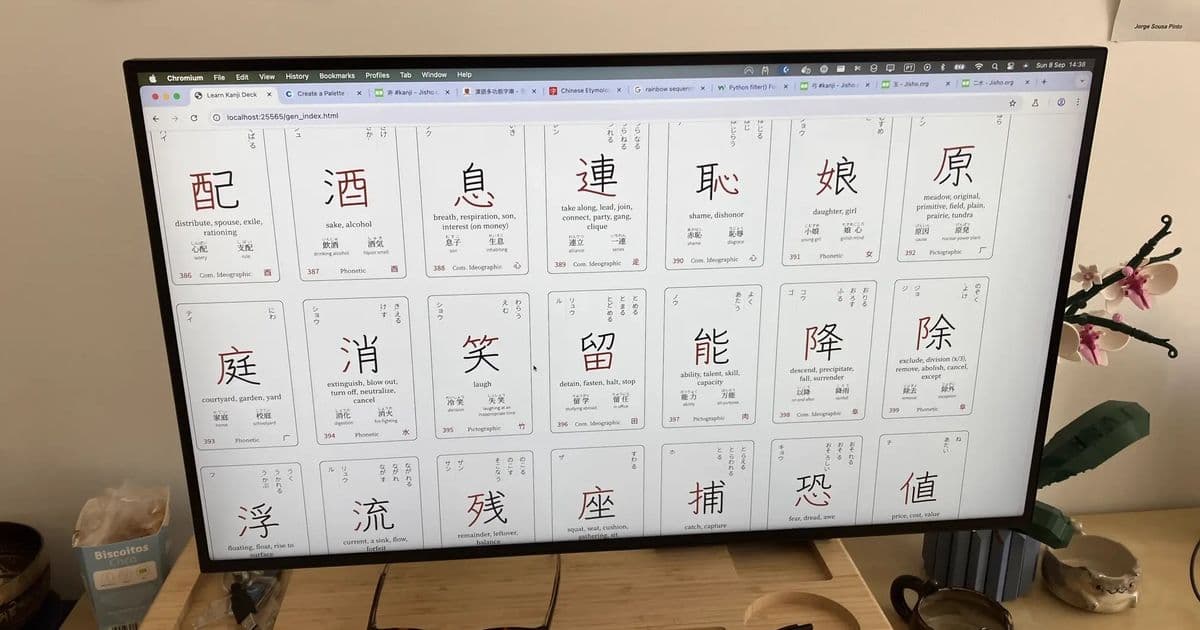
Determined to create something better, I spent two days programming my own Anki deck, compiling exactly the information I found valuable. The result was beautiful:
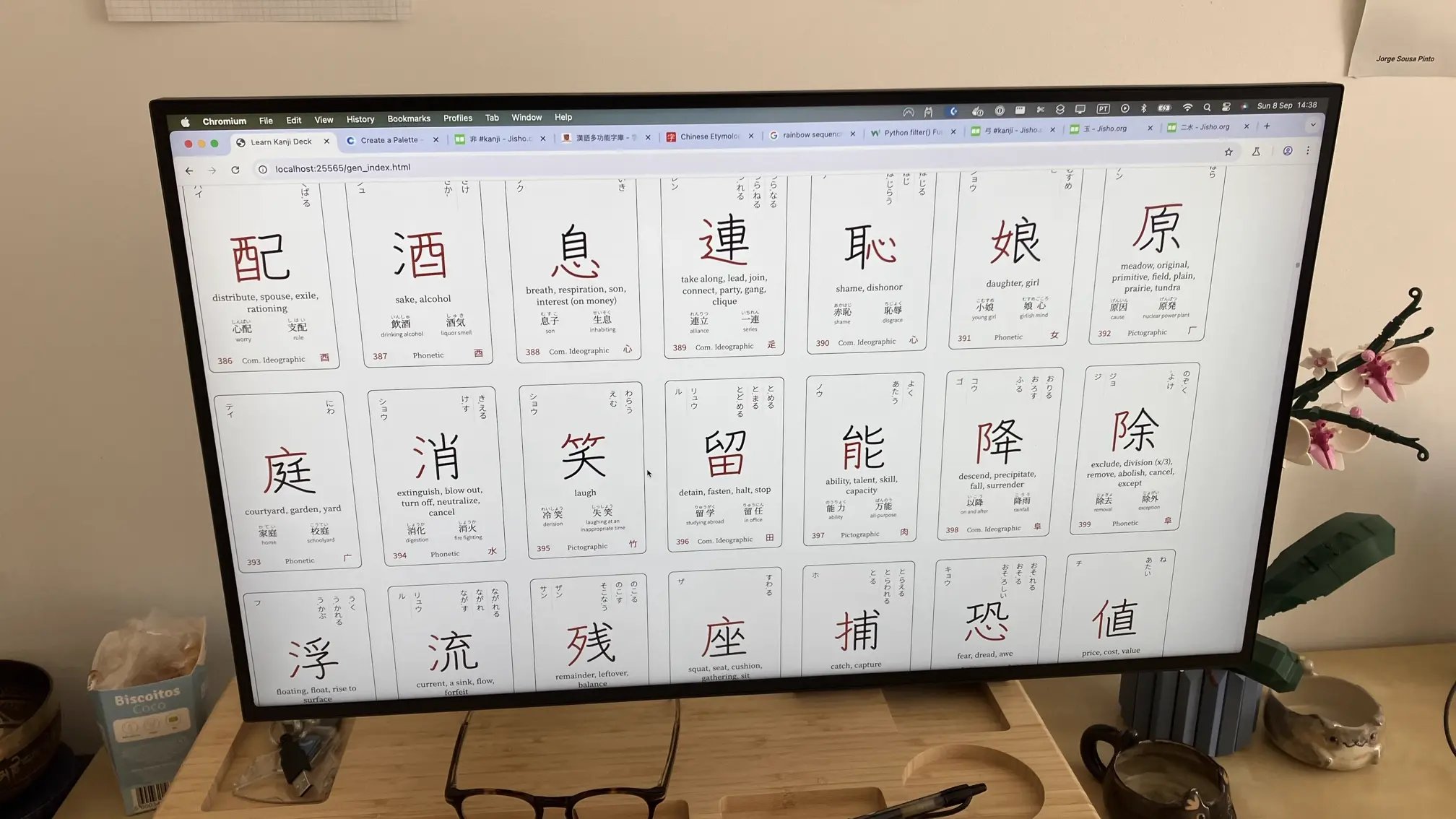
When the digital prototype looked so polished, I wondered: "What if I made this physical?"
Manufacturing Physical Cards (September 2024)
Initially, I assumed printing custom cards would require bulk orders and significant upfront investment. However, I discovered MakePlayingCards.com, a specialized printing service that could produce single copies and handle worldwide shipping and fulfillment.
I programmatically generated PDFs for each card using Playwright, then converted them to high-resolution PNGs with ImageMagick. The first test order of 60 cards cost about 15€ and arrived looking promising:
While waiting, I taught myself Blender to create product animations for marketing. Though I never achieved the professional quality I envisioned for the Kickstarter video, the 3D modeling skills proved invaluable for designing the deck boxes.
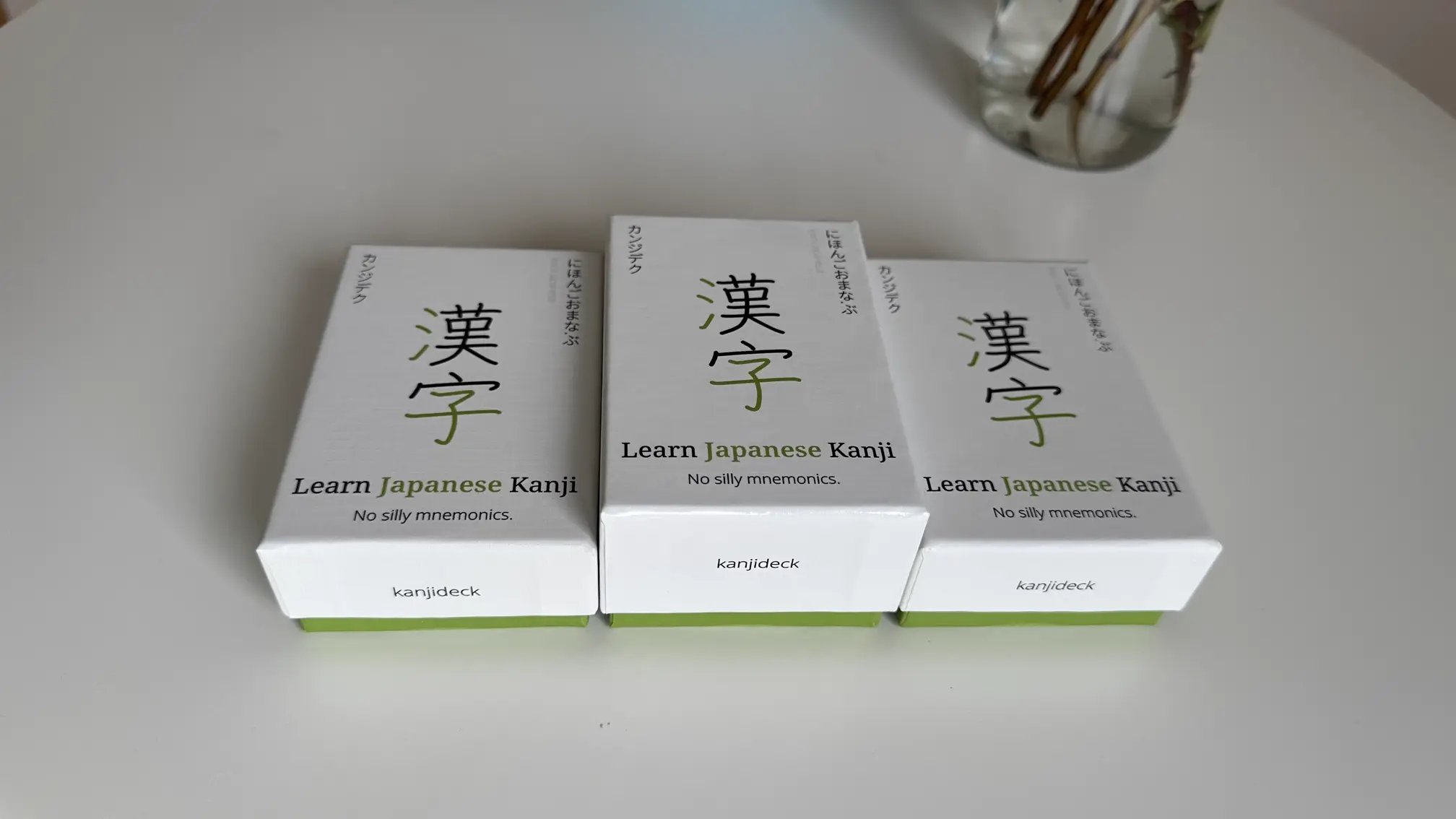
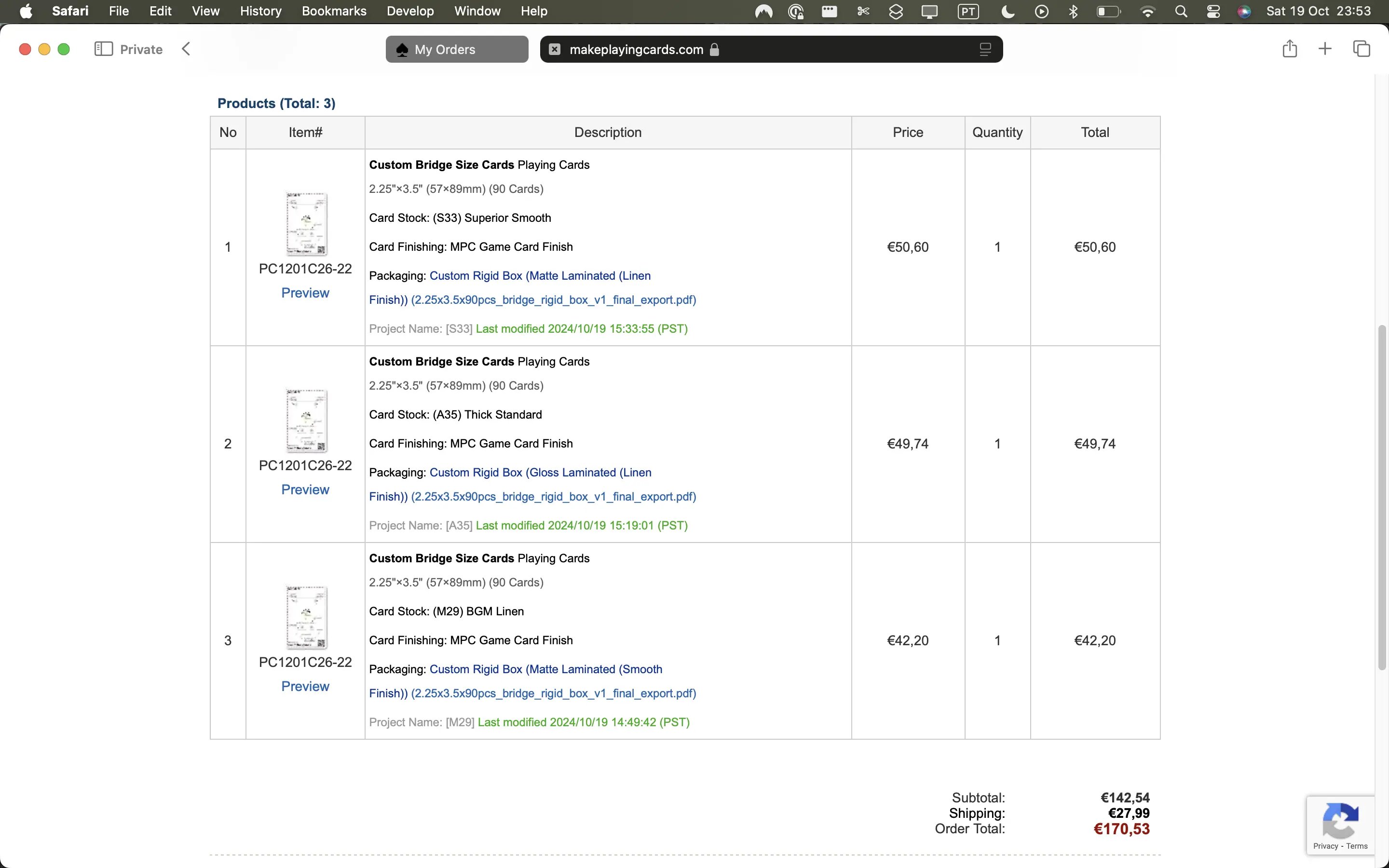
The second order included three copies of the same deck with different card and box materials. At nearly 50€ per deck without shipping, the costs were substantial but became reasonable at scale.
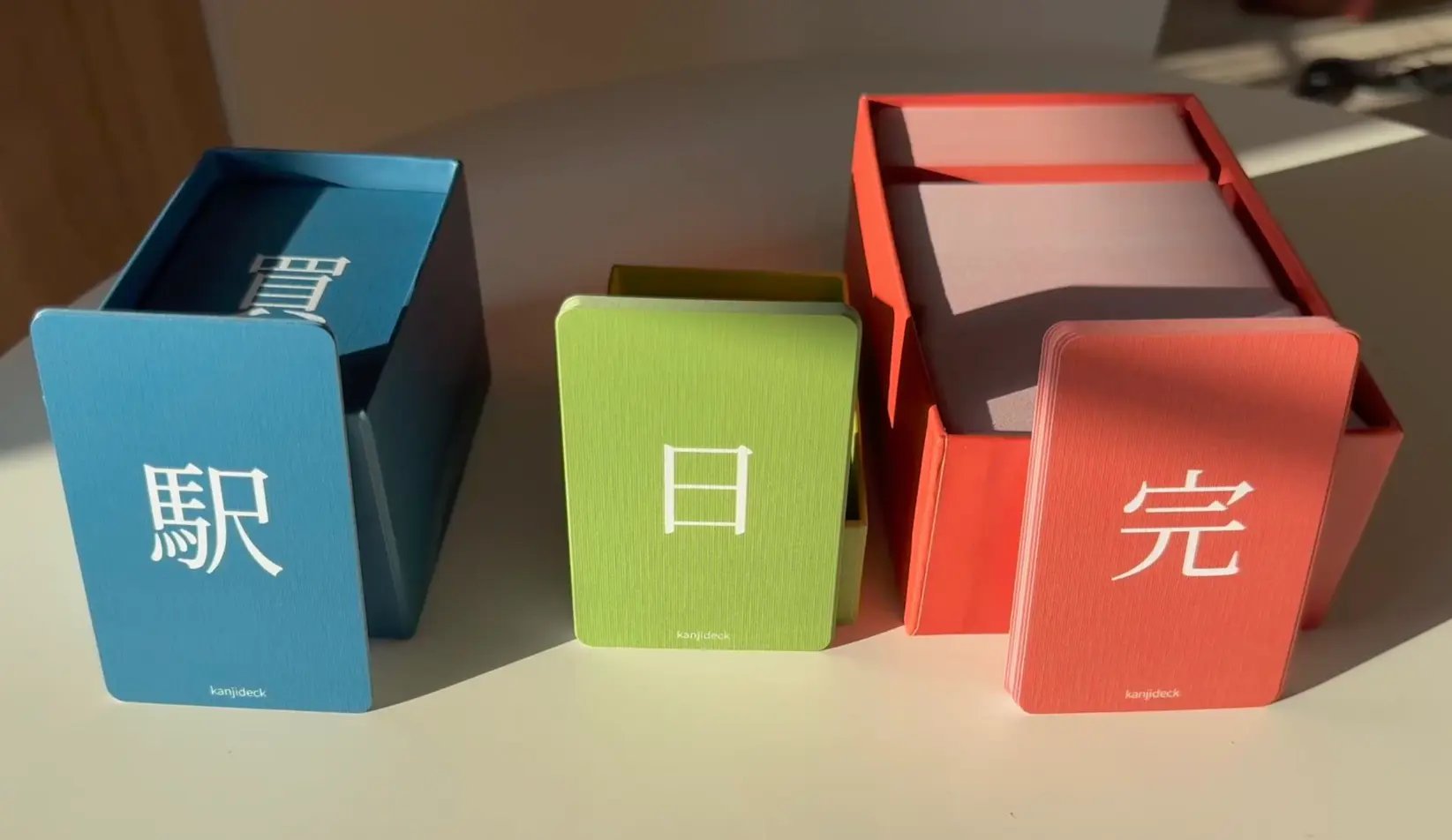
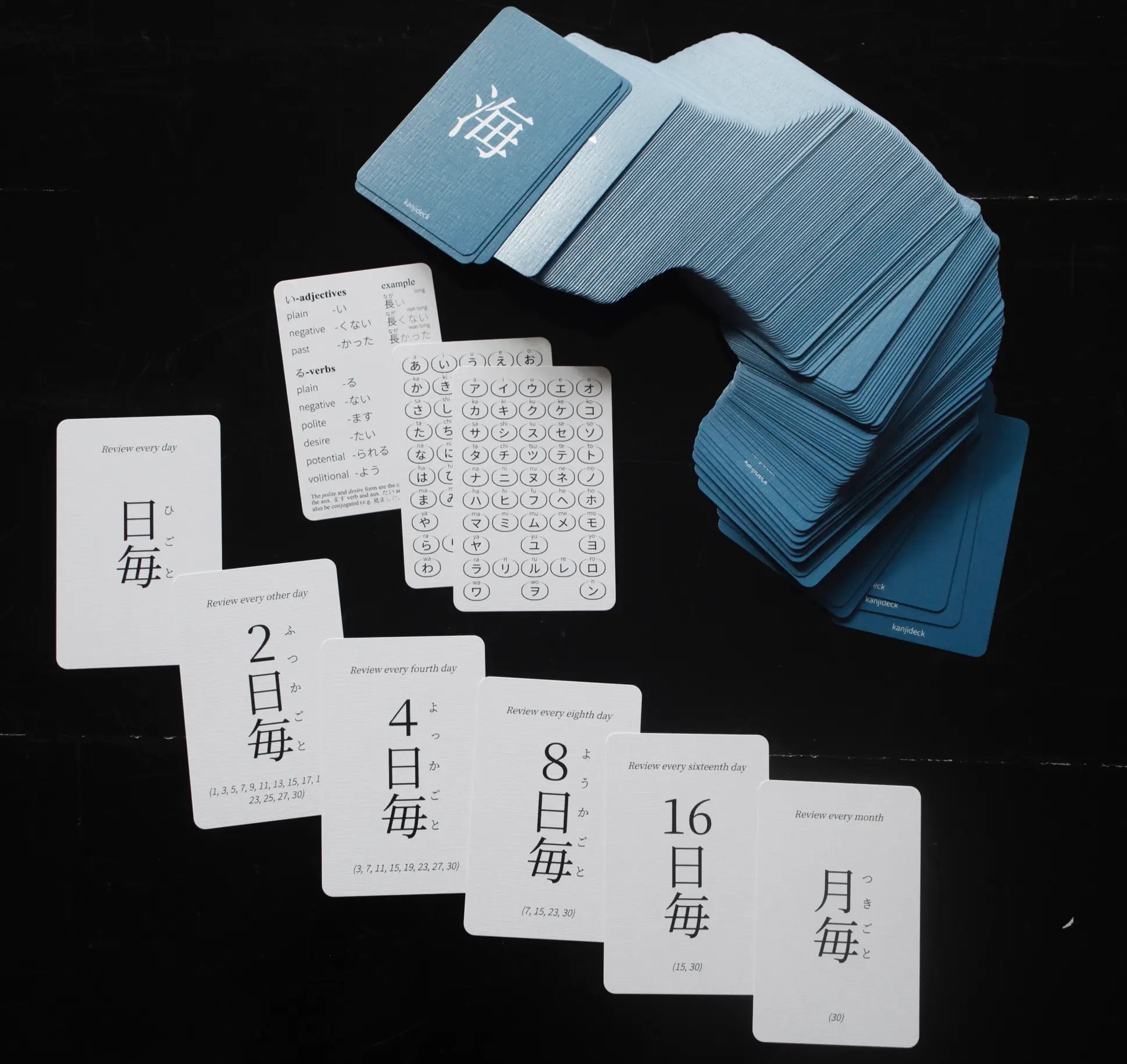
I iterated on the design several times, eventually pivoting from having three tiers where each contained all previous cards to having three separate decks corresponding to individual JLPT levels (N5, N4, and N3). The final products looked like this:
Starting a U.S. Company (October 2024)
I hit an unexpected roadblock: Kickstarter only allows campaigns from specific countries, and Portugal wasn't on the list. The platform suggested using Stripe Atlas to incorporate a U.S. company, which I did for $300.
Stripe Atlas handled everything, delivering legal documents within days. I also opened a Mercury bank account as recommended. The process was remarkably smooth, though I've since forgotten the exact details.
Accounting and Taxes
Running a company comes with responsibilities I couldn't delegate due to budget constraints. I had to handle bookkeeping and tax reporting myself.
Fortunately, years earlier I'd started using Plain Text Accounting (PTA) for personal finances with double-entry bookkeeping. I use hledger, a Haskell-based tool, though the principles apply across PTA tools. For those interested, I recommend Beancount's "The Double-Entry Counting Method."
Filing U.S. taxes as a foreign-owned LLC proved challenging. Unlike Portugal's government website with pre-filled forms and validation, U.S. tax reporting involves faxing forms to government numbers. It felt like playing "Keep Talking and Nobody Explodes" on nightmare difficulty with hidden bombs and instructions.
Pricing Strategy (November 2024)
Determining pricing was complex. I needed to price three products considering discounts and bundles, with manufacturing costs dependent on variable unit sales, across different regions with varying VAT and shipping costs.
My spreadsheet strategy involved one row per deck type, with separate rows for early bird discounts. I grouped regions by similar VAT rates and shipping costs, calculating revenue and costs per unit:
I set a baseline of 250 copies for JLPT-5, 250 for JLPT-4, and 100 for JLPT-3 decks. The Kickstarter goal was derived from these baseline sales, with a multiplier to model different sales scenarios.
Digital Infrastructure (December 2024)
I secured kanjideck.com and set up services on a Hetzner machine configured with NixOS. Self-hosted services included:
- Plausible for analytics
- Listmonk for mailing lists
- Grafana for monitoring
- fail2ban for security
- NixOS Mailserver for email
- A custom service called scrollsent to handle subscription requests
Self-hosting email proved more challenging than anticipated. Despite perfect scores on mail-tester.com, many emails went to spam. I encouraged subscribers to check their spam folders, which seemed to improve deliverability over time. However, when I eventually migrated to SendGrid due to deliverability issues, I realized that reputation matters far more than technical configuration.
Marketing and Ads (January 2025)
Marketing proved to be the most challenging aspect. I started an Instagram page and ran ads to build a mailing list for launch momentum. However, social media management wasn't for me. Creating regular content felt draining, and organic reach was minimal—posts rarely exceeded 10 likes without paid promotion.
Meta Ads were particularly frustrating. The platform was buggy and aggressively pushed AI features. Despite the terrible experience, Meta delivered the best results among alternatives. Google, TikTok, and Reddit ads were even less effective. A Reddit ad campaign blew through my $50 budget in an hour, spending $78 for 47 clicks and zero purchases.
This experience made me question my goals. I realized that regardless of the objective, this wasn't how I wanted to achieve it.
Burnout and Suspension (March 2025)
Marketing fatigue set in. Between struggling for momentum, creating media content, preparing the Kickstarter page, spending on ads, and the looming video production task, I lost interest and missed my launch deadline.
Trade instability from Trump tariffs, with my manufacturer in China, further diminished motivation. On April 9th, I announced the project's indefinite suspension on Instagram.
Reaching Out for Help (October 2025)
I eventually realized I couldn't and didn't need to do everything alone. My sister, an excellent artist, agreed to handle video production and social media management. This lifted a huge burden, allowing me to focus on aspects I enjoyed.
My partner began creating ad creatives that looked significantly better than mine, and my mom drafted launch emails. This support made launching possible.
Kickstarter Launch (January 2026)
The project launched on January 27th with a $55,000 goal. In the first hour, we raised about $1,500, reaching $5,000 by the end of day one. Days two and three brought $2,500 and $1,100 respectively.
As I write this, we've raised $8,808 from 136 backers, about 16% of the goal. A week later, we reached $15,000 (28%) from 254 backers.
Murphy's Law in Action
Several things went wrong near launch:
- Google had an email classification bug that sent most messages to spam
- Microsoft blocklisted my mail server's IP when sending to 1,400 subscribers, forcing a last-minute migration to SendGrid
- Kickstarter experienced an hour-long outage on launch day
These issues seemed unlucky, but perhaps I only noticed them because my product was on the line.
Conclusion
Despite the challenges, it was worth it. I'm still studying Japanese daily, having learned 1,130 Kanji over 434 consecutive days, with about a thousand more to go.
The journey from personal learning tool to Kickstarter project taught me invaluable lessons about product development, business operations, marketing, and the importance of asking for help. While the campaign's outcome remains uncertain, the experience itself has been transformative.
For those curious about the etymology-based approach to Kanji learning that inspired this project, I encourage reading the Kanjideck Guide. And for those interested in the technical aspects, I plan to open-source the digital version once I can clean up the code.
Sometimes the most rewarding projects are those that push us beyond our comfort zones and force us to learn entirely new skill sets. Kanjideck has certainly done that for me.
Comments
Please log in or register to join the discussion